AI Agents & AI Agent Software
Discover AI agent software designed to handle multi-step tasks, use tools and data, automate workflows, and assist with complex work with less manual effort.
AI Agents Products
Ready-to-use solutions designed to help with specific workflows and tasks.
What Is an AI Agent?
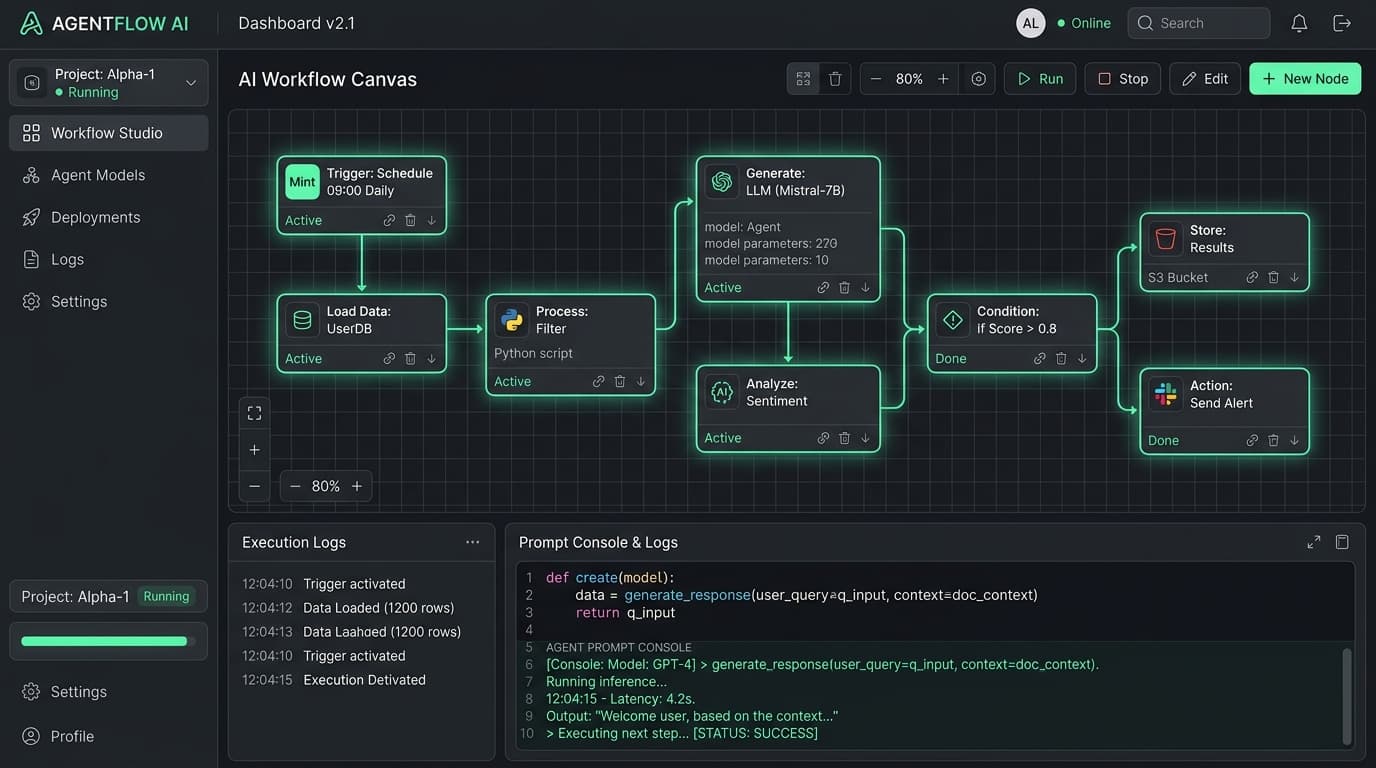
An AI agent is software designed to pursue a goal by interpreting instructions, deciding what steps to take, using available tools or data, and carrying out multiple actions to complete or assist with a task.
Depending on the system's design, an AI agent can receive a high-level goal, reason about the steps required to achieve it, and then interact with external environments. It may use APIs, files, applications, or web browsers to perform multiple actions. After taking an action, it can evaluate its progress or results, adjusting its approach to complete or assist with a workflow.
AI agent software represents a shift from software that simply generates text to software that can actively handle multi-step workflows with limited manual intervention.
AI Agents vs Chatbots
While both use artificial intelligence, their capabilities and system designs differ significantly.
Chatbots
A chatbot is primarily designed to interact through conversation and generate responses. You provide a prompt, and it provides text or information based on its training. It typically does not take actions outside of the chat window.
AI Agents
An AI agent can be designed to pursue a goal, make decisions about steps, use tools, take actions, and work through multi-step processes. It does not just generate an answer; it executes a workflow.
Note: Not every chatbot is completely isolated, and not every AI agent is fully autonomous. The distinction relies on whether the software is primarily conversational or primarily goal- and action-oriented.
AI Agents vs Traditional Automation
Traditional automation generally follows predefined, rigid rules and linear workflows. If "X" happens, the system always does "Y". It breaks if a step changes unexpectedly or if it encounters unstructured data.
AI agents can handle more flexible tasks by interpreting goals, deciding steps dynamically, using tools, and adapting their actions based on context, depending on their implementation. Instead of following a strict "if-then" rule, an agentic AI system can evaluate the current state and determine the best tool or action to reach the desired outcome.
How AI Agents Work
While implementations differ across various platforms, a multi-step AI agent generally operates using the following process:
- Goal or Instruction: The user provides an objective (e.g., "Research these 5 competitors and summarize their pricing").
- Context and Information: The agent accesses memory or provided files to understand the parameters.
- Planning and Reasoning: The AI decides the logical steps required to achieve the goal.
- Tool or System Use: The agent connects to allowed tools (web search, databases, APIs, or calculators).
- Actions: The agent performs the planned steps.
- Evaluation: The agent reviews the outcome of its actions to ensure it aligns with the goal.
- Completion or Human Handoff: The agent delivers the final result or requests human approval before proceeding.
What Can AI Agents Do?
AI agents can be deployed for a variety of complex operations. Common use cases for AI agent software include:
Research
Navigating the web to compile data, read multiple sources, and generate synthesized reports.
Data Processing
Extracting unstructured information from emails or documents and organizing it into databases.
Customer Support
Resolving complex tickets by accessing internal knowledge bases and executing refunds or updates via APIs.
Marketing Workflows
Executing multi-step campaigns, analyzing engagement metrics, and adapting content distribution.
Lead Qualification
Researching inbound leads, scoring them based on criteria, and updating CRM records.
Repetitive Task Automation
Handling any multi-step task execution that requires minor reasoning but occurs frequently.
AI Agents for Business Workflows
Business AI agents may assist with internal operations, research, customer support, lead handling, information processing, and data-driven workflows. By delegating repetitive administrative work to autonomous AI agents, human employees can focus on strategic decisions and relationship building.
For example, an AI agent designed for lead handling might receive an email from a prospect, use a tool to research the prospect's company, summarize the findings, and draft a personalized response for a sales representative to review.
Who Can Use AI Agents?
AI agent software is valuable across multiple roles and organization sizes:
- Businesses and Startups: To scale operations and automate complex processes without significantly expanding headcount.
- Agencies and Freelancers: To automate research, client reporting, and internal operations.
- Marketers and Researchers: To aggregate large volumes of data and execute multi-step analysis.
- Customer Support Teams: To handle triage, answer complex inquiries, and take action in billing systems.
- Developers and Professionals: To automate testing, code review, and repetitive technical workflows.
What Are the Limitations of AI Agents?
While AI workflow automation is powerful, these systems are not flawless. AI agents can make incorrect decisions, misunderstand ambiguous instructions, or use incorrect information if their data sources are flawed.
They can also fail if the tools, APIs, or data they rely on become unavailable. Because of these limitations, AI agents typically require human review for important actions. For critical business processes, they require monitoring, appropriate permissions, and strict security controls to ensure they do not take unintended actions.
How to Choose AI Agent Software
When evaluating AI automation tools, choose an AI agent based on the workflow it needs to perform, not simply the fact that it uses AI.
- Workflow Capabilities: Does it actually solve your specific task complexity?
- Supported Tools and Integrations: Can it connect securely to your existing software stack?
- Human Approval Controls: Does it allow a human to review actions before execution?
- Reliability and Observability: Can you see exactly what steps the agent took to reach its conclusion?
- Data and Privacy Requirements: Does the software meet your security and compliance standards?
- Ease of Configuration: Is it simple enough for your team to manage and scale?
- Pricing and Value: Does the cost align with the actual manual effort saved?
Frequently Asked Questions About AI Agents
Learn more about autonomous AI agents, workflow automation, and intelligent software.
Explore More Software
Discover other categories of software on MintSaaS.