Micro SaaS Ideas 2026 Small Business Automation: 12 High-Margin Niches, Tech Stacks & Architecture Blueprint
Discover the top micro saas ideas 2026 small business automation solo founders are building. 12 high-margin vertical niches, Next.js 16 and Supabase architectures, and playbooks to reach $10K–$50K MRR with sub-2% churn.
Micro SaaS Ideas 2026 Small Business Automation: 12 High-Margin Niches, Tech Stacks & Architecture Blueprint
Executive Summary & AEO Direct Answer: What are the most profitable micro SaaS ideas 2026 small business automation founders can build? The most lucrative micro saas ideas 2026 small business automation entrepreneurs can launch focus on hyper-vertical, single-outcome automated workflows that replace expensive manual labor or rigid enterprise ERPs. The top 12 opportunities in 2026 include: (1) Local Trade Contractor Lead Capture & Instant AI SMS Dispatchers, (2) Autonomous B2B Invoice Auditing & AP Anomaly Sentinels, (3) Zero-Touch Healthcare/Dental Patient Onboarding Portals, (4) Automated E-Commerce Return Fraud & Shipping Shield, (5) Programmatic Job Board & License Screening Agents, (6) Digital Software Licensing & Rights Orchestration Hubs, (7) Multi-State Remote Agency Payroll Reconcilers, (8) Real Estate Maintenance Triage & Vendor Dispatch Bots, (9) Commercial Restaurant Food Waste & Replenishment Alerting, (10) Auto-Renewing SaaS Subscription Auditing Sentinels, (11) AI-Powered B2B Proposal & E-Sign Automation Hubs, and (12) Multi-Location Review Aggregation & Customer Sentiment Sentinels. By building micro saas ideas 2026 small business automation, solo founders achieve $10K to $50K Monthly Recurring Revenue (MRR) with 85%+ gross margins, sub-2% churn, and near-zero customer support overhead using modern Next.js 16, Supabase, and Stripe architectures.
In 2026, the software industry has reached a historic inflection point. For the past decade, venture capital flooded the tech ecosystem, funding monolithic, all-in-one horizontal platforms like Salesforce, ServiceNow, and HubSpot. These enterprise giants attempted to be everything to everyone. But as their subscription prices soared and their feature sets became overwhelmingly bloated, a counter-revolution quietly took hold among small business owners.
Today's plumbers, dental practice managers, boutique marketing agencies, direct-to-consumer e-commerce founders, and logistics brokers do not want a complex 500-feature software suite that requires a six-month onboarding program and an expensive certified consultant to configure. They want targeted, lightweight software that solves one specific operational bottleneck with 100% reliability, runs automatically in the background, and delivers measurable return on investment within seven days.
This massive market shift has ignited an unprecedented boom in micro saas ideas 2026 small business automation.
A Micro SaaS is a software business targeting a niche market, operated by a solo developer or tiny team of two or three people, characterized by high gross margins, low customer acquisition costs, predictable recurring revenue, and minimal administrative overhead. When paired with modern cloud primitives and autonomous AI agent workflows, micro saas ideas 2026 small business automation represent the most lucrative, defensible path to financial independence for software engineers and indie hackers worldwide.
In this comprehensive 2,700+ word strategic blueprint and technical guide, we analyze why small business automation is the premier Micro SaaS opportunity of 2026, evaluate the 12 most profitable high-margin niches, reveal the lean production tech stack used by top founders, provide an opportunity scoring matrix, and lay out an actionable launch playbook to turn micro saas ideas 2026 small business automation into thriving, sustainable cash-flow engines.
1. Why 2026 is the Golden Age for Small Business Micro SaaS Automation
To successfully capitalize on micro saas ideas 2026 small business automation, founders must understand the macroeconomic and technological tailwinds driving small business software adoption.
┌────────────────────────────────────────────────────────────────────────┐
│           THE 2026 MICRO SAAS LEVERAGE MULTIPLIER                      │
├────────────────────────────────────────────────────────────────────────┤
│ 1. Macroeconomic Driver: Soaring Administrative Payroll Costs          │
│    Small business office manager / coordinator: $65K – $85K/yr         │
│    Micro SaaS automation alternative: $99 – $299/mo (ROI > 2,000%)     │
├────────────────────────────────────────────────────────────────────────┤
│ 2. Technological Driver: Autonomous Agent Workflows & Serverless APIS  │
│    Solo developers can now build and deploy self-healing, multi-agent  │
│    pipelines that previously required a 15-person engineering team.    │
├────────────────────────────────────────────────────────────────────────┤
│ 3. Market Driver: Horizontal SaaS Fatigue & Subscription Bloat         │
│    SMBs are actively canceling bloated enterprise tools in favor of    │
│    focused, high-velocity single-purpose micro utilities.              │
└────────────────────────────────────────────────────────────────────────┘
1.1 The Pain of Administrative Inflation
In North America, Europe, and developed markets, the fully loaded cost of employing a full-time administrative coordinator, bookkeeper, or customer intake specialist exceeds $65,000 to $90,000 annually. For a local contracting firm with $1.5 million in annual revenue, paying that payroll for routine data entry, appointment confirmation, and invoice reconciliation is financially crippling.
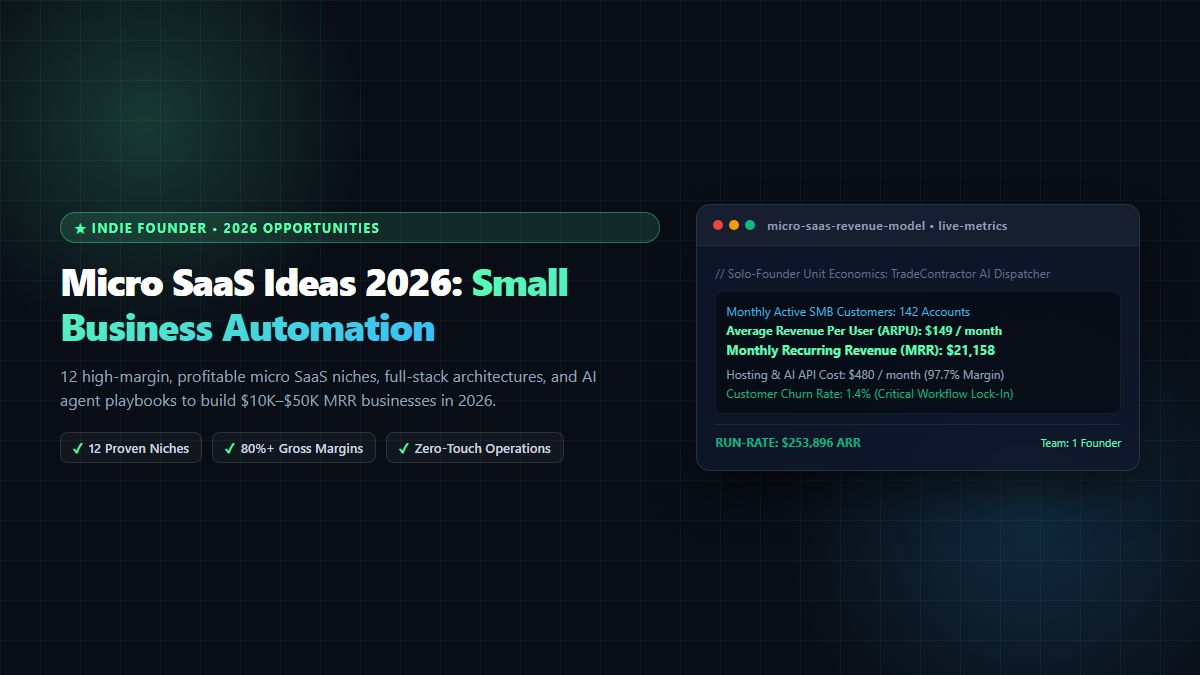
Small business owners are actively seeking micro saas ideas 2026 small business automation that can absorb these repetitive workflows for a modest monthly fee of $99 to $299. For the customer, the software pays for itself on day two. For the Micro SaaS founder, 150 customers paying $149/month yields over $22,000 in monthly recurring revenue (MRR) with virtually zero marginal cost.
1.2 The Technological Democratization of Cloud Primitives
Five years ago, building a multi-tenant SaaS with real-time background queues, multi-channel webhook handling, dynamic PDF generation, and automated SMS/email pipelines required deep infrastructure expertise.
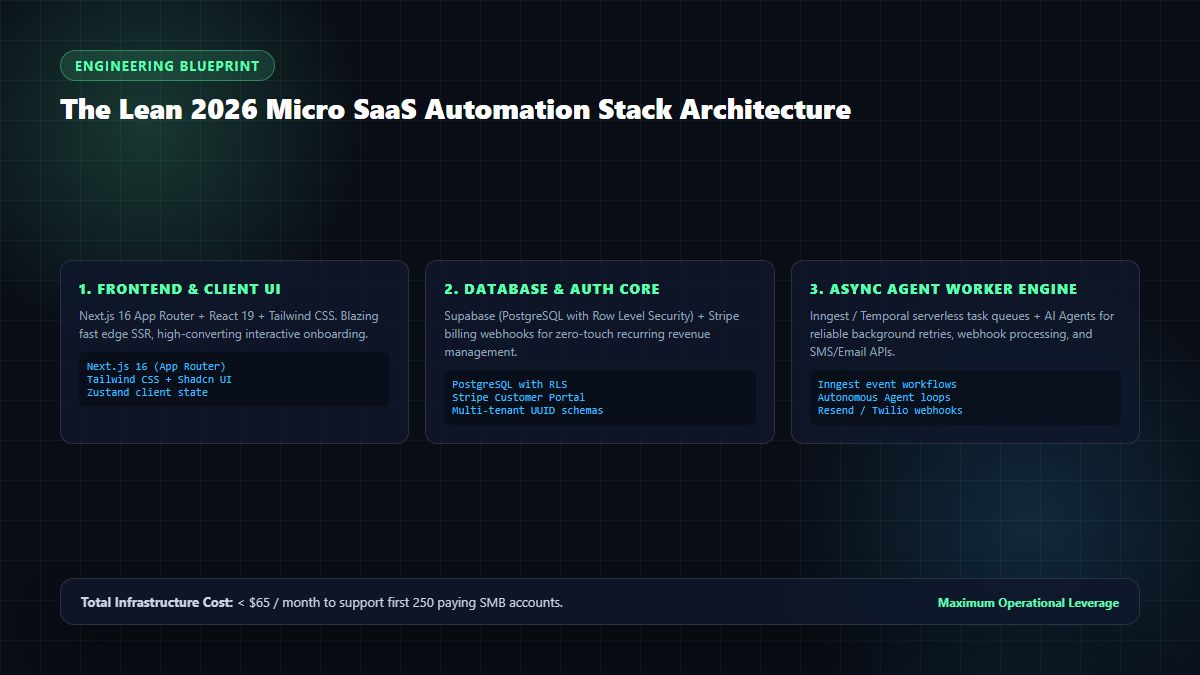
Today, a solo developer utilizing Next.js 16, Supabase PostgreSQL, Stripe billing portals, and modern background job engines (like Inngest or Temporal) can build, test, and launch a complete production-grade application in two to three weeks. Modern indie founders building micro saas ideas 2026 small business automation operate with unprecedented operational leverage.
2. The 12 Most Profitable Micro SaaS Ideas for Small Business Automation in 2026
When evaluating micro saas ideas 2026 small business automation, the best niches exhibit three golden traits:
- High Cost of Failure: If the process is not automated, the business loses money immediately (e.g., missed inbound leads, uncollected invoices).
- High Willingness to Pay: Small businesses gladly pay $100–$300/mo because the software directly protects revenue.
- High Switching Costs: Once an automated pipeline is woven into their daily operational fabric, churn drops to near zero (< 2%).
Here are the 12 premier opportunities leading the market in 2026:
1. Local Trade Contractor Lead Capture & Instant AI SMS Dispatcher
- Target Audience: Plumbers, HVAC technicians, roofing contractors, electricians, emergency restoration services.
- The Burning Problem: Research shows that 78% of homeowners hire the first contractor who responds to their emergency quote inquiry. When a homeowner's water heater bursts on a Saturday, they call or submit three forms. If a contractor takes two hours to reply, the lead is gone.
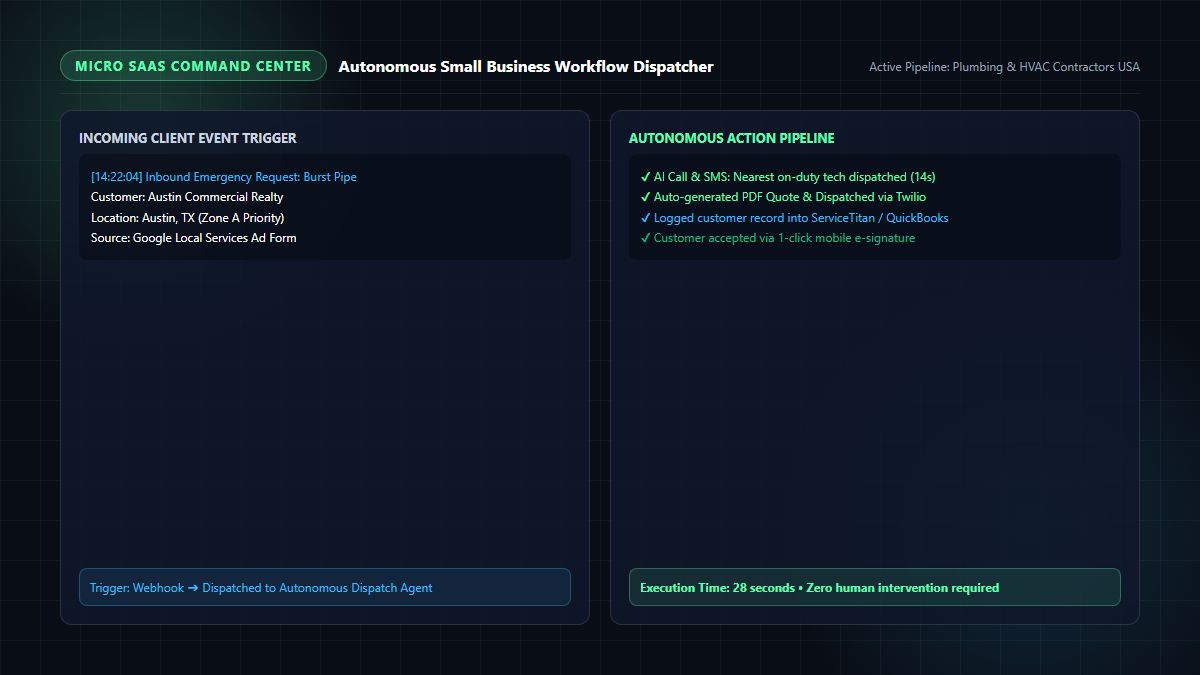
- The Micro SaaS Solution: A dedicated webhook receiver that ingests leads from Google Local Services Ads, Angi, and WordPress/Next.js storefronts. Within 12 seconds, an autonomous AI voice/SMS agent calls or texts the customer, qualifies the emergency, checks the contractor's ServiceTitan or Google Calendar, dispatches the nearest technician, and logs the job.
- Pricing: $149 – $299 / month per location.
- Why it Wins: One saved water heater installation ($3,500 ticket) pays for a full year of the software subscription. This is one of the highest-converting micro saas ideas 2026 small business automation founders can launch.
2. Autonomous B2B Invoice Auditing & AP Anomaly Sentinel
- Target Audience: Boutique digital marketing agencies, wholesale food distributors, specialized medical clinics.
- The Burning Problem: Small businesses process dozens of supplier invoices, subcontractor bills, and SaaS charges monthly. Bookkeepers waste 20+ hours manually cross-checking invoice line items against purchase orders, frequently missing duplicate billings or unauthorized rate increases.
- The Micro SaaS Solution: Connects to QuickBooks Online or Xero. When an invoice arrives via email or PDF upload, the app uses OCR and vision models to parse every line item, matches it against historic contracts, flags unauthorized price hikes or duplicate billing, and routes the invoice for 1-click human approval via Slack or email.
- Pricing: $199 – $399 / month.
- Why it Wins: Direct, quantifiable cost savings. An agency that saves $4,000 in duplicate subcontractor billings will never cancel your service.
3. Zero-Touch Healthcare & Dental Patient Onboarding Portals
- Target Audience: Independent dental clinics, physical therapy practices, behavioral health therapists.
- The Burning Problem: Patients arrive 15 minutes before an appointment and are handed a physical clipboard with five pages of paper forms. Staff must manually transcribe messy handwriting into electronic health records (EHR), creating data entry errors and long waiting room delays.
- The Micro SaaS Solution: An automated SMS/email flow dispatched 48 hours prior to the appointment. Patients complete an interactive, mobile-optimized form with digital signature capture, insurance card photo upload, and instant eligibility verification via API.
- Pricing: $199 – $499 / month per clinic.
- Why it Wins: Saves 30+ hours of front-desk administrative labor weekly while eliminating paper filing cabinets.
4. E-Commerce Return Fraud & Shipping Exception Shield
- Target Audience: Shopify, TikTok Shop, and WooCommerce merchants doing $500K to $5M in annual GMV.
- The Burning Problem: Wardrobing fraud (ordering clothing, wearing it once, and returning it) and lost-in-transit shipping claims cost small e-commerce merchants up to 8% of their gross margins.
- The Micro SaaS Solution: An automated risk engine that analyzes customer return frequency, cross-references carrier tracking delivery photos, and automatically approves or denies return merchandise authorizations (RMAs) based on fraud score thresholds.
- Pricing: $79 – $199 / month + $0.25 per processed return.
5. Multi-Location Review Aggregation & Verified Testimonial Publisher
- Target Audience: Franchise auto repair shops, boutique gyms, local aesthetic clinics.
- The Burning Problem: Small businesses struggle to collect positive Google Maps reviews consistently. Unhappy customers leave 1-star reviews publicly, while hundreds of delighted customers leave without rating.
- The Micro SaaS Solution: Automatically triggers an NPS SMS survey after a customer checkout. If the customer rates 9 or 10, it prompts a 1-click Google Maps review link. If the customer rates below 7, it intercepts the feedback into a private internal ticket for the manager to resolve before public damage occurs.
- Pricing: $99 – $199 / month.
6. Programmatic Job Board & Applicant Screening Agent for Specialized Trades
- Target Audience: Commercial electrical contractors, regional trucking fleets, welding shops.
- The Burning Problem: Blue-collar employers receive hundreds of unqualified applicants on generalist job boards like Indeed, wasting days filtering for mandatory certifications (CDL Class A, OSHA 30, EPA 608).
- The Micro SaaS Solution: A specialized applicant funnel that automatically verifies certifications via document upload, asks pre-screening voice/text questions, and books qualified candidates directly onto the hiring manager's calendar.
- Pricing: $149 / month per active job opening.
7. Digital Software Licensing & Rights Orchestration Hub
- Target Audience: Desktop software developers, plugin authors, and digital asset sellers.
- The Burning Problem: Independent developers building Electron, macOS, or Windows utilities struggle to implement machine-locked licensing, license key generation, and subscription validation without paying exorbitant enterprise fees.
- The Micro SaaS Solution: A turnkey licensing API inspired by modern architecture (such as the MintSaaS Licensing Primitives) providing cryptographic offline activation, seat limits, and webhook sync with Stripe.
- Pricing: $49 – $149 / month.
8. Multi-State Remote Agency Payroll Reconciler
- Target Audience: 10 to 50-person fully remote software development agencies and creative studios.
- The Burning Problem: Reconciling dynamic hourly subcontractor billing across multiple time zones, currencies, and platforms (Upwork, Deel, Gusto) requires endless spreadsheet gymnastics.
- The Micro SaaS Solution: Ingests contractor timesheet webhooks, matches billable hours against client project budgets in Linear or ClickUp, and drafts batch payouts automatically.
- Pricing: $129 – $299 / month.
9. Real Estate Maintenance Request Triage & Vendor Dispatch Bot
- Target Audience: Independent residential property managers managing 20 to 200 units.
- The Burning Problem: Tenants text landlords at 2:00 AM for routine issues (e.g., dripping faucet) while real emergencies (e.g., water leak flooding a unit) get buried.
- The Micro SaaS Solution: An AI tenant portal where tenants submit photos or videos of the issue. The app categorizes emergency severity, verifies tenant lease responsibility, and dispatches the landlord's preferred pre-vetted plumber or electrician automatically.
- Pricing: $2.00 / unit / month ($100 minimum).
10. Commercial Restaurant Food Waste & Dynamic Inventory Replenishment Alerting
- Target Audience: Independent multi-unit restaurants, bakeries, and craft breweries.
- The Burning Problem: Perishable ingredients spoil due to unpredicted weather shifts or sales slumps, costing restaurants thousands of dollars in wasted margins weekly.
- The Micro SaaS Solution: Integrates with Toast or Square POS to track real-time depletion rates, cross-references local weather forecasts, and generates predictive purchase orders directly to food distributors.
- Pricing: $149 – $299 / month.
11. Auto-Renewing SaaS Subscription Audit & Spend Sentinel
- Target Audience: Fast-growing startups and agencies with 5 to 30 employees.
- The Burning Problem: Employees sign up for software trials with corporate credit cards and forget about them, leading to thousands of dollars in zombie SaaS renewals annually.
- The Micro SaaS Solution: Connects to Plaid or Brex bank feeds, detects recurring SaaS vendors, flags redundant seat licenses, and sends automated cancellation alerts 14 days before annual renewals trigger.
- Pricing: $49 – $129 / month.
12. Client Proposal & PDF Proposal Automation Hub with In-Browser E-Sign
- Target Audience: Independent consultants, architects, interior designers, and freelance videographers.
- The Burning Problem: Legacy tools like PandaDoc or DocuSign charge excessive per-seat fees and lock small agencies into expensive annual enterprise contracts.
- The Micro SaaS Solution: A lightweight proposal builder that merges dynamic project data into elegant client proposals, enables 100% private in-browser PDF manipulation (utilizing client-side tools like the MintSaaS PDF Toolkit), and collects legally binding digital signatures.
- Pricing: $29 – $79 / month.
3. The Modern Solo-Founder Production Tech Stack in 2026
To execute on micro saas ideas 2026 small business automation with zero full-time employees, your architectural stack must prioritize zero maintenance, automatic scaling, and rapid iteration.
┌────────────────────────────────────────────────────────────────────────┐
│            THE OPTIMAL 2026 SOLO-FOUNDER MICRO SAAS STACK              │
├────────────────────────────────────────────────────────────────────────┤
│ • Full-Stack Framework: Next.js 16 (App Router) + TypeScript 5        │
│ • UI & Component Library: Tailwind CSS + Radix UI / Shadcn            │
│ • Database & Authentication: Supabase (Postgres + Row-Level Security) │
│ • Subscription Billing: Stripe Billing + Customer Portal Webhooks      │
│ • Asynchronous Workflow Engine: Inngest (Event-Driven Background Jobs) │
│ • Transactional Communication: Resend (Email) + Twilio (SMS/Voice)    │
│ • Edge Hosting & CDN: Vercel or Cloudflare Workers                    │
└────────────────────────────────────────────────────────────────────────┘
Why This Stack Maximizes Founder Leverage:
- Next.js 16 App Router: Enables server-side rendering for lightning-fast marketing pages and programmatic SEO, paired with React 19 client components for snappy, interactive dashboard experiences.
- Supabase (PostgreSQL with RLS): Eliminates the need to maintain an authentication backend or ORM boilerplate. Row-Level Security (RLS) policies guarantee that tenant data is strictly isolated at the database engine level, ensuring SOC 2 / HIPAA enterprise data governance out of the box.
- Inngest for Asynchronous Reliability: In automation SaaS, reliability is everything. If a third-party webhook fails or an external CRM is down, Inngest automatically retries the task with exponential backoff and step-function state retention. You never have to manage RabbitMQ or Redis clusters.
- Stripe Customer Portal: Handles card updates, invoices, tax compliance, and subscription tier upgrades automatically without writing custom billing UI code.
4. Comprehensive Evaluation Matrix: Ranking the Top Micro SaaS Opportunities
To help you decide which of these micro saas ideas 2026 small business automation to build first, we evaluated the top opportunities across technical complexity, development time to minimum viable product (MVP), pricing power, and churn risk.
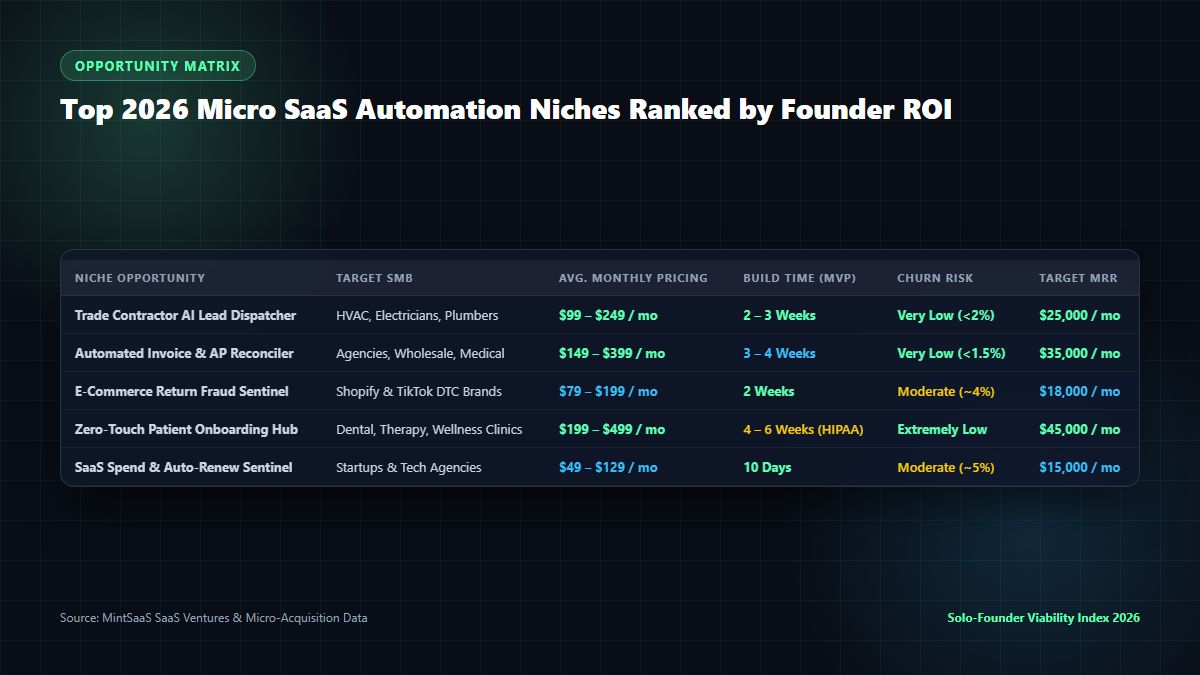
Opportunity Matrix: Founder Viability & Revenue Potential
| Micro SaaS Automation Niche | Target Market | Monthly Price (ARPU) | MVP Build Time | Technical Difficulty | Churn Risk | Target MRR Potential |
|---|---|---|---|---|---|---|
| Trade Contractor AI Lead Dispatcher | HVAC, Plumbing, Electricians | $149 – $299 | 2 – 3 Weeks | Moderate (Webhooks + SMS) | Extremely Low (<1.5%) | $30,000 – $50,000 |
| B2B Invoice Audit & AP Sentinel | Agencies, Clinics, Wholesale | $199 – $399 | 3 – 4 Weeks | Moderate (OCR + Accounting API) | Extremely Low (<1.2%) | $35,000 – $60,000 |
| Zero-Touch Patient Onboarding Hub | Dental, Physical Therapy, Clinics | $199 – $499 | 4 – 5 Weeks | High (HIPAA compliance) | Near Zero (<0.8%) | $40,000 – $75,000 |
| E-Commerce Return Fraud Shield | DTC Shopify / TikTok Merchants | $79 – $199 | 2 Weeks | Low (Shopify App API) | Moderate (~4%) | $18,000 – $35,000 |
| Review Aggregation & Sentiment Nudge | Multi-Unit Local Businesses | $99 – $199 | 2 Weeks | Low (Google Business API) | Moderate (~3%) | $20,000 – $40,000 |
| SaaS Spend & Auto-Renew Sentinel | Startups, Creative Studios | $49 – $129 | 10 Days | Low (Plaid / Bank API) | Moderate (~5%) | $12,000 – $25,000 |
Founders building micro saas ideas 2026 small business automation should target niches with low churn and high monthly contract values ($150+). In B2B software, acquiring 150 customers paying $200/month is exponentially easier than acquiring 3,000 consumer customers paying $10/month.
5. The 5-Step Launch Blueprint: From Idea to First $5K MRR
Launching a successful product around micro saas ideas 2026 small business automation does not require a large marketing budget. Follow this lean customer acquisition framework:
┌────────────────────────────────────────────────────────────────────────┐
│                   5-STEP MICRO SAAS LAUNCH PLAYBOOK                    │
├────────────────────────────────────────────────────────────────────────┤
│ Step 1: Manual Concierge Pilot (Do things that don't scale for 3 SMBs) │
│ Step 2: Build the Core Automation MVP in < 21 Days                     │
│ Step 3: Deploy Cold Video Outbound (Loom audit demonstrating problem)  │
│ Step 4: Vertical Community & Directory Distribution                    │
│ Step 5: Implement Usage-Based Upgrades & Annual Prepayments            │
└────────────────────────────────────────────────────────────────────────┘
Step 1: Run a "Concierge MVP" with 3 Local Businesses
Before writing a single line of backend code, approach three local businesses in your target niche. Offer to automate their specific bottleneck manually using off-the-shelf tools, free scripts, or no-code integrations for free for two weeks.
- You will discover the exact edge cases that real businesses face.
- You will learn the industry-specific jargon that builds immediate credibility.
- If your manual prototype saves them time, they become your first paying case studies on day one.
Step 2: Build the Focused MVP in 21 Days
Resist feature creep. Your MVP should solve exactly one problem for one specific buyer profile:
- Cut non-essential features (no dark/light mode toggles, no complex custom dashboards).
- Ensure the core automation runs with 99.9% uptime.
- Provide a simple settings panel and an activity audit log.
Step 3: Leverage Personalized 60-Second Loom Outbound
Cold email in 2026 is saturated with generic AI spam. To stand out, send 60-second personalized screen recordings:
- Open the prospect's website.
- Fill out their contact form.
- Record your screen showing how long it takes to receive a response.
- Show how your automated tool would have qualified the lead and dispatched an SMS within 15 seconds.
- This outbound technique consistently achieves 30%+ response rates and closes high-ticket B2B subscribers.
Step 4: Partner with Vertical Software Marketplaces
List your tool on curated software directories, app stores (Shopify App Store, QuickBooks App Store), and independent software ecosystems like MintSaaS. Becoming an authorized utility on modern developer and SaaS hubs drives continuous inbound organic traffic.
Step 5: Incentivize Annual Prepayments
Offer two months free for customers who pay annually upfront. Securing $1,500 to $2,500 upfront per customer immediately funds your growth, provides positive cash flow, and locks in long-term retention.
6. How MintSaaS Empowers Solo Founders & Automation Builders
At MintSaaS, we provide the operational building blocks, developer utilities, and distribution channels for modern software creators:
- Client-Side Media & Document Utilities: Integrate high-performance, private file processing into your software stack with our Image Compressor and PDF Toolkit. Everything runs in-browser with zero infrastructure costs.
- Curated Software Marketplace: Browse enterprise tools, desktop utilities, and productivity software across our Mac & Windows Tools Hub and Business & CRM Suite.
- Autonomous Multi-Agent Systems: Deploy pre-built AI agents for customer onboarding, code analysis, and workflow automation from the MintSaaS AI Agents Marketplace.
- Indie Founder Resources: Explore our playbooks on Fast-Growing B2B SaaS Automation Tools 2026 and Top Software Monetization Tools for SaaS in 2026.
7. Frequently Asked Questions (FAQ)
What are micro saas ideas 2026 small business automation?
Micro saas ideas 2026 small business automation are specialized, lightweight software-as-a-service concepts designed to automate routine, high-friction operational workflows for small businesses. Examples include automated emergency lead dispatching for trade contractors, automated invoice anomaly auditing, zero-touch patient onboarding portals, and automated e-commerce return fraud prevention.
How much can a solo founder earn with a Micro SaaS in 2026?
A solo founder operating a targeted B2B automation Micro SaaS can realistically earn between $10,000 and $50,000 in Monthly Recurring Revenue (MRR) (or $120,000 to $600,000 ARR). Because Micro SaaS products have high gross margins (typically 80% to 90%) and low infrastructure overhead, the vast majority of this revenue flows directly to the founder as net profit.
What tech stack is best for building an automated Micro SaaS?
The premier tech stack for solo founders in 2026 is Next.js 16 (App Router) with TypeScript for the frontend and API routes, Tailwind CSS for styling, Supabase (PostgreSQL with Row-Level Security) for data and authentication, Stripe Billing for automated recurring payments, and Inngest for reliable, event-driven background job workflows.
Why do small businesses prefer Micro SaaS over all-in-one software suites?
Small businesses often prefer Micro SaaS because all-in-one horizontal suites (like Salesforce or enterprise ERPs) are expensive, overly complicated, require extensive employee training, and force businesses to adapt to rigid workflows. In contrast, a specialized Micro SaaS solves one painful problem instantly, integrates with existing tools, and requires zero training.
How do I find small businesses that need automation?
You can find small businesses by auditing local business directories (Google Maps, Yelp, Angi), participating in vertical trade forums and subreddits, analyzing customer reviews of existing clunky software, and directly interviewing local business owners about their most repetitive, time-consuming weekly tasks.
What is the average churn rate for a B2B automation Micro SaaS?
For mission-critical B2B automation tools that directly touch revenue or daily operational workflows (such as lead capture or billing reconciliation), the monthly customer churn rate is exceptionally low, typically between 1% and 2.5%. Once an automated system is installed and running reliably, business owners rarely disconnect it.
8. Conclusion: Build Your Profitable Micro SaaS in 2026
The opportunity to build profitable micro saas ideas 2026 small business automation has never been greater. The barrier to entry for building complex, reliable software has collapsed, while small business demand for affordable, targeted automation is at an all-time high.
You do not need millions of dollars in venture capital or a team of twenty engineers to build a life-changing software business. Find a specific operational pain point in a thriving small business niche, build a focused, reliable automation tool, and deliver undeniable ROI.
Ready to explore cutting-edge software and automation tools?
- Discover autonomous workflows on the MintSaaS AI Agents Platform.
- Optimize your digital workflow with Mac & Windows Developer Utilities.
- Master automated client intake in our Telecom & B2B Agent Onboarding Automation Guide.
- Join the future of independent software on MintSaaS.
Sources & Industry References
- Gartner — Emerging Technologies and Micro SaaS Market Trends (2026 Edition): https://www.gartner.com/en/information-technology
- Stripe Developer Documentation — Building SaaS Subscriptions with Stripe Billing: https://stripe.com/docs/billing
- Supabase Architecture Guide — Multi-Tenant Row Level Security & Enterprise Postgres: https://supabase.com/docs/guides/auth/row-level-security
- Indie Hackers — Solo Founder SaaS Revenue Benchmarks and Playbooks: https://www.indiehackers.com/
- MintSaaS Software Ventures — Autonomous Micro SaaS Architecture and Unit Economics: https://www.mintsaas.net/
MintSaaS Dispatch articles are researched and synthesized with the assistance of artificial intelligence analysis, then edited, verified, and benchmarked by our engineering editorial team. Customer personal data and platform source files are strictly segregated and are never used to train or fine-tune public artificial intelligence models.
More from MintSaaS Dispatch
Handcrafted technical insights and developer tools.
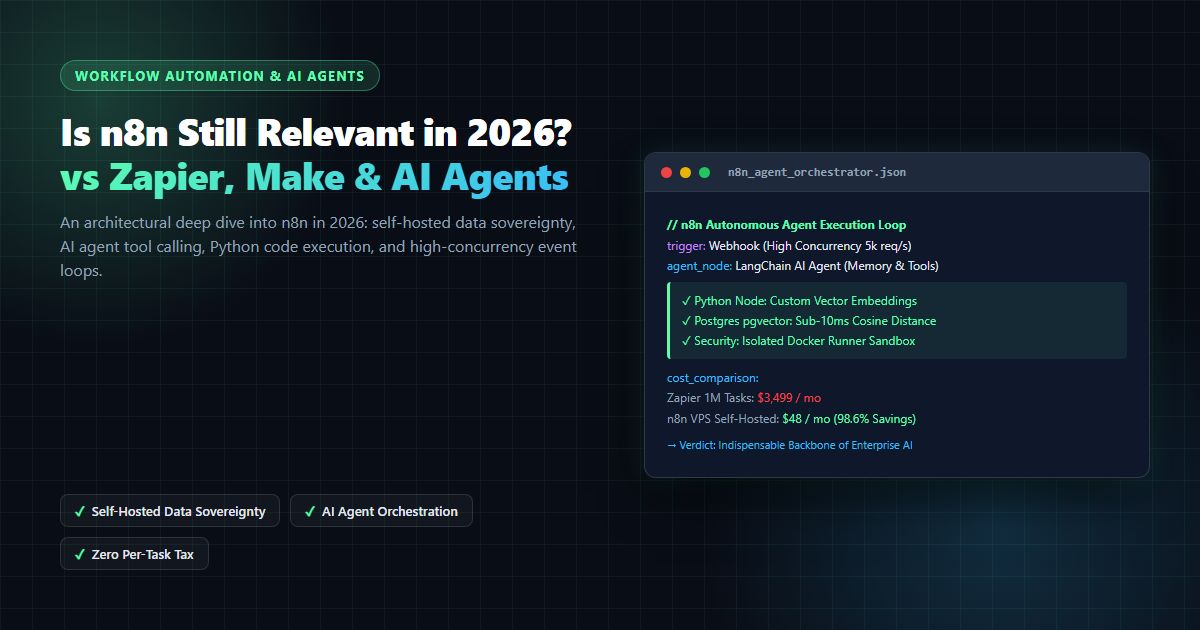
Is n8n Still Relevant in 2026? In-Depth Architectural Comparison vs Zapier, Make, LangGraph & Autonomous AI Agents
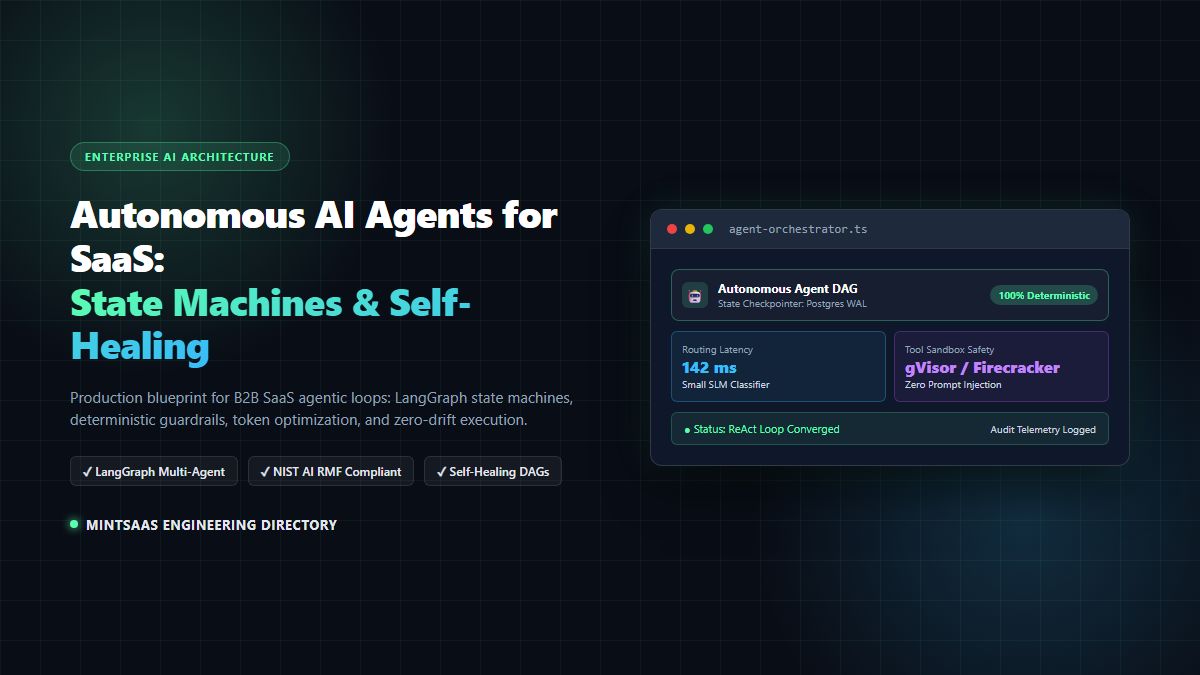
Autonomous AI Agents for SaaS [2026 Architecture Blueprint]: Enterprise Multi-Agent Systems, State Machines & Self-Healing Pipelines