Top Software Monetization Tools for SaaS in 2026: Pricing Models, Licensing & Revenue Architecture
Evaluate the top software monetization tools for SaaS: compare hybrid usage billing, global Merchant of Record (MoR) tax compliance, cryptographic offline desktop licensing, and outcome-based pricing frameworks for profitable software companies.
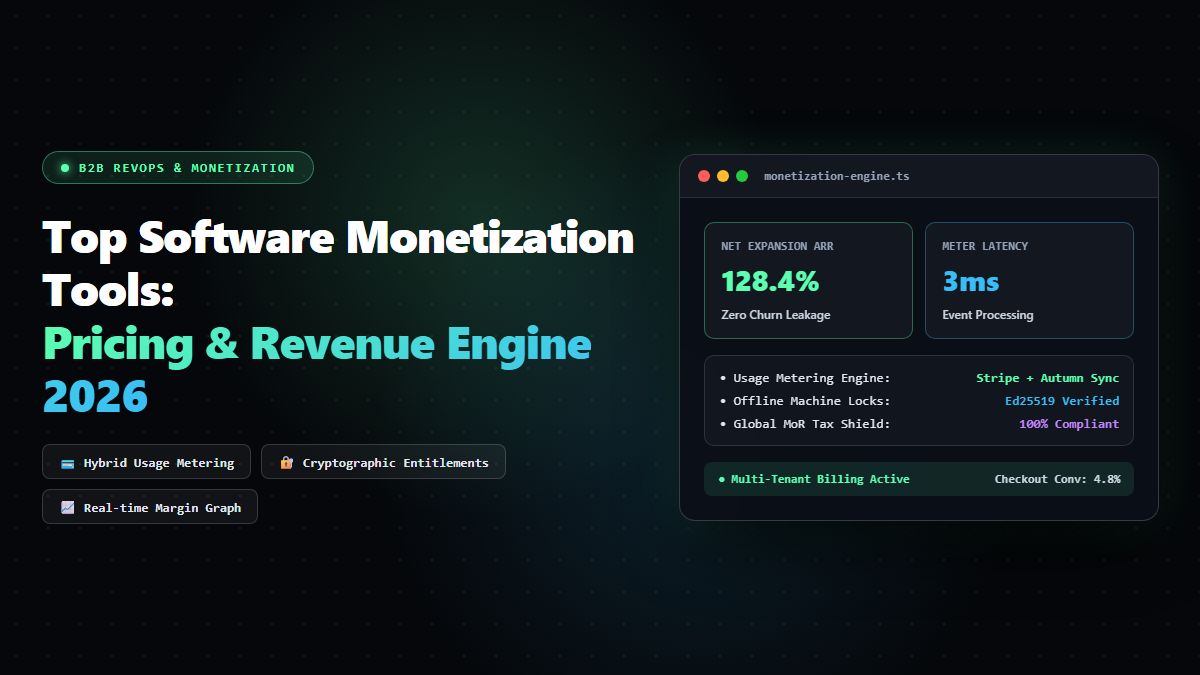
Top Software Monetization Tools for SaaS in 2026: Pricing Models, Licensing & Revenue Architecture
In the modern software economy, building great product software is only half the battle. How you price, package, license, and monetize that software determines whether your company scales profitably or succumbs to runaway cloud infrastructure costs and customer churn.
Over the past decade, pure per-seat subscription SaaS dominated the industry. However, by 2026, severe enterprise budget scrutiny, the rise of autonomous AI agents that compress headcount, and buyer fatigue with endless monthly subscriptions have triggered a tectonic shift. Today, the fastest-growing B2B software companies deploy hybrid monetization architectures: blending one-time perpetual licenses, metered usage-based billing, outcome-driven pricing tiers, and cryptographically verified offline desktop entitlements.
Choosing the right monetization infrastructure is no longer a simple question of integrating a payment gateway; it is a foundational architectural decision that impacts your data pipelines, billing compliance, churn rate, and customer lifetime value (LTV).
In this authoritative guide, we evaluate the top software monetization tools for SaaS in 2026, break down modern licensing and billing mechanics, analyze global Merchant of Record (MoR) solutions, and demonstrate how the MintSaaS Software Licensing & Distribution Architecture enables seamless, leak-free digital product sales.
Quick Answer (AEO Summary): What Are the Top Software Monetization Tools in 2026?
The leading software monetization tools for SaaS in 2026 fall into four distinct architectural tiers:
- Merchant of Record (MoR) Platforms (Global Tax, Compliance & Multi-Currency):
- Lemon Squeezy & Paddle: Best for indie developers, micro-SaaS, and digital creators selling globally without establishing local tax entities across 50 US states and international VAT jurisdictions.
- Stripe Billing & Invoicing: The enterprise benchmark for high-velocity API-first billing, developer customization, and complex enterprise contract workflows.
- Usage-Based & Metered Billing Engines:
- Metronome & Lago: Purpose-built for AI and API-first SaaS products where revenue scales with token usage, compute hours, or database transaction volume.
- Stripe Metered Billing: Seamless extension for standard Stripe users integrating consumption thresholds.
- Cryptographic Software Licensing & Entitlement Gatekeepers:
- Cryptolens & Keygen.sh: Dedicated licensing engines for desktop utilities (macOS, Windows, Linux) and on-premise enterprise binaries requiring hardware-locked or offline key validation.
- MintSaaS Native Licensing Suite: Built-in cryptographic offline license key generation, activation limits, and real-time validation APIs (
/api/licenses/validate) for modern desktop and SaaS utilities.
- Subscription Analytics & Churn Recovery:
- ProfitWell (Paddle) & Baremetrics: Deep MRR/ARR cohort analysis, benchmarked churn prevention, and automated payment recovery (dunning) sequences.

The 4 Dominant Monetization Models Dominating SaaS in 2026
Modern software buyers reject rigid, one-size-fits-all contracts. To maximize revenue, software creators in 2026 structure their monetization across four flexible models:
1. Hybrid Seat + Usage-Based Pricing
Pure per-seat pricing faces severe headwinds because autonomous AI agents allow lean teams of 5 people to generate the output of a 50-person department. If a SaaS charges purely per user seat, adopting AI shrinks customer contract values.
- The Modern Formula: A base monthly platform fee covering standard seats, coupled with metered usage charges (e.g., API requests, tokens processed, gigabytes stored, or active workflows executed).
- Ideal For: AI agent platforms, customer support automation, marketing automation, and ETL data pipelines.
2. The Return of the "Perpetual License with Paid Maintenance"
Driven by SaaS subscription fatigue, desktop utilities and developer tools are experiencing massive resurgence with one-time purchase licenses.
- The Modern Formula: Customers pay a single upfront fee (e.g., $29 to $79) for lifetime access to the software version they purchased, bundled with 1 year of free updates and security patches. After year one, users can optionally purchase an annual maintenance pass to continue receiving major new features.
- Ideal For: macOS menu bar tools, Windows power utilities, photo/media editors, and offline privacy tools (like Mint Cleaner Pro and Mint DevFlow).
3. Outcome & Milestone-Based Monetization
Instead of charging for access or usage, enterprise software increasingly charges for tangible business milestones achieved.
- The Modern Formula: A base platform retainer plus a performance fee per successful transaction (e.g., $1.50 per verified lead, 0.5% per collected invoice, or $5 per resolved support ticket).
- Ideal For: Autonomous B2B sales agents, debt collection engines, and automated recruitment pipelines.
4. Feature-Gated Modular Add-Ons
Rather than forcing all customers into bloated "Enterprise" tiers, modern SaaS platforms provide an accessible entry core with modular micro-subscriptions.
- The Modern Formula: $19/month core tier, with unbundled add-ons ($10/month for advanced analytics, $15/month for dedicated webhooks, $20/month for custom domain white-labeling).
Comprehensive Evaluation: Top 6 Software Monetization Platforms in 2026
| Platform | Primary Model | MoR (Handles Taxes)? | Key Strengths | Best Fit For |
|---|---|---|---|---|
| Paddle | SaaS Subscriptions & MoR | Yes | Built-in global VAT/sales tax filing, localized payment methods (iDEAL, Pix) | Scaling B2B & B2C web SaaS |
| Lemon Squeezy | Digital Products & SaaS MoR | Yes | Ultra-clean UI, instant checkout setups, native license key generation | Solopreneurs, digital downloads, micro-SaaS |
| Stripe Billing | Custom API Invoicing & Metering | No (requires Stripe Tax add-on) | Unmatched developer ergonomics, global payment rail depth | Enterprise SaaS with dedicated finance teams |
| Lago | Open-Source Metered Billing | No | Zero vendor lock-in, self-hostable, handles billions of raw consumption events | Developer-first AI infrastructure & APIs |
| Keygen.sh | Software Licensing API | No | Hardware node locking, floating licenses, offline cryptographic key validation | Desktop software, Mac/Windows apps, on-prem tools |
| MintSaaS Native Suite | Zero-Fee Integrated Licensing | Flexible | Built-in cryptographic license keys, instant checkout, zero recurring platform cuts | Independent desktop software & templates |
Technical Deep Dive: Cryptographic License Verification Architecture
For software companies selling downloadable binaries (macOS .dmg, Windows .exe, or local Docker containers), protecting revenue without irritating legitimate buyers requires modern cryptographic offline licensing.
Why Legacy Online Ping Checks Fail
Legacy DRM tools forced software to contact a licensing server every time the app launched. If the user was offline (e.g., coding on an airplane or in a secure air-gapped facility) or if the licensing server experienced an outage, paying customers were locked out of their software, generating furious support tickets and negative reviews.
The Modern Asymmetric (Ed25519) Cryptographic Standard
Modern licensing architectures (like the MintSaaS Licensing Engine) utilize asymmetric cryptography:
- At Purchase: When an order is completed, your server generates a license payload containing the buyer's email, order ID, product SKU, feature entitlements, and expiration date.
- Server-Side Signing: The server signs this payload using a secure Ed25519 Private Key stored exclusively on your backend.
- Client-Side Verification: The distributed desktop software binary embeds only the corresponding Ed25519 Public Key. The application mathematically verifies that the license key is authentic and untampered without ever needing to make an outbound internet call.
- Periodic Online Heartbeat (Optional): When internet connectivity is available, the software performs an asynchronous background sync to inspect whether the license was refunded or revoked, without ever blocking offline usage.
// Example: Server-side cryptographic license validation endpoint
import { NextRequest, NextResponse } from "next/navigation";
import crypto from "crypto";

export async function POST(req: NextRequest) {
  try {
    const { licenseKey, machineFingerprint } = await req.json();

    // 1. Fetch license record from secure database
    const license = await getLicenseRecord(licenseKey);
    if (!license || license.status !== "active") {
      return NextResponse.json({ valid: false, error: "Invalid or revoked license" }, { status: 401 });
    }

    // 2. Validate machine activation limits
    const isKnownMachine = license.activations.some(a => a.fingerprint === machineFingerprint);
    if (!isKnownMachine && license.activations.length >= license.maxActivations) {
      return NextResponse.json({ valid: false, error: "Maximum device activations exceeded" }, { status: 403 });
    }

    // 3. Return signed entitlement token
    const token = generateSignedToken(license, machineFingerprint);
    return NextResponse.json({ valid: true, token, expiresAt: license.expiresAt });
  } catch (err) {
    return NextResponse.json({ error: "License validation service unavailable" }, { status: 500 });
  }
}
5 Critical Monetization Pitfalls Every Software Founder Must Avoid
- Underpricing on Per-Seat While Ignoring High-Compute Consumption: If your SaaS integrates LLMs (OpenAI, Anthropic, Gemini) or high-volume WebAssembly transcoding, a $15/user/month flat subscription can quickly result in negative gross margins if power users generate thousands of API calls. Always implement soft caps or metered overages.
- Failing to Automate Dunning and Payment Churn: In B2B SaaS, 20% to 40% of churn is involuntary (expired credit cards, fraud false-positives). Implementing automated dunning sequences, card account updaters, and grace-period notifications recovers up to 70% of failed renewals.
- Navigating Global VAT and Sales Tax Without an MoR: In the United States alone, over 30 states enforce economic nexus laws requiring software companies to collect and remit local sales tax once certain transaction thresholds are reached. In Europe, VAT MOSS requires registration. Using a dedicated Merchant of Record (Paddle, Lemon Squeezy) transfers 100% of tax liability off your shoulders.
- Locking Software Behind Intrusive Online-Only DRM: Legitimate customers despise software that freezes when Wi-Fi drops. Always ensure your desktop applications function seamlessly offline with cached cryptographic entitlement keys.
- Overcomplicating the Checkout Flow: Every extraneous form field (asking for company fax, postal code for digital goods, or multi-step account creation before payment) drops checkout conversion rates by 8% to 15%. Keep checkouts razor-sharp: Email + Payment Details + Instant Delivery.
For a deeper inspection of how modern enterprise software architectures compare against legacy models, explore our comprehensive SaaS vs Traditional Software Guide and our Best SaaS Tools for Small Businesses in 2026.
Frequently Asked Questions (FAQ)
What is the difference between a payment gateway and a Merchant of Record (MoR)?
A standard payment gateway (like standard Stripe or Razorpay) processes credit card transactions into your bank account, but leaves 100% of legal sales tax calculation, global VAT remittance, and regulatory compliance on you. A Merchant of Record (such as Paddle or Lemon Squeezy) legally acts as the seller of record: they process the transaction, calculate and remit local sales taxes globally, handle chargeback liabilities, and pay you net royalties.
How do modern SaaS companies handle metered billing without slowing down apps?
High-throughput SaaS companies do not ping billing APIs synchronously during user requests. Instead, they emit asynchronous telemetry events into high-speed queues (Kafka, Redis, or SQS). A dedicated billing worker aggregates event counts in real-time and flushes batched consumption tallies to billing platforms like Metronome or Stripe Metered Billing on an hourly or daily schedule.
Can I monetize desktop software without paying monthly recurring SaaS fees?
Yes. By adopting one-time perpetual purchase models backed by self-hosted cryptographic licensing (such as the architecture powering MintSaaS utilities), you pay zero monthly platform fees. You receive 100% of your revenue (minus standard 2.9% payment processing fees) while providing customers with fast, offline-capable desktop binaries.
What is the average checkout conversion rate for B2B software products?
Optimized single-page checkout flows typically achieve conversion rates between 3.5% and 6.2% for low-friction software products priced under $100. Introducing friction (forced phone number fields, lengthy registration screens, or slow page loads) frequently drives conversion down to sub-1.5%.
Conclusion: Build an Engine That Scales With Your Product
Software monetization is no longer an afterthought bolted onto a completed codebase. By matching your pricing model to actual customer value, automating global tax compliance, and leveraging tamper-proof cryptographic licensing, you build a resilient revenue engine designed for sustainable, profitable growth.
Explore the complete MintSaaS Digital Products & Software Directory, inspect our Business Task Automation Guide, and learn how to optimize your infrastructure with our Best CRM Software Guide for 2026.
Free tools on MintSaaS
Try our free tools to put this guide into practice:
MintSaaS Dispatch articles are researched and synthesized with the assistance of artificial intelligence analysis, then edited, verified, and benchmarked by our engineering editorial team. Customer personal data and platform source files are strictly segregated and are never used to train or fine-tune public artificial intelligence models.
More from MintSaaS Dispatch
Handcrafted technical insights and developer tools.
Best CRM Software in 2026: The Complete Guide to Modern Customer Relationship Management for SaaS & Startups
Best Operations Software for Consumer Brands in 2026: Multi-Channel Inventory, Supply Chain & Headless Tech Stacks