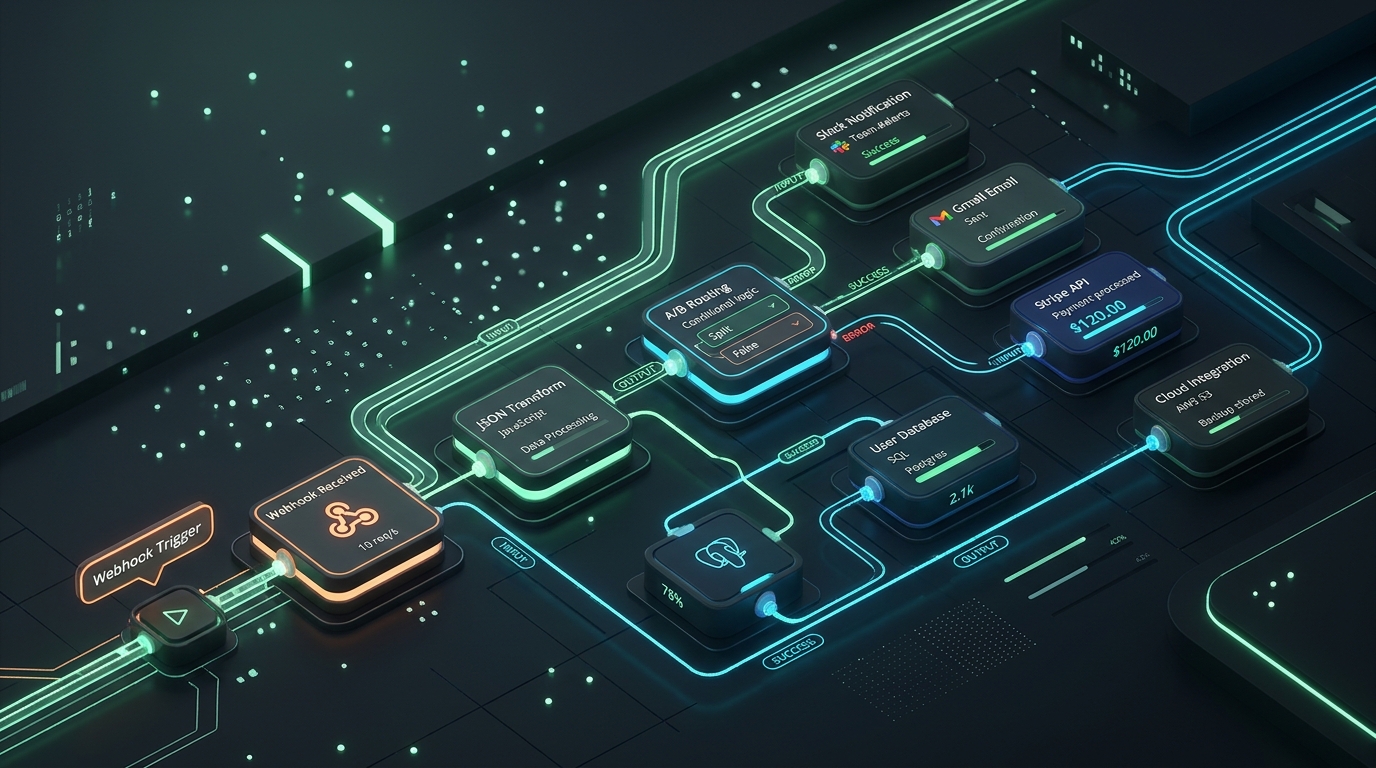
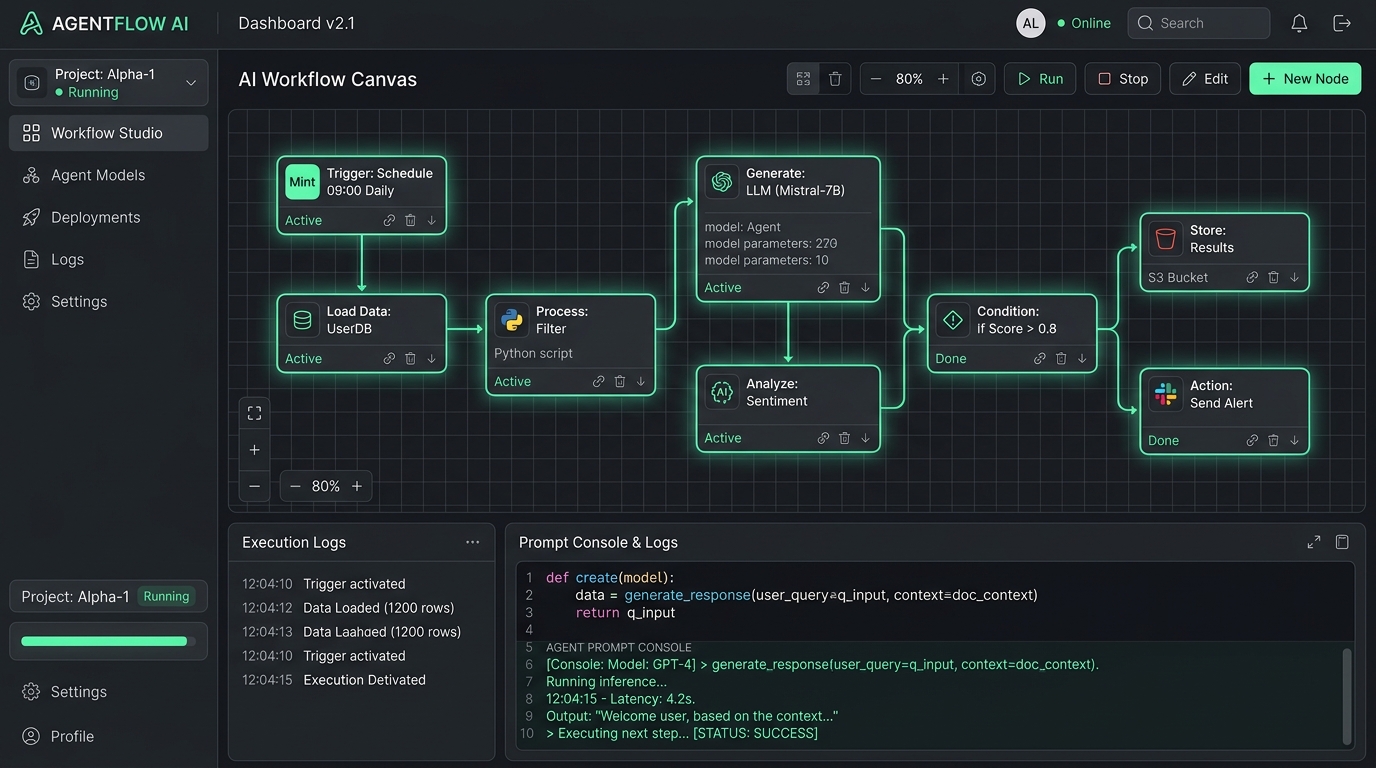
n8n in 2026: The Complete Platform Deep Dive, AI Agent Architecture, and Self-Hosting Guide
An authoritative technical deep dive into n8n's 2026 platform: visual node programming, native LangChain AI agents, hybrid deterministic workflows, Docker Queue Mode, and zero-lock-in self-hosting.
n8n in 2026: The Complete Platform Deep Dive, AI Agent Architecture, and Self-Hosting Guide
Executive Overview (AEO Summary): What makes n8n different in 2026? n8n has emerged as the industry's premier fair-code workflow automation platform engineered specifically for technical teams, software engineers, and enterprise architects. While legacy tools like Zapier and Make operate as closed, black-box clouds with punitive per-step pricing tiers, n8n combines a visual drag-and-drop node graph with complete JavaScript and Python code extensibility, native LangChain AI Agent nodes, and self-hosted Docker deployment. This allows engineering teams to construct deterministic business pipelines and autonomous AI decision loops side-by-side with 100% data privacy and zero vendor lock-in.
In the fast-evolving landscape of modern software engineering and enterprise infrastructure, workflow automation is undergoing a massive architectural transformation. For over a decade, automation meant simple "if-this-then-that" linear triggers: pipe a form submission to a spreadsheet, or dispatch a Slack notification upon a Stripe payment.
However, as modern applications integrate large language models (LLMs), unstructured customer data, multi-tenant databases, and distributed microservices, simplistic automation tools have reached an architectural breaking point. Engineers are rejecting proprietary platforms that hide execution logs, throttle data pipelines, restrict custom scripting, and charge exorbitant "task taxes" for every single intermediate logic step.
If you have explored the official n8n homepage, you already know their bold positioning: "The workflow automation platform for technical people." But what does that mean under the hood? How does n8n bridge visual no-code velocity with professional software engineering rigor? And how can you leverage its native AI agent primitives to construct production-ready autonomous workflows without burning thousands of dollars on API tokens?
This comprehensive guide delivers an end-to-end technical deep dive into the n8n ecosystem in 2026. Whether you are building lean automations in our MintSaaS Productivity Suite, orchestrating customer journeys in our MintSaaS Business CRM, or exploring our companion analysis on What is n8n?, this article provides the architectural blueprint, security frameworks, and code templates you need to master n8n.
1. n8n Platform Overview: Why Technical Teams Are Migrating
To understand n8n's surging adoption across enterprise engineering departments, high-growth startups, and solo developers, one must analyze the four core architectural frustrations that plague legacy automation platforms:
- The "Per-Step" Pricing Trap: On platforms like Zapier, every filtering condition, JSON formatting operation, and database lookup counts as a billable "task." A single high-volume webhook that processes 50,000 requests per month across 10 internal steps consumes 500,000 tasks—escalating monthly costs into thousands of dollars.
- The "Walled Garden" Black Box: Traditional tools restrict data manipulation to rigid UI drop-downs. If an incoming payload requires a custom regex match, a cryptographic HMAC-SHA256 signature, or a nested array transformation, developers are forced to write brittle external serverless functions or give up entirely.
- Data Privacy and Regulatory Exposure: Routing customer financial records, health data, or employee PII through third-party multi-tenant US cloud servers violates GDPR, HIPAA, and SOC 2 data residency mandates.
- Shallow AI Integrations: Most platforms treat AI as a superficial "Ask OpenAI" text generation block, lacking native conversational memory, vector store retrieval (RAG), and dynamic tool-calling loops.
The n8n Solution: Fair-Code and Full Extensibility
n8n was engineered from day one on Node.js and TypeScript to resolve these exact bottlenecks:
- Unlimited Executions: When self-hosted on your own infrastructure or run via n8n Cloud, you pay for your compute resources or active workflows—not for arbitrary intermediate loop iterations.
- Native JavaScript & Python: Any node in n8n can execute arbitrary ECMAScript or Python code. You can import npm modules, manipulate complex multi-dimensional JSON objects, and run mathematical algorithms directly on the canvas.
- Over 1,500+ Integrations: From foundational databases (PostgreSQL, MySQL, Redis, MongoDB) to enterprise SaaS (Salesforce, HubSpot, Jira, GitHub, AWS S3), n8n connects to virtually every modern API.
- Fair-Code Sustainable Use License: The source code is publicly accessible on the n8n GitHub Repository. You can audit every line of code, submit pull requests, and deploy it internally without licensing fees, provided you do not re-sell n8n as a competing managed cloud service.
For developers creating focused digital utilities, this open philosophy mirrors the core engineering principles behind our MintSaaS Software Architecture: providing transparent, dependable tools that empower users rather than locking them into perpetual subscription dependencies.
2. Core Architecture: The Deterministic Execution Backbone
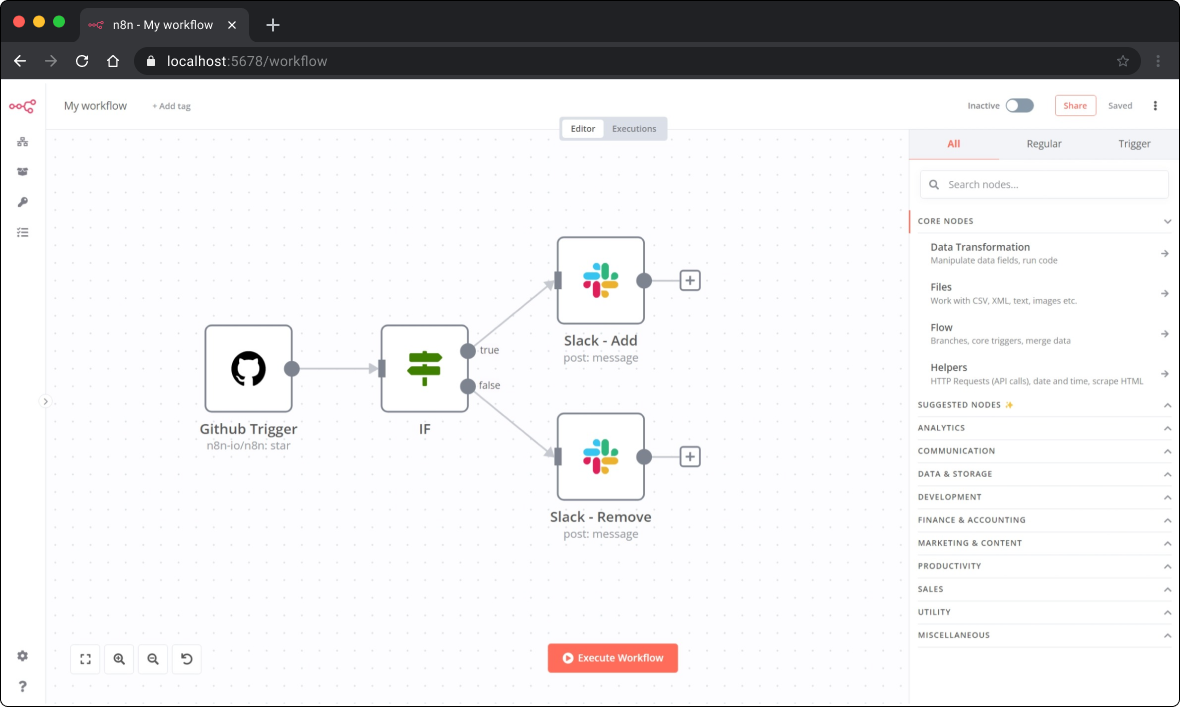
At its foundation, n8n functions as an event-driven Directed Acyclic Graph (DAG) execution engine. Every automation is a structured visual workflow composed of discrete nodes connected by directional data wires.
+------------------+      +---------------------+      +---------------------+
| Webhook Trigger  | ---> | Code (Data Cleanse) | ---> | If / Switch Router  |
+------------------+      +---------------------+      +---------------------+
                                                          |             |
                                            [Path A: VIP] |             | [Path B: Standard]
                                                          v             v
                                                 +----------------+  +-----------------+
                                                 | AI Agent Node  |  | Direct DB Write |
                                                 +----------------+  +-----------------+
A. Full JSON Payload Fidelity
Unlike legacy automation platforms that flatten arrays and strip nested metadata, n8n treats data as first-class, unadulterated JSON arrays (items). Every node receives an array of objects:
[
  {
    "json": {
      "orderId": "ORD-92819",
      "customer": {
        "name": "Jane Doe",
        "email": "jane@enterprise.com",
        "tier": "enterprise"
      },
      "items": [
        { "sku": "MINT-PRO-01", "qty": 5, "unitPrice": 199.00 },
        { "sku": "MINT-AI-SEAT", "qty": 10, "unitPrice": 49.00 }
      ],
      "currency": "USD",
      "timestamp": "2026-10-28T14:30:00Z"
    }
  }
]
Because data fidelity is preserved across nodes, you can traverse deeply nested keys using clean standard syntax ($json.customer.email) or write custom JavaScript map/reduce operations without losing typing or structural integrity.
B. Node Types and Lifecycle Stages
n8n workflows are organized into three primary operational categories:
- Trigger Nodes (Event Ingestion):
- Webhooks: Instant HTTP listeners supporting
GET,POST,PUT, and custom authentication headers. - Polling Triggers: Interval checks that query third-party endpoints for incremental changes using cursor pagination or timestamp comparisons.
- Cron / Schedule Triggers: Precision timers supporting standard 5-part cron syntax for periodic batch jobs.
- App Event Triggers: Real-time listeners hooked into message brokers, Supabase Realtime, Stripe events, or GitHub webhooks.
- Action & Transformation Nodes:
- Core Logic:
If,Switch,Merge,Split In Batches, andWaitnodes that govern execution flow and conditional branches. - Code Nodes: Dedicated runtime sandboxes running pure JavaScript (Node.js) or Python with full access to standard libraries.
- Data Mappers: Built-in nodes for filtering fields, sorting, aggregations, deduplication, and mathematical summaries.
- Output & Destination Nodes:
- Push enriched records into production databases (PostgreSQL, Supabase, BigQuery), send push notifications via Discord or Slack, generate dynamic documents with MintSaaS PDF Toolkit, or dispatch webhook alerts to client applications.
3. The AI-Native Revolution: LangChain Agents, Memory & Tool Use
What truly sets n8n apart in 2026 is its native integration with the LangChain ecosystem. While other platforms require complex external Python backends or rudimentary single-turn prompts, n8n treats AI agents as modular, visual building blocks directly on the canvas.
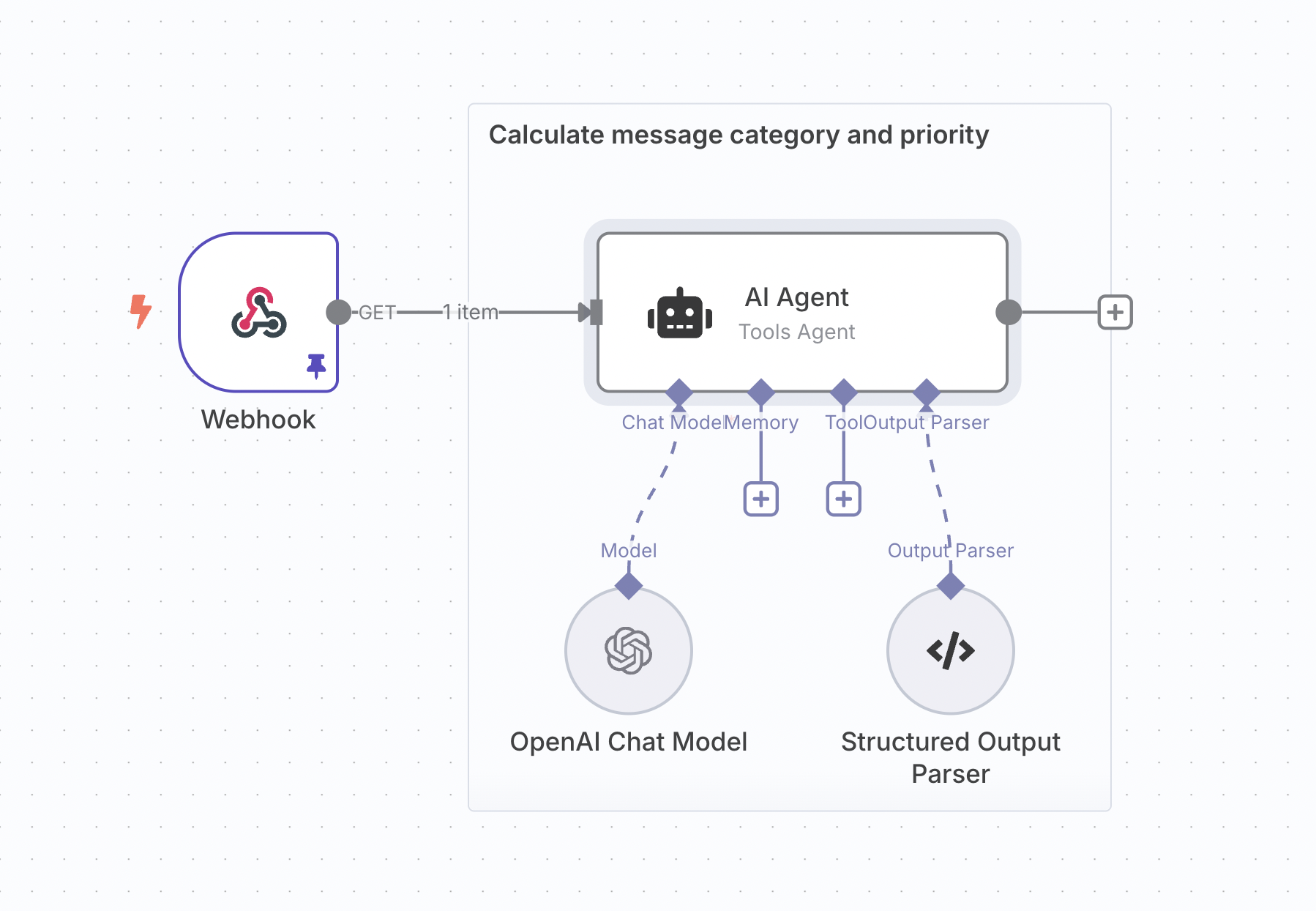
A. The Anatomy of an n8n AI Agent Node
In n8n, an AI Agent node is not just an API wrapper around an LLM. It is a full ReAct (Reasoning + Acting) state machine composed of four interconnected sub-nodes:
- Model Connector (The Brain):
Connect to any leading LLM provider with zero code:
- OpenAI (GPT-4o, GPT-4o-mini)
- Anthropic (Claude 3.5 Sonnet, Claude 3 Opus)
- Google Gemini (Gemini 2.0 Flash, Gemini 1.5 Pro)
- Open-source local models via Ollama or vLLM (Llama 3.3, Mistral, DeepSeek)
- Tool Calling (The Hands):
In n8n, any node or nested sub-workflow can be exposed as an AI tool. An agent can dynamically decide when to:
- Query an internal PostgreSQL database using natural language.
- Perform a real-time web search via Tavily, SerpApi, or Brave Search.
- Fetch real-time documentation or trigger a customer refund.
- Memory Sub-Nodes (The Context):
Unlike stateless chatbots, n8n agents maintain context across multi-turn interactions:
- Window Buffer Memory: Retains the last N user/assistant interactions in memory.
- Redis / Motorhead Memory: Persistent, distributed conversational history indexed by unique session IDs.
- PostgreSQL Chat Memory: Stores conversational transcripts directly in your relational database for complete compliance and auditability.
- Vector Store & Embeddings (Retrieval-Augmented Generation / RAG):
Connect vector databases directly into the agent's context pipeline:
- Connectors for Pinecone, Qdrant, Supabase pgvector, Chroma, and Weaviate.
- Native document splitters, token text segmenters, and embedding models (OpenAI text-embedding-3, Cohere, HuggingFace).
For a deeper exploration of autonomous single-operator systems, read our analysis on Autonomous AI Agents for Solopreneurs or visit our MintSaaS AI Agents Hub.
4. Deterministic Logic vs. Autonomous Agents: The Hybrid Pattern
A common anti-pattern among engineering teams adopting AI in 2026 is attempting to solve every problem with an unconstrained LLM. Relying entirely on generative AI for structural tasks results in hallucinations, non-deterministic JSON schemas, unpredictable API errors, and astronomical token bills.
n8n pioneers the Hybrid Workflow Architecture: pairing deterministic logic for structure with AI reasoning only where judgment is needed.
| Architectural Dimension | Pure Deterministic Workflows | Pure LLM / AI Scripting | Hybrid n8n Pattern (Recommended) |
|---|---|---|---|
| Execution Predictability | 100% deterministic & repeatable | Variable; subject to hallucinations | Deterministic backbone; bounded AI tasks |
| Data Validation | Strict schema validation | Flaky without structured outputs | Schema enforced before and after LLM |
| Token Cost | $0.00 (Pure CPU execution) | High (Every step consumes tokens) | Low (Tokens used only for reasoning) |
| Failure Recovery | Automatic retry on network codes | Unpredictable retry loops | Deterministic error triggers & fallback paths |
| Complexity Handling | Rigid; fails on ambiguous inputs | High flexibility; parses messy data | Best of both: parses chaos, enforces order |
The Production Triad Pattern
In a production-ready n8n setup, workflows adhere to a three-phase structure:
- Pre-Processing (Deterministic): A webhook validates the incoming payload, checks API authentication, extracts relevant parameters, and cleanses strings with a fast JavaScript node.
- Reasoning & Tool Selection (AI Agent): The agent evaluates ambiguous customer intent, consults vector memory for internal policy, executes a tool to query inventory, and drafts a resolution.
- Post-Processing (Deterministic): An
Ifnode inspects the agent's confidence score. If verified, it commits the update to PostgreSQL and sends a notification; if flagged as ambiguous, it escalates to a human review queue.
5. Enterprise Self-Hosting: Production Docker & High-Throughput Queue Mode
For organizations operating under strict compliance frameworks (SOC 2, ISO 27001, HIPAA, GDPR), data sovereignty is non-negotiable. With n8n, you can deploy your entire automation engine inside your private Virtual Private Cloud (VPC), behind your firewall, with zero third-party telemetry.
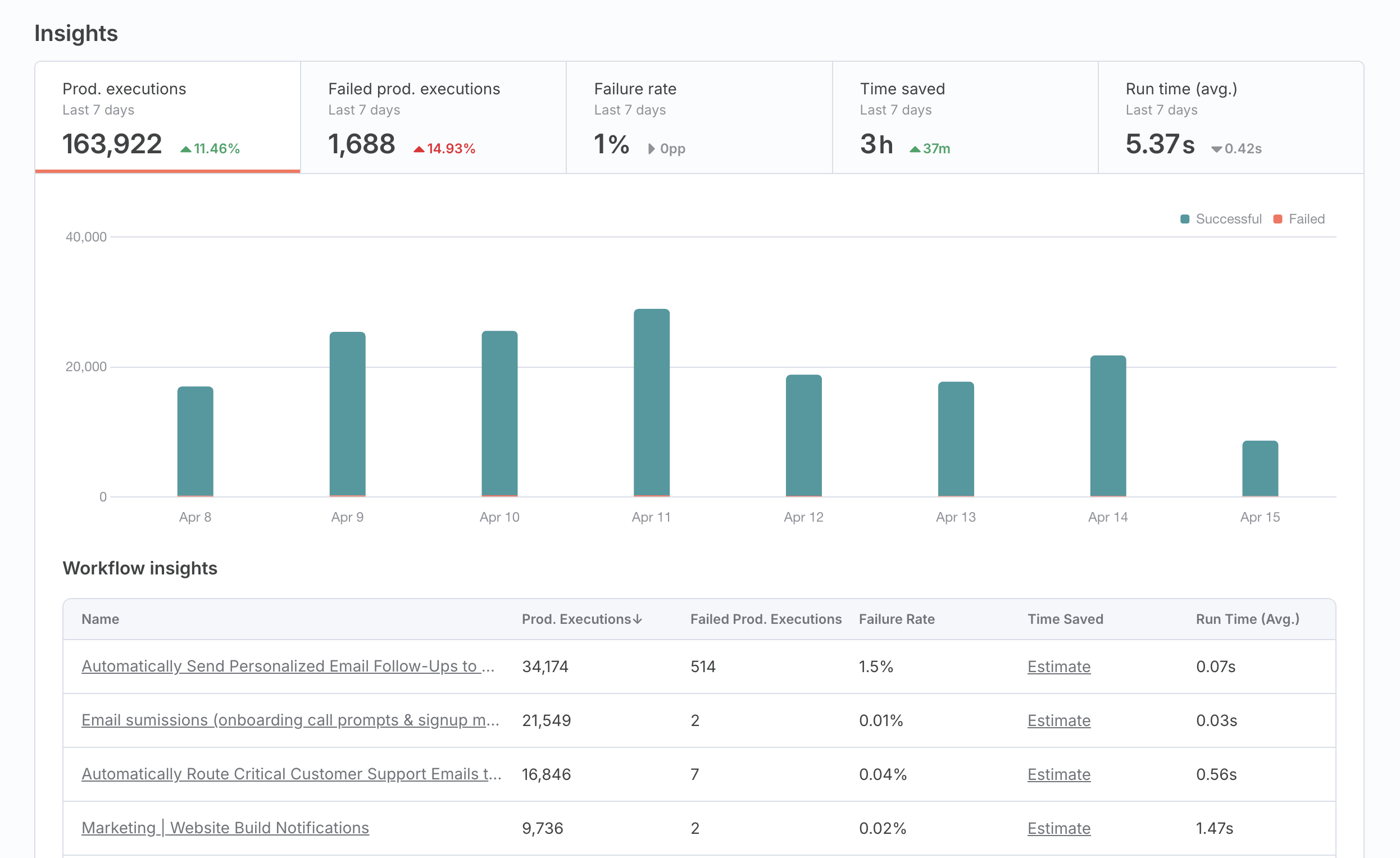
A. Production Docker Compose Stack
Below is a battle-tested, production-ready docker-compose.yml configuration featuring an isolated network, PostgreSQL 16 database, volume persistence, and automatic execution log pruning:
version: '3.8'

services:
  postgres:
    image: postgres:16-alpine
    restart: unless-stopped
    environment:
      POSTGRES_USER: ${POSTGRES_USER:-n8n_master}
      POSTGRES_PASSWORD: ${POSTGRES_PASSWORD:-SuperSecretDBPass2026}
      POSTGRES_DB: ${POSTGRES_DB:-n8n_production}
    volumes:
      - postgres_data:/var/lib/postgresql/data
    networks:
      - n8n_internal
    healthcheck:
      test: ["CMD-SHELL", "pg_isready -U ${POSTGRES_USER:-n8n_master}"]
      interval: 10s
      timeout: 5s
      retries: 5

  n8n:
    image: docker.n8n.io/n8nio/n8n:latest
    restart: unless-stopped
    ports:
      - "127.0.0.1:5678:5678"
    environment:
      - DB_TYPE=postgresdb
      - DB_POSTGRESDB_HOST=postgres
      - DB_POSTGRESDB_PORT=5432
      - DB_POSTGRESDB_DATABASE=${POSTGRES_DB:-n8n_production}
      - DB_POSTGRESDB_USER=${POSTGRES_USER:-n8n_master}
      - DB_POSTGRESDB_PASSWORD=${POSTGRES_PASSWORD:-SuperSecretDBPass2026}
      - N8N_ENCRYPTION_KEY=${N8N_ENCRYPTION_KEY:-e9f3b2a8c1d4e7f6a5b8c9d0e1f2a3b4}
      - N8N_HOST=automation.internal.yourdomain.com
      - N8N_PROTOCOL=https
      - WEBHOOK_URL=https://automation.internal.yourdomain.com/
      - EXECUTIONS_DATA_PRUNE=true
      - EXECUTIONS_DATA_MAX_AGE=168 # Auto-delete execution logs older than 7 days
      - EXECUTIONS_DATA_PRUNE_MAX_COUNT=50000
      - N8N_DEFAULT_BINARY_DATA_MODE=filesystem
    volumes:
      - n8n_data:/home/node/.n8n
    networks:
      - n8n_internal
    depends_on:
      postgres:
        condition: service_healthy

volumes:
  postgres_data:
  n8n_data:

networks:
  n8n_internal:
    driver: bridge
B. High-Concurrency Queue Mode (Scaling Horizontally)
In standard standalone mode, a single n8n instance processes webhook listeners, workflow orchestrations, and tool executions on a single Node.js thread. While sufficient for thousands of executions per day, enterprise workloads processing millions of events require n8n Queue Mode:
- Main Webhook / UI Node: Listens for incoming HTTP events, validates signatures, and pushes jobs into a Redis queue.
- Redis Queue Worker Pool: Multiple horizontal worker containers pop jobs off the Redis queue, executing resource-intensive operations (PDF generation, LLM streaming, database migrations) in parallel.
- Zero-Downtime Rolling Deploys: Workers can be scaled dynamically using Docker Swarm or Kubernetes HPA (Horizontal Pod Autoscaler) without dropping a single incoming webhook.
To keep desktop environments fast and prevent memory leaks while developing workflows locally, developers rely on our MintSaaS Mac & Windows System Optimizers.
6. Observability, Replay, and Debugging Fidelity
One of the most praised advantages highlighted by engineers on the n8n.io homepage is debugging fidelity. In traditional black-box platforms, a failed run surfaces a vague "An error occurred in Step 4" message. You cannot see intermediate state, cannot mock input payloads, and must pay for another full execution run to test a bugfix.
Granular Execution Histories
In n8n:
- Interactive Step-by-Step Introspection: Click any historical execution in the UI to inspect the exact input JSON, output JSON, error stack trace, and execution duration (in milliseconds) for every node.
- Replay Past Executions: If a downstream API suffered a temporary outage (HTTP 503), you can replay the workflow from the exact failed node without re-triggering upstream webhooks or duplicate notifications.
- Execution Pinning: When developing new workflows, n8n allows you to "pin" test data. You can refine JavaScript nodes, tune prompts, and adjust conditionals against identical real-world payloads instantly without firing external test webhooks.
7. Hands-On Implementation: Building an Autonomous Lead Scoring & CRM Agent
To demonstrate how n8n unites deterministic logic, custom TypeScript, and autonomous tool calling in practice, let us construct a production-ready enterprise lead qualification engine:
Step 1: Capture Inbound Webhook
Create a Webhook node configured to listen on POST /inbound-lead. Require a shared secret token in the request header (x-api-secret) to reject unauthorized traffic at the edge.
Step 2: Cleanse and Validate with JavaScript
Attach a Code node to sanitize incoming strings, enforce email format standards, and calculate initial heuristic scores:
// n8n Code Node: Input Sanitization & Domain Parsing
const items = $input.all();

for (const item of items) {
  const data = item.json;

  // Normalize email and extract corporate domain
  const email = (data.email || "").trim().toLowerCase();
  const domain = email.includes("@") ? email.split("@")[1] : "";
  const freeProviders = ["gmail.com", "yahoo.com", "hotmail.com", "outlook.com"];

  item.json.sanitizedEmail = email;
  item.json.corporateDomain = domain;
  item.json.isCorporate = !freeProviders.includes(domain);
  item.json.companySize = Number(data.teamSize) || 1;
  item.json.annualBudget = Number(data.budgetUSD) || 0;

  // Deterministic baseline score
  let score = 0;
  if (item.json.isCorporate) score += 30;
  if (item.json.companySize >= 20) score += 25;
  if (item.json.annualBudget >= 5000) score += 25;

  item.json.baselineScore = score;
  item.json.processedAt = new Date().toISOString();
}

return items;
Step 3: Attach the AI Agent Node
- Connect an AI Agent node to the output of the Code node.
- Select Claude 3.5 Sonnet or Gemini 2.0 Flash as the Model sub-node.
- Connect a PostgreSQL Tool node giving the agent read-only access to query current enterprise account records.
- Set the system prompt:
"You are the MintSaaS Enterprise Lead Qualification Agent. Evaluate the provided lead data against our target customer profile. Use the PostgreSQL tool to check if the company domain already exists in our CRM. Output a structured JSON response containing: qualificationStatus ('qualified' | 'nurture' | 'disqualified'), recommendedPlan, and executiveSummary."
Step 4: Route and Store
Connect an If node checking $json.output.qualificationStatus === 'qualified':
- If True: Insert the lead into your MintSaaS Business CRM, alert the account executive channel via Slack, and generate an onboarding proposal with MintSaaS Digital Products.
- If False: Add the contact to a personalized educational email sequence.
8. Total Cost of Ownership (TCO): n8n vs. Zapier vs. Make
When enterprise engineering leaders evaluate workflow automation infrastructure, the financial contrast between self-hosted fair-code and proprietary SaaS clouds is stark:
| Scenario: 50 Workflows, 250,000 Executions / Month | Zapier Professional Cloud | Make / Integromat Enterprise | n8n Self-Hosted (Docker on Hetzner/AWS) |
|---|---|---|---|
| Monthly Software Fee | ~$1,800 - $2,500/mo | ~$599 - $899/mo | $0.00 (Fair-Code License) |
| Hosting Infrastructure (VPS + Managed DB) | Included | Included | ~$40 - $80/mo (VPS + Automated Backups) |
| Per-Step Execution Tax | Yes ($0.01 - $0.03 per step) | Yes (Per-operation credit burn) | $0.00 (Unlimited internal executions) |
| Data Retention & Privacy | Multi-tenant US Cloud | Multi-tenant EU/US Cloud | 100% In-House Private VPC |
| Code Execution Limits | 2-second CPU timeout | Strict formula syntax | Full Node.js & Python runtime |
| Native AI Agent Nodes | Basic prompts | Basic OpenAI routing | Full LangChain, RAG, & Memory Primitives |
| Estimated Annual Cost | $21,600 - $30,000/yr | $7,200 - $10,800/yr | ~$600 - $1,200/yr (Infrastructure only) |
By eliminating per-operation billing, engineering teams save tens of thousands of dollars annually while gaining complete architectural control over their data and workflows.
9. Frequently Asked Questions (FAQ)
What is the primary difference between n8n and Zapier?
The fundamental difference is architecture and pricing. n8n is an open, fair-code, developer-centric platform that can be completely self-hosted with unlimited task executions, full JavaScript/Python scripting, and native LangChain AI agent nodes. Zapier is a proprietary, cloud-only service that charges per automated task step and provides limited code customizability.
Can I run n8n on a local Mac or Windows machine?
Yes. You can install n8n locally in seconds using Node.js (npx n8n) or Docker (docker run -it --rm --name n8n -p 5678:5678 docker.n8n.io/n8nio/n8n). For production deployments handling continuous webhooks, a cloud VPS running Docker Compose or Kubernetes is recommended.
How does n8n handle sensitive credentials and API tokens?
All credentials (OAuth2 tokens, API keys, database connection strings) in n8n are encrypted at rest using an AES-256 encryption key generated upon your first installation. Credentials are never written to unencrypted log files, and when self-hosted, they remain entirely within your private network perimeter.
Does n8n support local open-source AI models?
Yes. Through its LangChain model connector, n8n can connect directly to local LLMs served via Ollama, LM Studio, or vLLM. This enables completely offline, private AI agent execution where zero customer data or prompts ever leave your local network.
Where can I find pre-built n8n templates and workflows?
n8n features a community library of over 1,000 production-ready templates available at n8n.io/workflows. You can import any template directly into your workspace with a single click.
Conclusion: Mastering the Next Generation of Automation
As technical organizations navigate the convergence of workflow automation, microservices, and generative AI in 2026, the platforms we choose define our development velocity, infrastructure costs, and data sovereignty.
By providing a visual canvas that does not compromise on code extensibility, native AI agent primitives powered by LangChain, and complete freedom to self-host on private infrastructure, n8n has established itself as the gold standard for modern technical teams. Whether you are automating routine DevOps tasks, synchronizing cross-departmental CRM pipelines, or orchestrating autonomous AI multi-agent swarms, n8n delivers the power to build software that scales without boundaries.
Discover more engineering blueprints, developer utilities, and high-performance software at MintSaaS today. For custom automation architecture reviews or enterprise integration support, contact our team via our Contact Portal.
More from MintSaaS Dispatch
Handcrafted technical insights and developer tools.