Best Operations Software for Consumer Brands in 2026: Multi-Channel Inventory, Supply Chain & Headless Tech Stacks
Evaluate the best operations software for consumer brands in 2026: benchmark Katana, Fulfil.io, Cin7, Pipe17 & Finale for multi-channel inventory orchestration, distributed 3PL routing, TikTok Shop/Shopify synchronization, and real-time FIFO landed cost tracking.
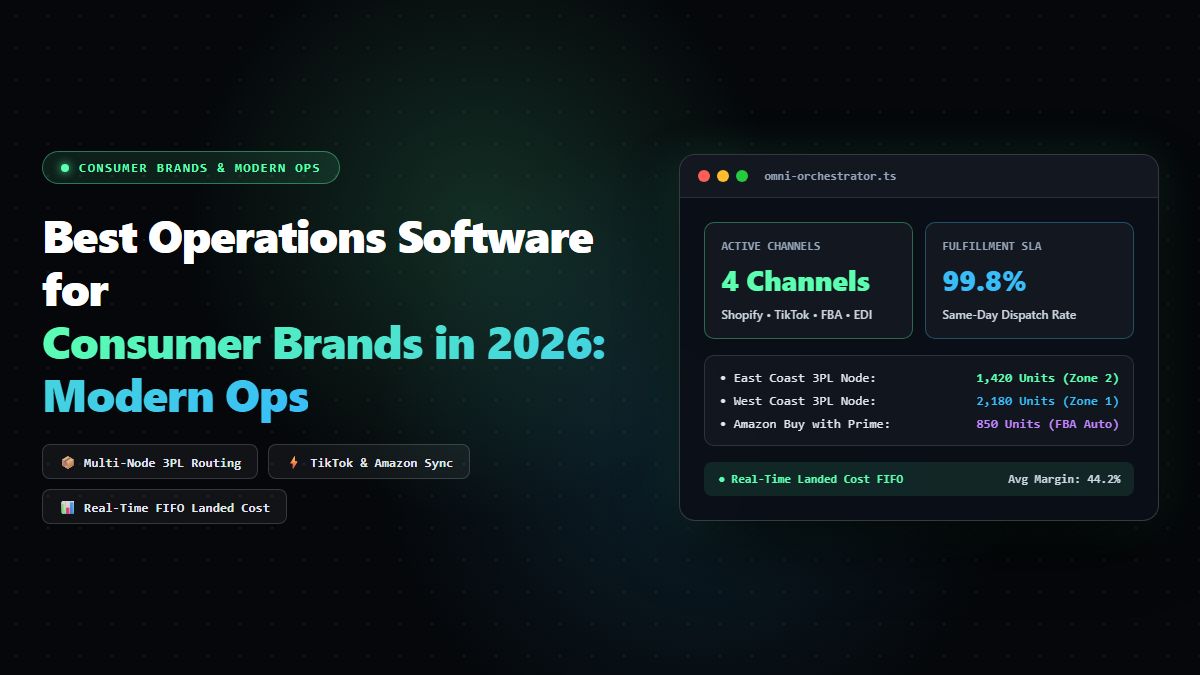
Best Operations Software for Consumer Brands in 2026: Multi-Channel Inventory, Supply Chain & Headless Tech Stacks
Consumer brand operations in 2026 bear almost no resemblance to the monolithic ERP deployments of the previous decade. For high-growth Direct-to-Consumer (DTC) merchants, omni-channel retailers, and digital-native consumer packaged goods (CPG) companies, the operational bottleneck is no longer demand generation or digital marketing. The real battleground is back-office execution: real-time multi-node inventory orchestration, automated 3PL order routing, headless order management, and real-time margin visibility across TikTok Shop, Amazon Buy with Prime, Shopify Plus, and brick-and-mortar wholesale.
Legacy enterprise systems like SAP Business One and NetSuite, while feature-rich, frequently encumber agile consumer teams with six-month implementation cycles, exorbitant seat licenses, and rigid database schemas that break whenever a brand launches on a new social commerce channel. Conversely, modern consumer brands in 2026 are constructing modular, API-first operational stacks that combine specialized inventory engines, automated integration fabrics, and AI-driven demand forecasting.
In this technical analysis and operational playbook, we evaluate the best operations software platforms for consumer brands in 2026, benchmark their architectural strengths and pricing realities, and provide an actionable blueprint for engineering an automated multi-channel operational foundation.
1. The 2026 Consumer Brand Operational Paradigm
Consumer brands operating in 2026 face an unprecedented level of channel fragmentation and customer fulfillment expectations:
- Omni-Channel Surface Area: A typical brand sells concurrently across an owned e-commerce storefront (Shopify Plus or headless Next.js), social video commerce (TikTok Shop, Instagram Shops), marketplace channels (Amazon FBA / Buy with Prime), and physical wholesale portals (Faire, EDI retail distributors like Target and Sephora).
- Distributed Fulfillment Nodes: Gone are the days of shipping all orders from a single proprietary warehouse. Modern brands utilize hybrid fulfillment: one regional primary 3PL for DTC parcels, Amazon FBA for marketplace sales, localized micro-fulfillment hubs for same-day urban deliveries, and cross-docking facilities for B2B pallet shipments.
- Unit Economic Volatility: Fluctuating customer acquisition costs (CAC) and rising parcel carrier surcharges require consumer founders and COOs to possess real-time Contribution Margin 3 (CM3) visibility on every single SKU, factoring in landed COGS, merchant processing fees, pick-and-pack expenses, and shipping tariffs.
To survive and scale profitably in this environment, consumer operations software must satisfy four core architectural primitives:
                    ┌──────────────────────────────────────────────┐
                    │       Omni-Channel Demand Surfaces           │
                    │ (Shopify Plus, TikTok Shop, Amazon, Faire)   │
                    └──────────────────────┬───────────────────────┘
                                           │ Webhooks / REST APIs
                                           ▼
                    ┌──────────────────────────────────────────────┐
                    │      Central Operations Core (OMS & IMS)     │
                    │  • Universal SKU Graph & Bundling Engine     │
                    │  • Intelligent Multi-Node Routing Engine     │
                    │  • Real-Time Landed Cost & Margin Telemetry  │
                    └──────────────────────┬───────────────────────┘
                                           │ Carrier APIs / WMS EDI
                                           ▼
                    ┌──────────────────────────────────────────────┐
                    │      Distributed Execution Nodes             │
                    │  (Regional 3PLs, Amazon FBA, Retail EDI)     │
                    └──────────────────────────────────────────────┘
2. Comprehensive Benchmark: Top 5 Operations Software for Consumer Brands in 2026
We evaluated over a dozen operations, inventory, and order management platforms across four non-negotiable criteria: Catalog & Bundling Flexibility, Multi-Node Routing Velocity, Native Omni-Channel Integration, and Developer API Extensibility. Below are the top five systems leading the market in 2026.
1. Katana Cloud Manufacturing & Operations (Best Overall for CPG & D2C Makers)
Katana has evolved from a pure shop-floor MRP system into the definitive modern operations platform for brands that formulate, assemble, or bottle their own consumer goods (skincare, functional beverages, electronics, apparel, and supplements).
- Core Strengths:
- Visual Multi-Level Bill of Materials (BOM): Effortlessly maps raw ingredients, packaging components, and finished SKUs, calculating true production costs dynamically down to four decimal places.
- Auto-Booking Inventory Engine: When orders sync from Shopify or Amazon, Katana’s deterministic booking engine automatically allocates available finished stock or issues automated purchase requisitions for depleted raw materials based on lead times.
- Open REST API & Webhooks: High rate limits and clean JSON payloads allow internal engineering teams to pipe production milestones directly into proprietary business intelligence dashboards.
- Drawbacks: Does not natively generate retail EDI document feeds (850/856/810); requires an EDI middle layer like SPS Commerce or Crstl for big-box retail compliance.
- Ideal Profile: Consumer brands generating \$3M to \$50M in annual GMV with in-house or contract-manufacturing operations.
2. Fulfil.io (Best Enterprise-Grade Cloud ERP for Omni-Channel Scale)
Fulfil.io is engineered specifically as a modern, API-first alternative to NetSuite for high-velocity consumer brands managing high order volumes across dozens of global sales channels and warehouses.
- Core Strengths:
- Unified OMS, IMS, and Financial Ledger: Unifies warehouse management, multi-currency accounting, and customer service ticketing in a single relational data model, eliminating data desynchronization between disparate systems.
- Algorithmic Order Splitting & Routing: Intelligently evaluates warehouse proximity, carrier shipping rates, split-shipment penalty costs, and stock availability to route each order line to the lowest-cost fulfillment partner.
- Native Return & Exchange Workflows: Deep bi-directional integrations with platforms like Loop Returns and Happy Returns allow seamless reverse logistics tracking without manual spreadsheet reconciliation.
- Drawbacks: High setup and implementation fees (\$15,000–\$35,000 onboarding); typically requires 60 to 90 days to configure workflows fully.
- Ideal Profile: Established consumer brands generating \$15M to \$150M+ GMV needing true enterprise resilience without legacy NetSuite bloat.
3. Cin7 Omni & Core (Best for Omni-Channel Wholesale & B2B Expansion)
Cin7 remains a dominant powerhouse for consumer brands expanding aggressively from pure-play direct-to-consumer storefronts into nationwide B2B department stores, supermarkets, and boutique networks.
- Core Strengths:
- Built-in Electronic Data Interchange (EDI): Includes pre-configured EDI connectors for hundreds of major global retailers (Walmart, Target, Costco, Nordstrom, Whole Foods), bypassing expensive third-party EDI translation brokers.
- Virtual Stock Allocations: Allows operations leaders to ring-fence specific inventory reserves for scheduled promotional flash sales or retail purchase orders, preventing accidental stockouts from runaway viral DTC campaigns.
- Automated Landed Cost Calculation: Automatically distributes freight forwarding, ocean shipping, customs duties, and drayage fees across product batches, giving finance teams accurate margin data.
- Drawbacks: The user interface can feel dense and dated; reporting query builder has a steep learning curve for non-technical team members.
- Ideal Profile: Omni-channel lifestyle, apparel, and hardware brands generating \$5M to \$40M GMV with heavy wholesale distribution.
4. Pipe17 (Best Smart Operations Middleware & Integration Hub)
Rather than replacing your existing inventory software or ERP, Pipe17 acts as an intelligent, serverless operational nervous system that coordinates all order data, product catalogs, and fulfillment signals across any existing stack.
- Core Strengths:
- No-Code Intelligent Operations Engine: Connects disparate systems (e.g., TikTok Shop, Amazon FBA, Shopify, Deliverr, ShipBob, and NetSuite) in minutes using pre-built operational logic rather than brittle point-to-point Zapier webhooks.
- Automated Order Exception Handling: Intercepts invalid shipping addresses, fraudulent orders, backordered bundles, and failed payment webhooks, holding the order and alerting the operations team before erroneous fulfillment occurs.
- Zero Latency Inventory Synchronization: Pushes real-time stock counts across 15+ marketplaces concurrently, virtually eliminating overselling suspensions on strict platforms like TikTok and Amazon.
- Drawbacks: Not a standalone ledger or warehouse management tool; must be paired with an existing inventory repository or 3PL network.
- Ideal Profile: Fast-growing digital brands using multiple 3PLs and cutting-edge social commerce channels who need instant operational glue without migrating databases.
5. Finale Inventory (Best for High-Volume Warehouse Management & Barcode Workflows)
For consumer brands operating their own fulfillment facilities or managing hybrid warehouse models, Finale Inventory provides rapid barcode scanning, pick-and-pack routing, and high-frequency stock synchronization.
- Core Strengths:
- High-Throughput Wave and Batch Picking: Optimized barcode scanner workflows guide warehouse staff along the most efficient physical path through aisles, drastically cutting fulfillment labor hours.
- Extreme Synchronization Velocity: Capable of processing tens of thousands of orders per hour during Black Friday / Cyber Monday surges without API throttling or database locking.
- Transparent, Predictable Tiered Pricing: Unlike systems that charge a percentage of gross merchandise volume (GMV tax), Finale utilizes flat pricing based on monthly order tiers.
- Drawbacks: Minimal native marketing or CRM integration; visual UI is strictly functional and utilitarian.
- Ideal Profile: High-volume e-commerce brands fulfilling in-house with dedicated warehouse personnel and mobile barcode scanners.
3. Comparative Architecture & Feature Matrix
The following decision matrix evaluates how the leading platforms perform across technical capabilities essential for modern consumer brands:
| Operational Criterion | Katana MRP | Fulfil.io | Cin7 Omni | Pipe17 | Finale Inventory |
|---|---|---|---|---|---|
| Primary Architectural Role | Manufacturing & IMS | All-in-One Cloud ERP | Omni-Channel & EDI | Smart Ops Fabric | WMS & Inventory Core |
| Multi-Level Bill of Materials | Exceptional | Advanced | Moderate | External | Basic Bundling |
| Native Retail EDI Integration | Via Partner | Custom API | Built-In Native | Pre-built Connectors | Via Partner |
| Distributed Multi-3PL Routing | Moderate | Algorithmic / Deep | Rules-Based | Autonomous | Rules-Based |
| Real-Time Margin & Landed Costs | Excellent | Exceptional | Very Good | Flow Telemetry | Strong (Batch/FIFO) |
| Developer API & Webhooks | REST API / Webhooks | GraphQL & REST | REST API | Webhooks / Events | REST API |
| Typical Deployment Timeline | 2–4 Weeks | 8–12 Weeks | 4–8 Weeks | 1–2 Weeks | 2–4 Weeks |
| Pricing Model | Tiered Subscription | Annual Platform Fee | Tiered + User Seats | Volume-Based Usage | Flat Monthly Tier |
4. Key Architectural Patterns: Designing an Automated Operations Engine
To achieve 99.9% order fulfillment accuracy and maintain healthy unit economics, high-growth consumer brands implement four specific operational patterns in 2026:
A. The Virtual Multi-Node Inventory Buffer
Never broadcast 100% of physical warehouse stock to public sales channels. A sudden viral spike on TikTok or Instagram can generate 500 orders in three minutes, creating duplicate sales for stock that has already been purchased on Shopify.
Implement an automated buffer rule in your operations engine:
$$\text{Available to Sell (ATS)} = \text{Physical On-Hand} - \text{Safety Stock Buffer} - \text{Allocated Unfulfilled Orders}$$
For high-risk channels (like TikTok Shop where out-of-stock cancellations result in severe merchant penalties), set the safety stock buffer dynamically based on average hourly order velocity:
{
  "sku": "MINT-HYDRATE-01",
  "channel_id": "tiktok_shop_us",
  "warehouse_physical_count": 1420,
  "allocated_orders": 310,
  "dynamic_safety_buffer": 50,
  "broadcast_available_quantity": 1060
}
B. Intelligent Order Orchestration & Split Optimization
Fulfilling an order containing three items from two different warehouses incurs double pick-and-pack fees and dual carrier shipping labels, often transforming a \$45 order from a 22% net profit margin into an operational loss.
Your operations engine must execute a deterministic routing algorithm prior to releasing fulfillment instructions to your 3PLs:
- Single-Source Priority: Query all nodes for a single facility that can satisfy all line items in one parcel.
- Geographic Proximity: If multiple nodes have full inventory, route to the warehouse closest to the recipient's ZIP code to utilize ground transit instead of express air.
- Split Threshold Evaluation: If a split is mathematically unavoidable, evaluate whether the SKU in short supply is backordered or scheduled for arrival within 24 hours. If lead time is acceptable, hold the order in an automated queue rather than splitting shipments prematurely.
C. Automated FIFO Landed Cost Tracking
Standard average costing masks product unprofitability when freight costs surge or currency exchange rates fluctuate. Leading consumer brands implement First-In, First-Out (FIFO) lot tracking:
- Every incoming container or production run is assigned a distinct lot ID with its exact FOB unit cost, ocean freight allocation, customs duty, and drayage expense.
- When orders are fulfilled, the inventory software depletes the oldest lot first, passing the precise landed COGS to your accounting database via webhook.
- This ensures that financial reporting accurately reflects real-time operational margins rather than theoretical quarterly estimates.
5. Implementation Roadmap: Migrating to a Modern Operations Stack
Migrating operations while fulfilling thousands of daily customer orders is akin to replacing an airplane's jet engine mid-flight. Follow this phased implementation strategy to eliminate downtime:
[Week 1-2: Catalog Cleanse] ──> [Week 3-4: Inventory Audit] ──> [Week 5-6: Parallel Pilot] ──> [Week 7: Cutover]
 • Normalize Master SKUs         • Cycle Count All Nodes          • Sync Read-Only Data           • Route Real Orders
• Audit Bundles & Barcodes • Freeze Schema Changes • Benchmark Latency • Sunset Old System- Phase 1: Master SKU & Barcode Normalization (Weeks 1–2):
Standardize your Master SKU nomenclature. Ensure that every single physical variant, sample packet, carton, and master case has a globally unique GTIN/UPC barcode. Eliminate duplicate SKUs across regional storefronts.
- Phase 2: Multi-Node Physical Cycle Counts (Weeks 3–4):
Perform physical cycle counts across all 3PLs, Amazon FBA, and owned facilities. Enter baseline stock into the new operations engine under quarantine mode while historical orders clear the legacy system.
- Phase 3: Parallel Order Flow & Integration Validation (Weeks 5–6):
Connect channel webhooks in shadow mode. Let the new system ingest live orders and calculate simulated routing decisions, comparing its output against your legacy workflows to identify discrepancies.
- Phase 4: Phased Fulfillment Cutover (Week 7):
Switch live fulfillment routing on your lowest-volume sales channel first (e.g., secondary marketplace or wholesale portal). Verify EDI compliance and 3PL confirmation webhooks. Once validated, flip routing for your flagship DTC storefront.
6. Frequently Asked Questions (FAQ)
What is the difference between an Order Management System (OMS) and an Enterprise Resource Planning (ERP) system?
An Order Management System (OMS) focuses primarily on the lifecycle of customer orders: capturing orders from sales channels, validating payment and addresses, routing line items to warehouses, and returning tracking numbers to customers. An ERP (Enterprise Resource Planning) system encompasses the OMS but also includes the general financial ledger, accounts payable/receivable, payroll, fixed asset tracking, and comprehensive human resource workflows. High-growth brands often use a lightweight OMS paired with modern cloud accounting (like QuickBooks Online or Xero) before graduating to a full ERP.
Can small or mid-sized consumer brands bypass NetSuite entirely in 2026?
Yes. Prior to 2022, scaling past \$10M GMV almost universally forced brands onto NetSuite or SAP. In 2026, a best-of-breed modular stack—combining an agile operations core (such as Fulfil.io or Katana), smart integration fabric (Pipe17), and modern financial consolidation tools—provides greater flexibility, higher developer velocity, and significantly lower total cost of ownership (TCO) without requiring dedicated full-time NetSuite administrators.
How does operations software handle TikTok Shop fulfillment SLA requirements?
TikTok Shop enforces strict shipping Service Level Agreements (SLAs), penalizing brands that do not dispatch orders within two business days. Modern operations software integrates directly with TikTok Shop's Partner APIs to automatically download orders in real-time, generate TikTok-compliant carrier labels, or immediately route orders to pre-qualified 3PL networks that guarantee same-day SLA turnaround.
Why is landed cost tracking essential for direct-to-consumer profitability?
Evaluating profitability solely on gross product margin (Retail Price minus Manufacturing Cost) ignores shipping surcharges, customs tariffs, packaging materials, and freight storage. Without real-time landed cost tracking, a consumer brand may sell thousands of units of a seemingly high-margin product while losing money on every single delivery due to unallocated fulfillment and shipping overhead.
Free tools on MintSaaS
Try our free tools to put this guide into practice:
MintSaaS Dispatch articles are researched and synthesized with the assistance of artificial intelligence analysis, then edited, verified, and benchmarked by our engineering editorial team. Customer personal data and platform source files are strictly segregated and are never used to train or fine-tune public artificial intelligence models.
More from MintSaaS Dispatch
Handcrafted technical insights and developer tools.
Top Software Monetization Tools for SaaS in 2026: Pricing Models, Licensing & Revenue Architecture
Best CRM Software in 2026: The Complete Guide to Modern Customer Relationship Management for SaaS & Startups