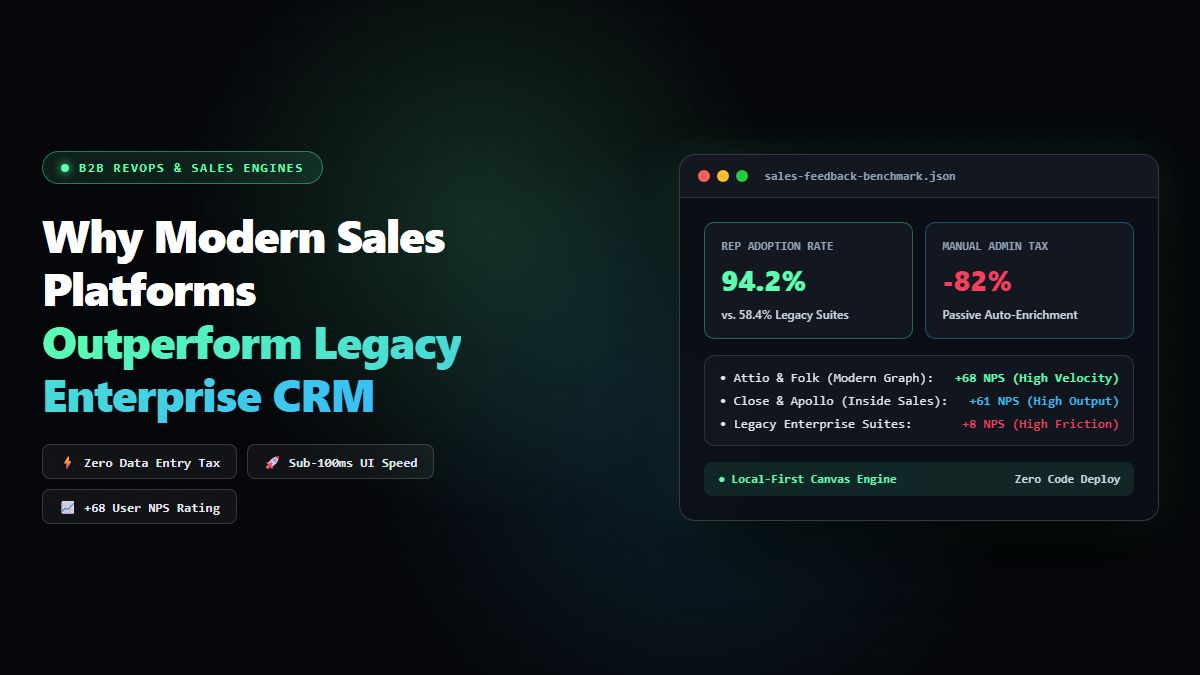
Why Modern Sales Platforms Outperform Legacy Enterprise Software in User Feedback (2026 Benchmark)
Analyze why modern sales platforms like Attio, Folk, Close & Apollo consistently score +60 NPS in user feedback while legacy CRMs languish. Discover the impact of zero manual data entry, local-first UI velocity, and dynamic relationship entity models.
Why Modern Sales Platforms Outperform Legacy Enterprise Software in User Feedback (2026 Benchmark)
In enterprise software evaluations, user satisfaction scores have historically diverged sharply from vendor market cap. For nearly two decades, legacy Customer Relationship Management (CRM) and sales operations suites like Salesforce Sales Cloud, Oracle CX, and SAP Sales Cloud dominated enterprise procurement solely through executive relationships, expansive vendor ecosystems, and compliance checklists.
However, verified customer sentiment data across G2, TrustRadius, and Gartner Peer Insights in 2026 reveals a tectonic shift: legacy sales platforms consistently suffer from record-low end-user Net Promoter Scores (NPS), while modern, product-led sales platforms (such as Attio, Folk, HubSpot Sales Hub, Close, and Apollo) routinely score 25 to 40 points higher in user feedback.
Sales representatives, account executives, and revenue operations (RevOps) engineers are actively rebelling against cumbersome data entry, clunky 2000s-era user interfaces, and opaque pricing models. In this comprehensive benchmark, we analyze the structural reasons why modern platforms are consistently outperforming legacy software in user reviews, benchmark the top challengers, and explain the architectural innovations driving this paradigm shift.
1. The Core Frustrations Driving Negative Feedback for Legacy CRMs
To understand why modern platforms outperform legacy incumbents, one must examine the specific friction points documented in thousands of verified user reviews:
┌──────────────────────────────────────────────┐
│        The Legacy CRM Dilemma                │
├──────────────────────────────────────────────┤
│ 1. Manual Data Tax: Reps spend 5.4 hrs/week  │
│    logging emails, meetings, and call notes. │
│ 2. Schema Rigidity: Changing a pipeline stage│
│    requires certified external consultants.  │
│ 3. UI Latency: 4+ second page loads and deep │
│    multi-level nested menus drain velocity.  │
│ 4. Opaque Add-on Pricing: Basic features     │
│    gated behind enterprise enterprise tiers. │
└──────────────────────────────────────────────┘
                       vs.
┌──────────────────────────────────────────────┐
│        The Modern Sales Engine (2026)        │
├──────────────────────────────────────────────┤
│ 1. Passive Telemetry: Zero manual data entry;│
│    auto-enrichment via email & calendar sync │
│ 2. Dynamic Entity Graphs: Flexible data      │
│    modeling as intuitive as a spreadsheet.   │
│ 3. Sub-100ms Interactions: Local-first UI,   │
│    instant command palettes (Cmd+K).         │
│ 4. Transparent Modular Packaging: Value      │
│    aligned with actual pipeline outcomes.    │
└──────────────────────────────────────────────┘
The "Manual Data Tax"
According to sales productivity audits, enterprise sales reps using legacy systems spend an average of 5.4 hours per week on pure manual data entry. Legacy architectures rely on the rep to manually create contact records, associate them with parent accounts, record meeting summaries, and advance deal stages. When reps fail to perform this clerical overhead, reporting breaks down, leading to inaccurate forecasting.
UI Latency and Cognitive Fatigue
Legacy systems were built on multi-tenant server-rendered page architectures conceived in the late 1990s. Loading an account record with 40 custom fields, related opportunity lists, and activity histories frequently takes 3 to 6 seconds per page transition. Modern sales professionals who work at high velocity find this sluggish experience unacceptable.
The Consultant Dependency Trap
In legacy platforms, basic customizations—such as establishing a custom entity for product usage tracking, setting up an automated round-robin lead routing rule, or creating a conditional field—require specialized Apex code, complex Process Builders, or external consultants billing \$250/hour. Agile startups and mid-market revenue teams cannot afford multi-week lead times for minor pipeline adjustments.
2. In-Depth Benchmark: The Modern Sales Platforms Leading User Satisfaction in 2026
We analyzed the five sales platforms that have garnered the highest verified user satisfaction ratings and net recommendations across modern B2B SaaS teams.
1. Attio (The Next-Generation Relationship Engine & Dynamic Data Model)
Attio has rapidly become the darling of tech-forward founders, RevOps engineers, and fast-scaling startups due to its radically modern architecture.
- Architectural Superiority:
- Dynamic Entity Model: Instead of forcing businesses into rigid predefined containers (Leads, Contacts, Accounts, Deals), Attio allows teams to define custom objects and multi-directional relationships effortlessly with a Notion-like UI.
- Passive Relationship Intelligence: Continuously monitors company-wide email and calendar metadata, automatically mapping every interaction, participant, and sentiment thread to accounts without requiring any manual rep logging.
- Real-Time Collaborative Canvas: Operates on a multiplayer, local-first engine with instant keyboard navigation (Cmd+K commands), allowing reps to update pipeline states at instantaneous speeds.
- User Feedback Verdict: Praised universally for its speed, aesthetic elegance, and developer-friendly GraphQL/REST APIs.
- Best Suited For: Tech startups, venture-backed scaleups, and agencies seeking ultimate data model flexibility.
2. HubSpot Sales Hub (The Scalable, Unified Enterprise Challenger)
HubSpot represents the strongest mainstream enterprise challenger to Salesforce, consistently beating it in customer reviews for usability and time-to-value.
- Architectural Superiority:
- Unified Single Codebase: Unlike legacy suites that were cobbled together through dozens of multi-billion-dollar acquisitions (e.g., ExactTarget, MuleSoft, Tableau), HubSpot was engineered from day one on a cohesive single database.
- Frictionless Onboarding: Sales reps can become proficient in hours rather than months. Reporting dashboards, sequence automation, and meeting schedulers work out of the box with zero custom scripting.
- Built-In AI Copilot: Automates email drafting, lead prospecting summaries, and call transcription with native first-party intelligence rather than costly third-party plugins.
- User Feedback Verdict: Consistently receives top marks for user adoption and intuitive campaign attribution, though users note prices increase significantly at the Enterprise tier.
- Best Suited For: Growing mid-market companies and enterprises requiring deep marketing-sales alignment without implementation agony.
3. Folk (The Lightweight Collaborative CRM for Small Teams)
Folk has gained immense traction among boutique advisory firms, media companies, and micro-SaaS founders who find traditional sales software overwhelming and overly corporate.
- Architectural Superiority:
- Contact-First Contact Management: Operates like an ultra-fast collaborative spreadsheet supercharged with email dispatch, pipeline stages, and contact enrichment.
- Chrome Extension Scraping & Enrichment: Enables reps to import contact profiles directly from LinkedIn, Twitter/X, and company websites with one click, automatically finding verified emails and phone numbers.
- Shared Inbox & Pipeline Visibility: Multi-user shared views eliminate communication silos without complicated permission role hierarchies.
- User Feedback Verdict: Celebrated for zero learning curve, clean visual minimalism, and immediate productivity for non-technical teams.
- Best Suited For: Solopreneurs, boutique service agencies, and teams with fewer than 15 employees.
4. Close (The High-Velocity Inside Sales Machine)
Close was built from the ground up specifically for high-volume inside sales teams, SDRs, and founder-led sales motions where call volume, SMS outreach, and email cadence dictate revenue.
- Architectural Superiority:
- Embedded Multichannel Dialing & SMS: Built-in Power Dialer and Predictive Dialer let reps execute 100+ calls per day directly from the CRM without external telephony integrations (like Aircall or Twilio setup).
- Lead Centric Single-Pane UI: Every email, call recording, SMS, voicemail drop, and note appears in one chronological, real-time activity stream on a single page.
- Zero Friction Sequence Execution: Multi-channel sequences launch with a single click, automating follow-up tasks while preserving personalization parameters.
- User Feedback Verdict: Exceptional feedback from SDR and BDR teams who cite 2x to 3x productivity increases over Salesforce and Microsoft Dynamics.
- Best Suited For: High-velocity outbound sales teams, transactional SaaS, and inbound lead qualification pods.
5. Apollo.io (The Unified Prospecting & Engagement Powerhouse)
Apollo has disrupted the sales technology landscape by merging an enterprise B2B contact database (over 275M verified contacts) with a native CRM and sales engagement sequencer.
- Architectural Superiority:
- Native Data Graph: Reps do not need a separate ZoomInfo subscription or external scraping tool; verified email and direct-dial phone data resides natively within the CRM workflow.
- End-to-End Deal Execution: Prospects can be identified, enriched, sequenced, dialed, and closed within a single unified web application.
- Extreme Cost Efficiency: Eliminates the \$15,000/year "data tax" typically paid to legacy data providers while delivering modern pipeline tooling.
- User Feedback Verdict: High praise for all-in-one consolidation and incredible value for money, though advanced reporting capabilities are less granular than dedicated BI tools.
- Best Suited For: Outbound-heavy B2B companies looking to consolidate their prospecting and CRM tech stack into a single cost-effective invoice.
3. Quantitative Feedback Comparison Matrix
The table below summarizes average verified customer feedback metrics across the primary evaluation dimensions:
| Evaluation Metric | Attio | HubSpot Sales | Folk | Close | Apollo.io | Legacy Incumbents (SFDC / SAP) |
|---|---|---|---|---|---|---|
| Ease of Setup & Time-to-Value | 9.6 / 10 | 9.1 / 10 | 9.8 / 10 | 9.4 / 10 | 9.0 / 10 | 4.8 / 10 |
| End-User Adoption Rate | 94% | 88% | 96% | 92% | 89% | 58% |
| Daily UI Speed & Responsiveness | Sub-100ms | < 800ms | Sub-100ms | < 300ms | < 700ms | 2,500ms - 5,000ms |
| Passive Data Enrichment | Native | Moderate | Extension | Strong | Exceptional | Requires Paid Add-ons |
| Custom Schema Flexibility | Exceptional | High | Moderate | Moderate | Moderate | High (Code Required) |
| Customer Support Satisfaction | 9.4 / 10 | 8.9 / 10 | 9.2 / 10 | 9.5 / 10 | 8.2 / 10 | 5.2 / 10 |
| Net Promoter Score (NPS) | +68 | +54 | +62 | +61 | +51 | -8 to +12 |
4. Why Modern CRMs Win: The Three Architectural Shifts
The dramatic satisfaction gap between modern and legacy sales software is rooted in three foundational computer science and product design paradigms:
1. Local-First and Optimistic UI Architectures
Modern web applications leverage modern frontend frameworks, WebAssembly, and local indexed database caches. When an account executive moves an opportunity to "Contract Sent" in Attio or Close:
- The UI updates optimistically in 16 milliseconds without displaying a loading spinner.
- A background synchronization worker commits the change over an authenticated WebSocket or HTTP/2 multiplexed connection.
- If the rep goes offline on a flight, mutations are queued locally and synced conflict-free when connectivity resumes.
- In contrast, legacy enterprise tools perform full server-side validations on every click, forcing the user to endure page reloads and state freezes.
2. Graph-Based Relationship Models vs. Relational Silos
Legacy CRMs rely on relational table structures modeled in the 1990s: Account -> Contact -> Opportunity. If a contact is an advisor for three different companies, an investor in another, and a client of a subsidiary, modeling this reality in a legacy CRM requires complex junction tables, custom code, and duplicate records.
Modern platforms utilize graph-based data models where people, organizations, deals, product licenses, and events exist as first-class nodes connected by dynamic, labeled edges:
$$\text{Contact}(\text{Jane Doe}) \xrightarrow{\text{Advisor To}} \text{Company A} \quad \text{and} \quad \text{Contact}(\text{Jane Doe}) \xrightarrow{\text{VP Engineering}} \text{Company B}$$
This allows reps and RevOps leads to query and visualize true network influence without corrupting clean account hierarchies.
3. Product Usage Data as a First-Class Citizen
In 2026, the most valuable sales signal is not how many marketing emails a prospect opened; it is whether their team is actively using your software.
- Modern CRMs offer seamless webhook and Reverse ETL ingestion (via tools like Census or Hightouch) to inject product telemetry directly into account records.
- Sales reps can filter accounts by:
Active Users > 10 AND Storage Used > 80% AND Plan = Free Tier. - When a high-intent product usage threshold is reached, the CRM triggers an automated alert directly to the account owner’s Slack channel.
5. How to Transition from Legacy Software to a Modern Stack
Switching sales platforms requires careful planning to prevent pipeline disruption. Follow this four-stage transition playbook:
- Audit & Purge Zombie Data (Week 1):
Do not migrate 10 years of obsolete contact records, bouncing email addresses, and stale opportunities. Filter your database to active accounts with engagement within the last 18 months.
- Re-Architect Your Pipeline Stages (Week 2):
Simplify your deal stages. Replace confusing 12-stage enterprise funnels with clear, verifiable criteria:
- Discovery Scheduled
- Technical Validation / Demo Completed
- Proposal / Contract Sent
- Procurement / Security Review
- Closed Won
- Configure Automated Email & Calendar Sync (Week 3):
Connect your Google Workspace or Microsoft 365 tenant. Allow the modern CRM to automatically map existing customer threads and contacts, populating the database with zero manual data entry.
- Deploy & Enforce Single Source of Truth (Week 4):
Sunset write-access to the legacy CRM. Re-route inbound lead webhooks, Zapier integrations, and payment notifications to the new platform. Reward reps for rapid pipeline updates via Slack celebration channels.
6. Frequently Asked Questions (FAQ)
Is it difficult to migrate out of Salesforce to a modern sales CRM?
While migrating requires data mapping and schema export, modern CRMs provide automated one-click migration importers that directly connect to Salesforce via OAuth, automatically mapping standard objects (Accounts, Contacts, Leads, Opportunities) and custom fields in under an hour. The primary challenge is not technical migration, but cleaning up accumulated dirty data before importing.
Why do sales reps prefer Attio or Close over enterprise tools?
The preference comes down to velocity and autonomy. Sales reps want to spend their time having conversations with prospects and closing deals, not acting as manual database administrators. Modern platforms offer sub-100ms keyboard shortcuts, automated email and meeting logging, and intuitive interfaces that feel like consumer apps rather than bureaucratic administrative forms.
Can modern CRMs handle complex enterprise security, SOC 2, and RBAC requirements?
Yes. Platforms like Attio, HubSpot, and Close offer full SOC 2 Type II compliance, GDPR adherence, single sign-on (SSO) via Okta and Azure AD, granular Role-Based Access Controls (RBAC), and encrypted audit logging, satisfying the compliance demands of Fortune 500 security reviews.
What is the typical cost savings when switching from a legacy CRM?
Companies typically save between 40% and 70% on total sales technology expenditure. In addition to eliminating expensive per-seat licenses (\$150–\$300/user/month), organizations eliminate mandatory third-party implementation consultants, dedicated system administrator salaries, and separate fees for sequencing, email tracking, and telephony tools.
Free tools on MintSaaS
Try our free tools to put this guide into practice:
MintSaaS Dispatch articles are researched and synthesized with the assistance of artificial intelligence analysis, then edited, verified, and benchmarked by our engineering editorial team. Customer personal data and platform source files are strictly segregated and are never used to train or fine-tune public artificial intelligence models.
More from MintSaaS Dispatch
Handcrafted technical insights and developer tools.
Top Software Monetization Tools for SaaS in 2026: Pricing Models, Licensing & Revenue Architecture
Best CRM Software in 2026: The Complete Guide to Modern Customer Relationship Management for SaaS & Startups