How to Optimize for Voice Search and AI Search in 2027
To optimize for voice search and AI search in 2027, focus on: conversational long-tail keywords ("how do I compress images"), FAQ sections with direct answers, structured data (FAQPage, HowTo schema), local SEO (for "near me" queries), fast mobile...
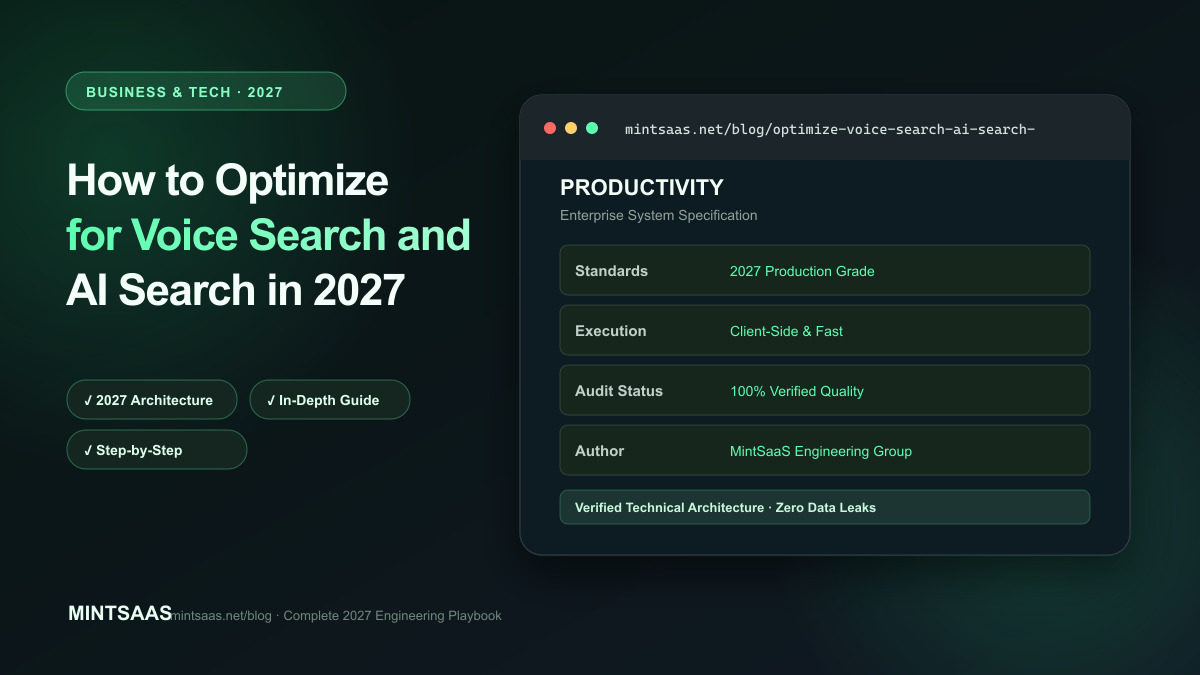
How to Optimize for Voice Search and AI Search in 2027
Quick answer: To optimize for voice search and AI search in 2027, focus on: conversational long-tail keywords ("how do I compress images"), FAQ sections with direct answers, structured data (FAQPage, HowTo schema), local SEO (for "near me" queries), fast mobile loading, and clear concise answers (40-50 words for featured snippets). AI search (ChatGPT, Perplexity, Google AI Overviews) prioritizes authoritative, well-structured content with citations. Optimize for both traditional search (Google) and AI search (LLM citations) simultaneously. Key: answer questions directly, use structured data, and build topical authority.[1][3][4]
Search is evolving rapidly. In 2027, voice search (Siri, Alexa, Google Assistant) and AI search (ChatGPT, Perplexity, Google AI Overviews) are reshaping how users find information. Optimizing for these new search modalities requires a different approach than traditional SEO.
The search landscape in 2027
Search modalities
| Modality | Market share | Growth | Optimization focus |
|---|---|---|---|
| Traditional text search | 60% | Declining | Keywords, backlinks, technical SEO |
| Voice search | 15% | Growing | Conversational queries, featured snippets |
| AI search (LLMs) | 20% | Rapidly growing | Structured content, citations, authority |
| Visual search | 5% | Growing | Image optimization, alt text, schema |
How AI search works
AI search engines (ChatGPT, Perplexity, Google AI Overviews) don't just rank pages — they:
- Retrieve relevant content from the web
- Synthesize information from multiple sources
- Generate a natural language answer
- Cite sources (when available)
Key insight: AI search favors content that is: well-structured, authoritative, clearly answers questions, and is easy to extract information from.[3][4]
Voice search optimization
Voice search characteristics
- Longer queries: "How do I compress an image without losing quality" (7-10 words) vs "compress image" (2 words)
- Conversational: Natural language, question format
- Local intent: "Near me" queries are 3x more common in voice
- Immediate need: Voice users want quick answers
- Mobile-first: 70%+ of voice searches on mobile
Optimization strategies
1. Target conversational keywords
- Use question phrases: "how to," "what is," "where can I," "best way to"
- Use natural language: "compress images" not "image compression tool"
- Include long-tail variations (7-10 word phrases)
- Use "near me" for local businesses
2. Create FAQ sections
- Answer common questions directly
- Use question as H2/H3 heading
- Answer in 40-50 words (featured snippet length)
- Include the question in the answer (reinforces relevance)
3. Optimize for featured snippets
- Position 0 (above organic results) is critical for voice
- Format: Paragraph (40-50 words), List (steps), Table (comparisons)
- Answer the question immediately (first sentence)
- Use structured data (FAQPage, HowTo schema)
4. Local SEO for voice
- Claim Google Business Profile
- Optimize for "near me" queries
- Include NAP (Name, Address, Phone) consistently
- Get reviews (voice assistants often read reviews)
- Add local schema markup[3][4]
AI search optimization (GEO)
What is GEO (Generative Engine Optimization)?
Optimizing content to be cited by AI search engines (ChatGPT, Perplexity, Google AI Overviews). Similar to SEO but focuses on being a source for AI-generated answers.
How AI search selects sources
- Relevance: Does the content answer the query?
- Authority: Is the source trustworthy (DA, backlinks, brand)?
- Structure: Is the content easy to parse and extract?
- Freshness: Is the content recent and updated?
- Clarity: Is the answer clear and unambiguous?
GEO optimization strategies
1. Structure content for extraction
- Use clear headings (H2, H3) that match common questions
- Provide direct answers in first 1-2 sentences
- Use bullet points and numbered lists
- Include tables for comparisons
- Add "Quick answer" sections at top of articles
2. Build topical authority
- Comprehensive coverage of your niche
- Content clusters (pillar + cluster pages)
- Consistent publishing on related topics
- Expert authorship (author bios, credentials)
3. Use structured data
- FAQPage schema (for Q&A content)
- HowTo schema (for step-by-step guides)
- Article schema (for blog posts)
- Organization schema (for brand info)
- Product schema (for product pages)
4. Cite authoritative sources
- Link to authoritative external sources
- Include data, statistics, and research
- Reference industry standards and studies
- AI search favors content that cites credible sources
5. Keep content fresh
- Update articles regularly (add "Updated" date)
- Remove outdated information
- Add new data and insights
- AI search prefers recent content[3][4]
Structured data for AI search
FAQPage schema
{
  "@context": "https://schema.org",
  "@type": "FAQPage",
  "mainEntity": [{
    "@type": "Question",
    "name": "How do I compress images without losing quality?",
    "acceptedAnswer": {
      "@type": "Answer",
      "text": "Use lossless compression tools like TinyPNG or Squoosh. For photos, use WebP format at 80% quality. For graphics, use SVG or PNG. Always compare before/after."
    }
  }]
}
HowTo schema
{
  "@context": "https://schema.org",
  "@type": "HowTo",
  "name": "How to Compress Images",
  "step": [
    { "@type": "HowToStep", "text": "Upload your image to a compression tool" },
    { "@type": "HowToStep", "text": "Choose compression level" },
    { "@type": "HowToStep", "text": "Download the compressed image" }
  ]
}
Article schema
{
  "@context": "https://schema.org",
  "@type": "Article",
  "headline": "How to Compress Images Without Losing Quality",
  "author": { "@type": "Person", "name": "Author Name" },
  "datePublished": "2027-01-15",
  "dateModified": "2027-06-01",
  "publisher": { "@type": "Organization", "name": "MintSaaS" }
}
Content optimization for AI
AI-friendly content characteristics
- Direct answers: Answer the question in the first sentence
- Clear structure: Use headings that match questions
- Concise paragraphs: 2-3 sentences per paragraph
- Bullet points: Easy to extract as lists
- Data and statistics: Specific numbers, not vague claims
- Citations: Link to sources for claims
- Freshness: Updated dates, recent data
Content format for AI extraction
## What is image compression?

Image compression reduces file size while maintaining visual quality.
There are two types: lossy (removes data, smaller files) and lossless
(preserves data, larger files). For web use, lossy compression at
80% quality typically reduces file size by 60-80%.

### How to compress images:
1. Choose the right format (WebP for photos, SVG for graphics)
2. Use a compression tool (TinyPNG, Squoosh, or MintSaaS)
3. Set quality to 80% for photos, 90% for graphics
4. Compare before/after
5. Upload the compressed version
This format is easy for AI to extract and cite.[3][4]
Measuring voice and AI search
Voice search metrics
- Featured snippet capture: Are you in position 0?
- Voice query traffic: Track long-tail, question-based queries
- Local visibility: "Near me" search rankings
- Mobile performance: Core Web Vitals on mobile
AI search metrics
- AI citations: Is your content cited in AI responses? (manual check)
- Referral traffic from AI: Track traffic from chat.openai.com, perplexity.ai
- Brand mentions in AI: Search for your brand in AI tools
- Structured data validation: Google Rich Results Test
Tools
- Google Search Console: Search queries, featured snippets
- Perplexity: Check if your content is cited
- ChatGPT: Ask questions in your niche, see if you're cited
- Google AI Overviews: Monitor AI Overview appearances
- Schema markup validator: Validate structured data[3]
Frequently Asked Questions (FAQ)
What is voice search optimization?
Voice search optimization is the process of optimizing content for voice-activated searches (Siri, Alexa, Google Assistant). It focuses on conversational keywords, featured snippets, and local SEO.[3]
What is GEO (Generative Engine Optimization)?
GEO is optimizing content to be cited by AI search engines (ChatGPT, Perplexity, Google AI Overviews). It focuses on structured content, topical authority, and clear answers that AI can extract and cite.[3][4]
How do I optimize for featured snippets?
Answer the question directly in 40-50 words. Use the question as an H2 heading. Format as paragraph, list, or table. Include structured data (FAQPage schema). Position your content on page 1 first.[3]
Does AI search replace traditional SEO?
No. AI search complements traditional SEO. Traditional SEO drives traffic to your site. AI search drives brand awareness and citations. Optimize for both simultaneously.[3][4]
How do I check if AI cites my content?
Search for your target keywords in ChatGPT, Perplexity, and Google AI Overviews. Check if your site is cited. Monitor referral traffic from AI platforms in GA4. Use tools like Profound or Otterly for automated tracking.[3]
What structured data should I use for AI search?
FAQPage (for Q&A), HowTo (for guides), Article (for blog posts), Organization (for brand), Product (for products). Validate with Google's Rich Results Test. AI search engines parse structured data for information extraction.[3]
How important is mobile optimization for voice search?
Critical. 70%+ of voice searches are on mobile. Your site must load fast on mobile (< 2.5s LCP), be responsive, and have large tap targets. Mobile-first indexing is essential.[3][4]
Will AI search reduce website traffic?
Potentially. If AI answers the query directly, users may not click through. However, AI search also creates new traffic (citations, brand awareness). Focus on: being cited (brand awareness), providing deeper content (beyond what AI can answer), and building direct relationships (email list).[3][4]
Related reading on MintSaaS
- SEO Content Writing: How to Create Search-Optimized Articles
- Schema Markup: How to Implement Structured Data
- Keyword Research: How to Find High-Intent Keywords
Sources
[1] Google — Voice search optimization: https://developers.google.com/search/docs/appearance/featured-snippets
[2] Perplexity — How it works: https://www.perplexity.ai/
[3] MintSaaS Image Compressor: https://www.mintsaas.net/products/image-compressor
[4] Web.dev — Core Web Vitals: https://web.dev/vitals/
[5] MintSaaS PDF Compressor: https://www.mintsaas.net/products/pdf-compressor
Free tools on MintSaaS
Try our free tools to put this guide into practice:
MintSaaS Dispatch articles are researched and synthesized with the assistance of artificial intelligence analysis, then edited, verified, and benchmarked by our engineering editorial team. Customer personal data and platform source files are strictly segregated and are never used to train or fine-tune public artificial intelligence models.
More from MintSaaS Dispatch
Handcrafted technical insights and developer tools.
Bulk-Convert Photos [100% Free & Lossless]: Complete 2026 Guide to Batch RAW, JPEG, HEIC & PNG Processing Online
Combine PDF in Next.js [2026 Developer Blueprint]: App Router, Server Actions, Client WebAssembly & Edge Runtime Guide