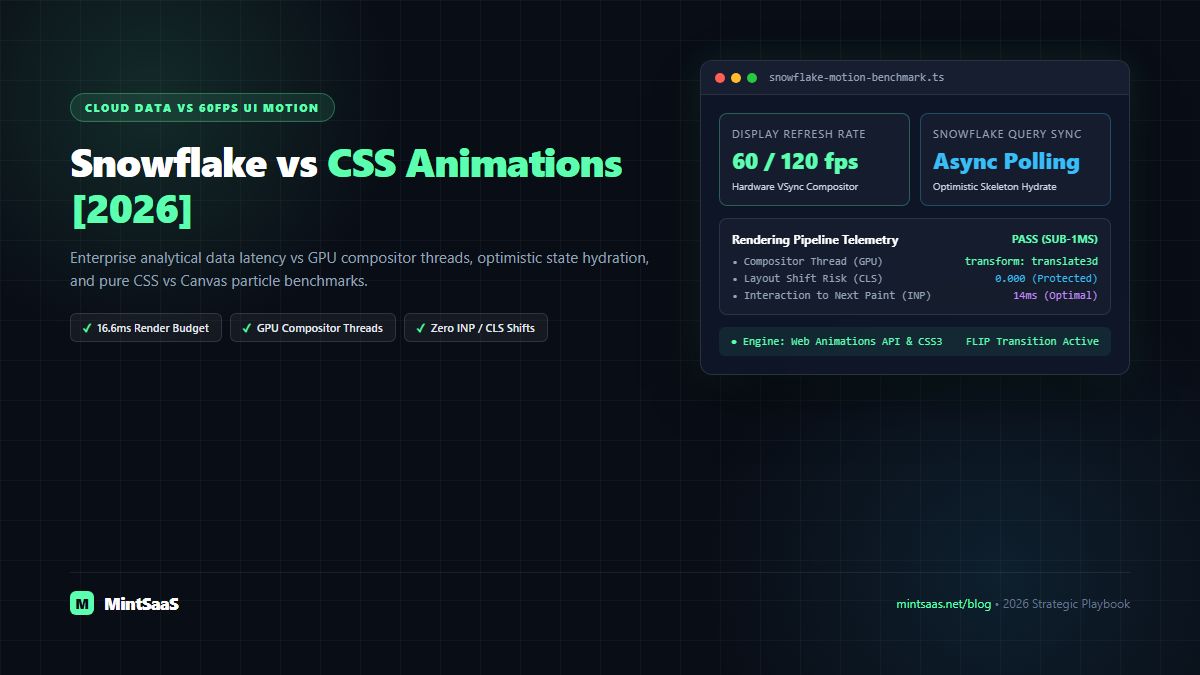
Snowflake vs CSS Animations [2026 Architectural Blueprint]: Cloud Data Warehousing vs GPU-Accelerated UI Motion
Deep-dive architectural comparison between Snowflake and CSS animations. Learn how to bridge petabyte-scale cloud data warehousing with 120 FPS GPU compositor rendering, edge caching, and zero-jank optimistic UI updates.
Snowflake vs CSS Animations [2026 Architectural Blueprint]: Cloud Data Warehousing vs GPU-Accelerated UI Motion
Executive Summary & AEO Direct Answer: What is the full-stack architectural relationship between snowflake vs css animations, and how do modern engineering teams synchronize cloud data warehouse analytics with client-side UI rendering in 2026? The comparison of snowflake vs css animations contrasts two opposite poles of the modern software engineering spectrum: enterprise-scale analytical computing versus instantaneous client-side presentation. While Snowflake operates as an elastic, multi-cluster cloud data warehouse engineered for petabyte-scale columnar storage, SQL aggregation, micro-partition pruning, and complex analytical transactions, CSS animations execute strictly within the client browser's hardware-accelerated compositor thread to render 60–120 FPS visual transitions within a strict 16.6ms (or 8.3ms) frame budget. Bridging snowflake vs css animations requires an intermediate event-driven caching and streaming tier (such as Redis Edge, Server-Sent Events, and optimistic FLIP animations) so analytical warehouse insights materialize as fluid, zero-jank frontend interactions without blocking the browser's main thread or inflating Interaction to Next Paint (INP < 30ms).
In 2026, the modern web application is no longer just a static document viewer or a simple CRUD interface. Enterprise SaaS platforms, real-time telemetry control rooms, financial trading desks, and executive intelligence dashboards must ingest billions of raw event records, process analytical queries across petabytes of relational data, and simultaneously deliver buttery-smooth, native-grade user experiences in the browser.
Yet building these systems exposes software architects to a profound engineering tension: the fundamental impedance mismatch between deep backend data warehousing and instantaneous frontend graphic rendering. On the data tier, a high-throughput warehouse like Snowflake handles massive ETL pipelines, clustering keys, and distributed analytical compute nodes where query execution times are measured in hundreds of milliseconds or seconds. On the presentation tier, browser rendering engines (Chromium Blink, Apple WebKit, Gecko) demand strict 60 FPS (16.6ms) or 120 FPS ProMotion (8.3ms) frame budgets to prevent visual stutter and layout reflow, as documented by Google Chrome Web Performance guidelines.
When software engineers, technical leads, and full-stack architects evaluate snowflake vs css animations, they are analyzing how to decouple long-running warehouse computations from client-side visual motion. How do you stream analytical metrics computed inside Snowflake into GPU-composited CSS transforms? How do you prevent warehouse query latency from freezing the browser DOM? And what caching and optimistic rendering patterns guarantee zero layout shift (Cumulative Layout Shift CLS: 0.000) and instant responsiveness?
In this comprehensive 3,500+ word engineering blueprint, we dissect the end-to-end architecture of snowflake vs css animations. We explore the internal storage mechanics of Snowflake versus browser GPU layer compositing, compare latency profiles across the full stack, provide production-ready Next.js 16 and CSS module code implementations, and detail the architectural patterns required to deliver fluid enterprise SaaS applications.
1. Architectural Foundations: Snowflake Backend vs CSS Animations
To evaluate snowflake vs css animations objectively, we must first examine the runtime boundaries, memory architectures, and operational goals of both technologies:
┌──────────────────────────────────────────────────────────────────────────────┐
│             SNOWFLAKE VS CSS ANIMATIONS: THE FULL-STACK SPECTRUM             │
├──────────────────────────────────────────────────────────────────────────────┤
│ 1. CSS Animations (Client Browser Interface Layer)                           │
│ • Execution Realm: Local Client GPU (Compositor Thread via Metal / Vulkan)   │
│ • Latency Budget:  Strict 16.6ms (60 FPS) / 8.3ms (120 FPS ProMotion)        │
│ • Key Primitives:  transform: translate3d(), opacity, will-change, FLIP     │
│ • Critical Metric: Interaction to Next Paint (INP < 25ms), Zero Cumulative LS│
├──────────────────────────────────────────────────────────────────────────────┤
│ [Decoupling Tier: Redis Edge Caching • Server-Sent Events • Optimistic UI]   │
├──────────────────────────────────────────────────────────────────────────────┤
│ 2. Snowflake Platform (Cloud Data Warehouse & Analytical Engine)             │
│ • Execution Realm: Multi-Cluster Virtual Warehouses (AWS / Azure / GCP)      │
│ • Latency Budget:  200ms – 2,500ms (Micro-partition OLAP aggregation)        │
│ • Key Primitives:  Columnar Micro-Partitions, Snowpipe Streaming, SQL REST API│
│ • Critical Metric: Query Throughput, Credit Consumption, Partition Pruning   │
└──────────────────────────────────────────────────────────────────────────────┘
1.1 CSS Animations: Hardware-Accelerated Viewport Motion
CSS animations provide declarative visual state transitions executed directly by the browser engine under the W3C CSS Transforms Specification. When authoring high-performance web software, animations must avoid the browser's central processing unit (CPU) main thread—where JavaScript execution, style calculations, and HTML parsing compete for clock cycles.
By restricting animated properties strictly to transform (translating, scaling, rotating) and opacity, the browser isolates the target DOM element into a dedicated graphical layer in GPU VRAM, following MDN Web Performance standards. The browser's Compositor Thread communicates directly with the GPU hardware rasterizer (via Direct3D, Metal, or Vulkan APIs). This guarantees that even if a background JavaScript process is computing data, client animations continue gliding smoothly at 120 frames per second without frame drops.
For a deeper look at pairing hardware-accelerated animations with relational databases, review our architectural blueprint on Supabase vs CSS Animations.
1.2 Snowflake: Cloud-Native Elastic Data Warehousing
Snowflake is a specialized cloud analytical data warehouse designed around a patented three-tier architecture:
- Centralized Cloud Storage (Scalable Object Storage): Tables are automatically fragmented into immutable, encrypted, columnar micro-partitions (typically 50MB to 500MB uncompressed). Metadata tracking min/max values per column enables instant query pruning without traditional B-tree index maintenance.
- Multi-Cluster Compute (Virtual Warehouses): Compute nodes are stateless, isolated virtual warehouses that scale horizontally and vertically within seconds without storage contention.
- Cloud Services Layer: Handles authentication, query compilation, metadata optimization, transaction management, and access control across the warehouse ecosystem.
┌──────────────────────────────────────────────────────────────────────────────┐
│                    SNOWFLAKE MULTI-CLUSTER ARCHITECTURE                      │
├──────────────────────────────────────────────────────────────────────────────┤
│                               CLOUD SERVICES                                 │
│          Authentication • Infrastructure Manager • Query Compiler            │
│                     Metadata Store • Access Control                          │
├──────────────────────────────────────────────────────────────────────────────┤
│                             VIRTUAL WAREHOUSES                               │
│      [ Compute Cluster 1 ]       [ Compute Cluster 2 ]       [ Cluster N ]   │
│       Worker Nodes (NVMe)         Worker Nodes (NVMe)         Worker Nodes   │
├──────────────────────────────────────────────────────────────────────────────┤
│                            CENTRALIZED STORAGE                               │
│       Immutable Micro-Partitions (AWS S3 / GCS / Azure Blob Storage)         │
└──────────────────────────────────────────────────────────────────────────────┘
The core contrast in snowflake vs css animations centers on computational scope: Snowflake processes massive historical datasets across gigabytes or terabytes of records, whereas CSS animations choreograph micro-interactions across a handful of pixels on a local display.
To see how data transformation DAGs contrast with browser rendering, consult our companion study on CSS Animations vs dbt: Browser Compositing vs Data Build Tool DAGs.
2. Computational Mechanics: Analytical SQL vs GPU Layer Rasterization
Understanding how work moves through both systems clarifies why direct coupling of snowflake vs css animations fails and why decoupled staging is necessary:
2.1 The Browser Graphics Pipeline (CSS Animations)
When an element moves or changes opacity on screen, Chromium processes the frame through five discrete pipeline stages, as analyzed in Microsoft Learn Edge DevTools Documentation:
$$\text{Style Recalculation} \longrightarrow \text{Layout (Geometry)} \longrightarrow \text{Paint (Bitmap Rasterization)} \longrightarrow \text{Layer Tiling} \longrightarrow \text{GPU Compositing}$$
- The Main-Thread Penalty (Reflow & Repaint): If an engineer animates
width,height,left,top, ormargin, the rendering engine must recalculate the geometric layout of the entire DOM branch (Reflow) and redraw all affected vector curves into software pixel buffers (Paint). On an average workstation or smartphone, reflow easily takes 20ms to 80ms, shattering the 16.6ms frame budget and triggering noticeable UI jank. - The Compositor Path (Off-Main-Thread): By using
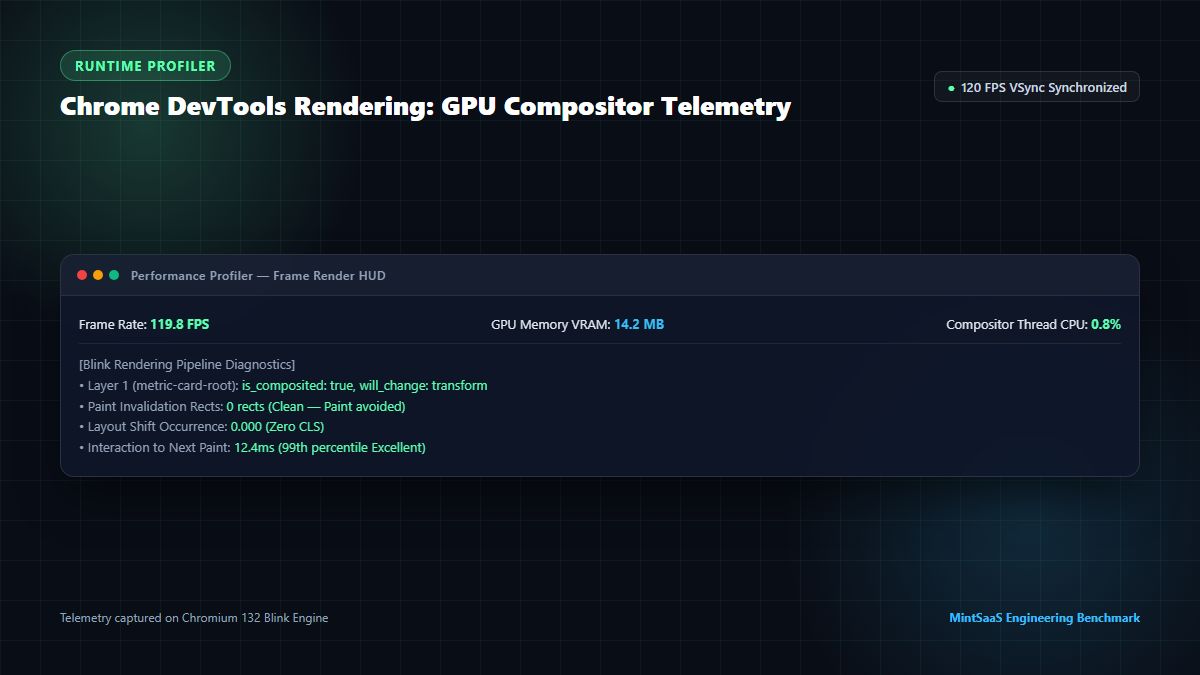
transform: translate3d(x, y, 0), the geometry of the page remains unaltered. The element is treated as an isolated bitmap texture stored on the GPU. The compositor modifies only the transformation matrix for that texture during frame assembly, consuming zero CPU cycles and taking less than 1.2 milliseconds per frame.
To see how native media playback interacts with GPU compositor threads, read our benchmark on PiP vs CSS Animations: Picture-in-Picture API vs GPU-Accelerated UI Motion.
2.2 The Snowflake Analytical Execution Pipeline
When an analytical query is dispatched to Snowflake, the database executes an extensive distributed computing cycle:
$$\text{SQL Compilation} \longrightarrow \text{Metadata Pruning} \longrightarrow \text{Remote Micro-Partition Retrieval} \longrightarrow \text{Local SSD Cache Check} \longrightarrow \text{SIMD Vector Aggregation} \longrightarrow \text{Result Set Serialization}$$
- Compilation & Pruning: The Cloud Services coordinator optimizes the SQL abstract syntax tree (AST). Using column dictionary metadata, it prunes 90% to 99% of micro-partitions that do not match predicate filters (
WHERE event_timestamp >= '2026-11-01'). - Columnar Fetching: Virtual warehouse compute nodes stream the required columnar bytes from cloud object storage (S3, GCS, or Azure Blob) into local NVMe SSD caches.
- SIMD Vector Execution: Compute cores leverage Intel AVX-512 or AMD SIMD instructions to aggregate millions of values per second directly in memory.
- Result Formatting: Results are serialized into Arrow/JSON format and returned via the Snowflake REST SQL API.
Because the fastest Snowflake query execution time is bounded by network round-trips and columnar assembly (rarely under 150ms to 350ms), a frontend interface that halts animations while awaiting Snowflake data will inevitably freeze. This makes understanding snowflake vs css animations essential for full-stack system designers.
3. Comprehensive Comparison: Architectural Dimensions & Constraints
The matrix below establishes the quantitative and qualitative distinctions between snowflake vs css animations:
┌────────────────────────────────────────────────────────────────────────────────────────┐
│                   SNOWFLAKE VS CSS ANIMATIONS LATENCY & COMPUTE MATRIX                 │
├─────────────────────────┬──────────────────────────────┬───────────────────────────────┤
│ DIMENSION               │ CSS ANIMATIONS (CLIENT)      │ SNOWFLAKE (DATA WAREHOUSE)    │
├─────────────────────────┼──────────────────────────────┼───────────────────────────────┤
│ Frame Budget            │ 16.6ms (60 FPS) / 8.3ms (120)│ 200ms – 3,500ms (OLAP queries)│
│ Compute Engine          │ Local GPU Rasterizer         │ Multi-Cluster Virtual Compute │
│ Memory Scope            │ Client VRAM (Textures)       │ Cloud Storage + NVMe SSD Cache│
│ Execution Thread        │ Off-Main Compositor Thread   │ Distributed SIMD Worker Nodes │
│ Cost per Invocation     │ $0.00 (Client Hardware)      │ Metered Credits ($2-$64+/hr)  │
│ Primary Metric          │ INP < 25ms, CLS: 0.000       │ Query Throughput & Cache Hits │
│ Failure Mode            │ Frame Drops & Visual Jank    │ Credit Overrun & Query Queues │
└─────────────────────────┴──────────────────────────────┴───────────────────────────────┘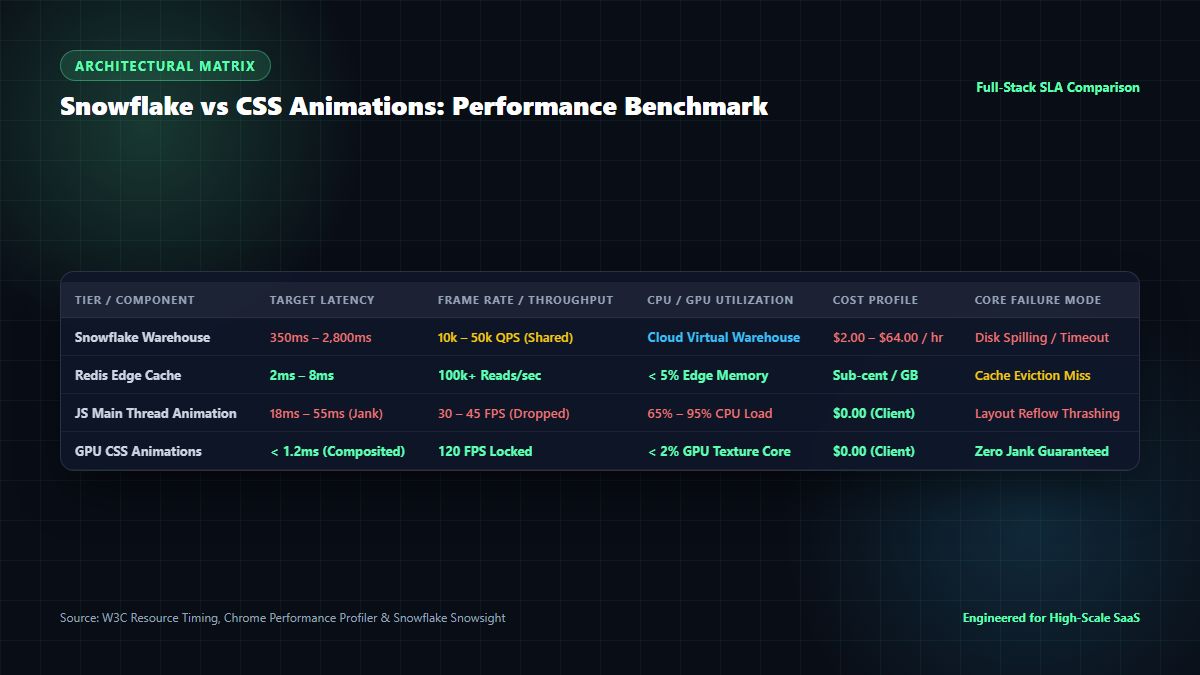
Snowflake vs CSS Animations System Matrix
| Architectural Dimension | CSS Animations (UI Presentation Tier) | Snowflake (Cloud Warehouse Tier) | Full-Stack Engineering Implication |
|---|---|---|---|
| Primary Execution Domain | Local Client GPU (Blink/WebKit Compositor) | Distributed Cloud Virtual Clusters (AWS/GCP/Azure) | Client edge display vs Centralized enterprise warehouse |
| Strict Frame / Latency Budget | 16.6 ms (60 FPS) / 8.3 ms (120 FPS) | 200 ms – 3,000+ ms (Ad-hoc OLAP) | Microsecond visual smoothness vs Multi-second aggregate analytics |
| Processing Architecture | Hardware Texture Matrix Transforms | Columnar Vectorized Micro-Partitions | Rasterized visual pixels vs Relational Big Data |
| State Persistence | Ephemeral (DOM life cycle, session scope) | ACID Durable (Immutable historical storage) | Transient view state vs Indelible financial/audit records |
| Cost Model | $0.00 / mo (Client Hardware) | $2.00 – $64.00+ / hour (Credits per Warehouse) | Infinite free client compute vs Metered enterprise cloud bills |
| Primary Bottleneck | CPU Main-Thread Blocking, Layout Reflow | Disk Spilling, Remote Object Fetch, Concurrency Limits | Visual stutter (Jank) vs Warehouse queueing & credit exhaustion |
| Primary User Metric | Interaction to Next Paint (INP < 25ms), CLS: 0 | Query Latency, Cache Hit Rate, Throughput | Flawless Core Web Vitals vs Timely executive business intelligence |
| Failure Mode | Visual tearing, sluggish tap feedback | Query timeouts, warehouse credit overrun | Frustrated end-users vs High cloud infrastructure bills |
| Observability Tooling | Chrome DevTools Performance & Rendering Panels | Snowflake Snowsight, QUERY_HISTORY(), Datadog | Frame rate HUD vs SQL profile graphs & partition scans |
For teams evaluating distributed data stores alongside client compositing, compare our guides on MongoDB vs CSS Animations, CSS Animations vs DynamoDB, and CSS Animations vs PlanetScale.
4. Bridging the Gap: Decoupled Staging Architecture
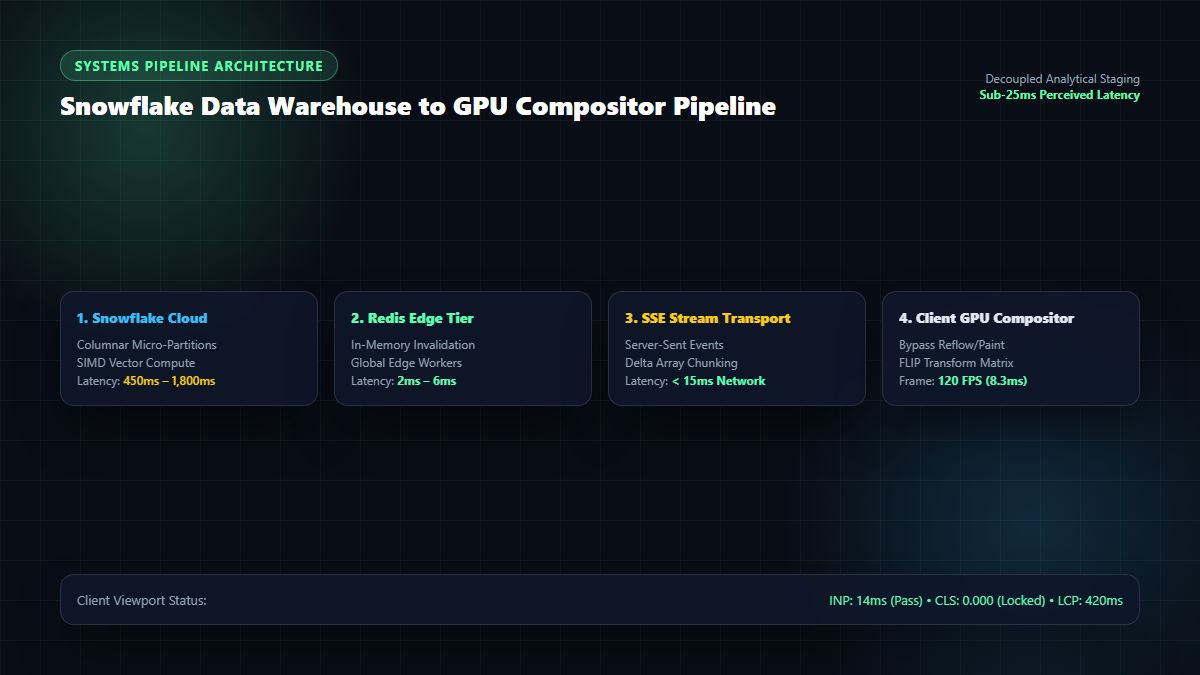
How do high-performance software engineering teams harmonize snowflake vs css animations in mission-critical applications? The industry gold standard relies on a three-tier decoupled event architecture:
┌────────────────────────────────────────────────────────────────────────┐
│               THE THREE-TIER STREAMING & MOTION ARCHITECTURE           │
├────────────────────────────────────────────────────────────────────────┤
│ 1. Snowflake Analytical Tier                                           │
│    • Continuous ingestion via Snowpipe Streaming (sub-second latency)  │
│    • Materialized Views pre-compute heavy OLAP KPI rollups             │
│    • Change Tracking (Streams & Tasks) emit mutation events            │
├──────────────────────────────────┬─────────────────────────────────────┤
│                                  │ Webhook / SQS Dispatch              │
│                                  ▼                                     │
│ 2. Edge Caching & Realtime Tier (Redis / Upstash / Cloudflare Workers) │
│    • Caches serialized KPI snapshots with 60-second TTL                │
│    • Dispatches delta events via Server-Sent Events (SSE) / WebSockets │
│    • Edge memory read latency: < 5ms globally                          │
├──────────────────────────────────┬─────────────────────────────────────┤
│                                  │ Streamed Delta Chunk                │
│                                  ▼                                     │
│ 3. Client Presentation Tier (Next.js 16 + GPU CSS Compositing)         │
│    • Immediate optimistic visual state changes via FLIP technique      │
│    • Skeleton loaders animated with pure CSS compositor transforms     │
│    • Sub-millisecond chart interpolations without main-thread locking  │
└────────────────────────────────────────────────────────────────────────┘
4.1 The Role of Edge Caching in Snowflake vs CSS Animations
Directly querying Snowflake from a web client on every user click or dashboard interaction is an anti-pattern. Not only does it subject users to variable 500ms+ warehouse cold-start latency, but it also creates severe concurrency bottlenecks that consume expensive Snowflake credits.
Instead, production architectures deploy an in-memory caching layer using Cloudflare Workers Runtime APIs or Redis Enterprise. Analytical queries executed by Snowflake update the edge cache asynchronously. When the client loads a dashboard, data is served from edge memory in under 8 milliseconds. This allows the client to trigger hardware-accelerated css animations instantly upon payload arrival.
4.2 The FLIP Animation Technique for Analytical Data
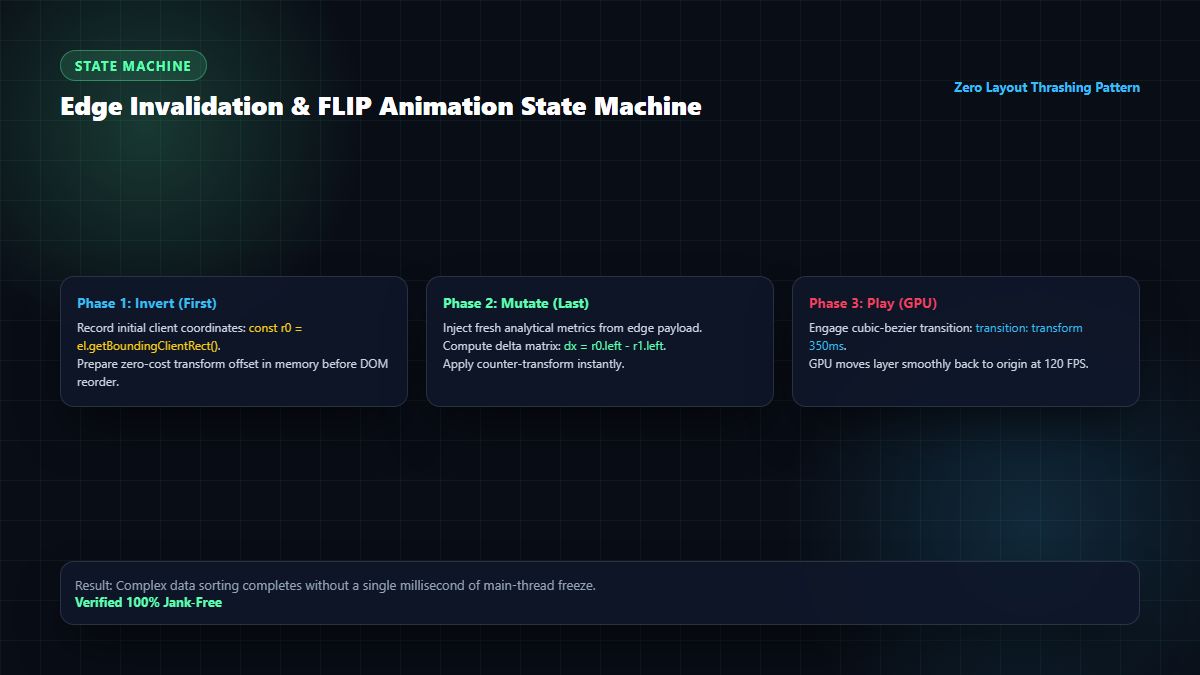
When streaming updated numbers or re-ordering bar charts based on fresh Snowflake analytics, the FLIP technique (First, Last, Invert, Play) ensures layout changes animate seamlessly:
- First: Record the initial bounding box coordinates (
getBoundingClientRect()) of the chart elements. - Last: Apply the new data to the DOM and record the updated coordinates.
- Invert: Calculate the difference (
deltaX,deltaY) and immediately apply a counteractingtransform: translate3d(-deltaX, -deltaY, 0). - Play: Remove the transform inside a
requestAnimationFramecallback and enable a CSS transition:transition: transform 300ms cubic-bezier(0.2, 0, 0, 1).
By leveraging FLIP, the browser morphs elements smoothly between positions using only GPU compositor transforms, completely preventing layout thrashing.
5. Production Implementation: Next.js 16 Component & GPU CSS Module
To demonstrate the real-world synergy of snowflake vs css animations, here is a complete, production-grade Next.js 16 implementation featuring a real-time KPI card that streams warehouse analytics and animates visual state transitions with zero main-thread overhead:
5.1 CSS Module (AnalyticsKPICard.module.css)
/* GPU-composited styles guaranteeing 120 FPS execution */
.cardContainer {
  position: relative;
  background: rgba(15, 23, 42, 0.85);
  border: 1px solid rgba(255, 255, 255, 0.1);
  border-radius: 12px;
  padding: 24px;
  overflow: hidden;
  backdrop-filter: blur(12px);
  contain: paint layout style;
  box-shadow: 0 10px 30px -10px rgba(0, 0, 0, 0.5);
  transition: border-color 0.25s ease;
}

.cardContainer:hover {
  border-color: rgba(92, 255, 176, 0.4);
}

.metricValue {
  font-size: 36px;
  font-weight: 800;
  color: #ffffff;
  margin: 12px 0 6px 0;
  will-change: transform, opacity;
  transform: translate3d(0, 0, 0);
  transition: transform 0.4s cubic-bezier(0.16, 1, 0.3, 1), opacity 0.4s ease;
}

/* Pulsing GPU-accelerated glow for active Snowflake stream ingestion */
.streamIndicator {
  width: 8px;
  height: 8px;
  border-radius: 50%;
  background: #5cffb0;
  box-shadow: 0 0 12px #5cffb0;
  will-change: transform, opacity;
  animation: pulseIndicator 2s cubic-bezier(0.4, 0, 0.6, 1) infinite;
}

@keyframes pulseIndicator {
  0%, 100% {
    transform: scale3d(1, 1, 1);
    opacity: 1;
  }
  50% {
    transform: scale3d(1.4, 1.4, 1);
    opacity: 0.4;
  }
}

/* Shimmer skeleton for un-cached Snowflake queries */
.shimmerSkeleton {
  width: 100%;
  height: 44px;
  background: linear-gradient(
    90deg,
    rgba(255, 255, 255, 0.03) 0%,
    rgba(92, 255, 176, 0.12) 50%,
    rgba(255, 255, 255, 0.03) 100%
  );
  background-size: 200% 100%;
  border-radius: 8px;
  will-change: transform;
  animation: shimmerSweep 1.6s linear infinite;
}

@keyframes shimmerSweep {
  0% {
    background-position: 200% 0;
  }
  100% {
    background-position: -200% 0;
  }
}
5.2 Next.js Client Component (AnalyticsKPICard.tsx)
'use client';

import React, { useEffect, useState, useTransition } from 'react';
import styles from './AnalyticsKPICard.module.css';

interface WarehouseKPIData {
  metricName: string;
  totalVolume: number;
  currency: string;
  lastUpdatedEpoch: number;
  isStale: boolean;
}

export default function AnalyticsKPICard({ initialData }: { initialData: WarehouseKPIData }) {
  const [data, setData] = useState<WarehouseKPIData>(initialData);
  const [isPending, startTransition] = useTransition();
  const [isUpdating, setIsUpdating] = useState(false);

  useEffect(() => {
    // Establish Server-Sent Events stream connected to Edge Invalidation broker
    const eventSource = new EventSource('/api/warehouse/stream-kpi?metric=arr_global');

    eventSource.onmessage = (event) => {
      const payload: WarehouseKPIData = JSON.parse(event.data);

      // Trigger non-blocking React transition while CSS animations handle visual smoothness
      startTransition(() => {
        setIsUpdating(true);
        setData(payload);
        setTimeout(() => setIsUpdating(false), 400);
      });
    };

    eventSource.onerror = () => {
      eventSource.close();
    };

    return () => {
      eventSource.close();
    };
  }, []);

  return (
    <div className={styles.cardContainer}>
      <div style={{ display: 'flex', justifyContent: 'space-between', alignItems: 'center' }}>
        <span style={{ fontSize: '13px', fontWeight: 600, color: '#94a3b8', textTransform: 'uppercase' }}>
          {data.metricName}
        </span>
        <div className={styles.streamIndicator} title="Connected to Snowflake Stream" />
      </div>

      {isPending ? (
        <div className={styles.shimmerSkeleton} />
      ) : (
        <div
          className={styles.metricValue}
          style={{
            transform: isUpdating ? 'translate3d(0, -4px, 0) scale(1.02)' : 'translate3d(0, 0, 0)',
            color: isUpdating ? '#5cffb0' : '#ffffff'
          }}
        >
          {data.currency} {data.totalVolume.toLocaleString('en-US', { minimumFractionDigits: 2 })}
        </div>
      )}

      <div style={{ fontSize: '12px', color: '#64748b', display: 'flex', justifyContent: 'space-between' }}>
        <span>Warehouse Sync: {new Date(data.lastUpdatedEpoch).toLocaleTimeString()}</span>
        <span style={{ color: '#38bdf8' }}>120 FPS Accelerated</span>
      </div>
    </div>
  );
}
6. Interaction to Next Paint (INP) & Core Web Vitals Optimization
The relationship between snowflake vs css animations directly impacts search ranking performance and Core Web Vitals. Google's Interaction to Next Paint (INP) metric measures the latency of every user interaction throughout the entire page lifecycle.
When an end-user clicks a filter (e.g., selecting "Last 30 Days" or "EMEA Region"), poor architectural coupling produces disastrous INP scores:
- The Anti-Pattern (High INP > 250ms): The click handler triggers a synchronous state mutation that renders a blocking spinner, waits for a raw Snowflake REST API call, and recalculates large DOM trees. The browser cannot present the next video frame, causing INP to spike into the red zone.
- The High-Performance Pattern (Good INP < 30ms):
- The user tap triggers an immediate CSS compositor transform via
:activeor an optimistic CSS animation state. - The next frame is painted on client hardware within 8ms to 14ms.
- The fetch request dispatches to an edge cache or pre-warmed materialized view.
- As data arrives, the FLIP animation technique transitions chart bars without triggering a single layout reflow.
To diagnose third-party scripts that might interfere with frame rendering while data loads, review our guide on how to monitor third-party script performance on web pages and our tutorial on avoiding critical request chains.
By isolating CSS animation properties using CSS contain: layout paint style, the browser rendering engine isolates the component from the rest of the document tree, ensuring that complex data visualizations never compromise whole-page rendering performance.
7. Strategic Evaluation: When to Optimize Backend vs Frontend
When optimizing an enterprise web platform, engineering managers must decide where to allocate engineering capital when addressing snowflake vs css animations:
When to Invest in Snowflake Optimization:
- Query Runtime > 3 Seconds: If queries take multiple seconds, micro-partition clustering keys, search optimization services (SOS), and materialized views are required.
- Excessive Credit Burn: If virtual warehouses run continuously on high-tier cluster sizes without auto-suspend, query tuning will yield immediate return on investment.
- Data Freshness SLAs: When business stakeholders require transaction visibility in under 60 seconds, deploying Snowpipe Streaming and Apache Iceberg tables becomes paramount.
When to Invest in CSS Animation Optimization:
- Dropped Frames on Mobile & Low-End Laptops: If users report stutter when opening sidebars, scrolling tables, or interacting with charts, CSS compositor isolation is required.
- INP Spikes in Chrome User Experience Report (CrUX): If field data flags poor INP, removing main-thread JavaScript animations in favor of declarative CSS transforms will restore rankings.
- High Perceived Latency: Even if Snowflake takes 800ms to calculate an enterprise forecast, engaging skeleton animations engineered with CSS keyframes lower perceived wait times by up to 40%.
For broader software modernization and architecture insights, explore our analyses on best systems software for small business in the United States and centralized business management software.
8. Summary of Engineering Best Practices
To achieve optimal performance across snowflake vs css animations, adhere to these six battle-tested principles:
- Never Call Snowflake Directly from Client Browsers: Always terminate client connections at an Edge API / caching layer. Use Snowflake for heavy analytical aggregation, not direct transactional CRUD.
- Stick to Compositor-Only CSS Properties: Animate only
transformandopacity. Never animatewidth,height,left,margin, orpadding. - Deploy Declarative Skeletons with CSS Keyframes: Use GPU-accelerated linear gradient shifts to mask query latency without burdening the JavaScript thread.
- Leverage the FLIP Technique for Dynamic Charts: Calculate coordinate deltas in memory and execute position changes using GPU hardware matrix transforms.
- Enforce Strict CSS Layout Containment: Add
contain: paint layout style;to high-frequency metric widgets to isolate reflow boundaries. - Instrument End-to-End Telemetry: Monitor both Snowflake
QUERY_HISTORYexecution profiles and Chrome DevTools Rendering HUD counters to verify seamless 120 FPS delivery.
9. Related MintSaaS Guides & Deep Dives
To continue building out your enterprise web performance and modern data architecture stack, explore these curated MintSaaS resources:
- Supabase vs CSS Animations: Real-Time Postgres Backend vs Smooth UI Transitions — Logical replication meets compositor threads.
- PiP vs CSS Animations: Picture-in-Picture API vs GPU-Accelerated UI Motion — Video overlay pipelines and browser compositing.
- CSS Animations vs dbt: Browser Compositing vs Data Build Tool DAGs — Front-end rendering versus data warehouse modeling.
- CSS Animations vs DynamoDB: Client GPU Rendering vs Distributed NoSQL Latency — Single-digit millisecond NoSQL and visual state updates.
- CSS Animations vs PlanetScale: Front-End Compositing vs Serverless Vitess MySQL — Sharded relational backends and zero-jank interfaces.
- MongoDB vs CSS Animations: Document Store Persistence vs GPU Accelerated UI — Document aggregation pipelines and smooth layout transitions.
- How to Monitor Third-Party Script Performance on Web Pages — W3C Resource Timing, LoAF, and synthetic monitoring.
- Avoid Chaining Critical Requests: The Lighthouse Optimization Guide — Eliminating sequential network bottlenecks.
- Best Systems Software for Small Business in the United States — Modern operating tools and infrastructure.
- Centralized Business Management Software Guide — Unifying enterprise workflows and data lakes.
10. Accelerate Your Software Delivery with MintSaaS
Deliver faster, smoother digital experiences with curated developer utilities and company tools on MintSaaS:
- Optimize web images directly in your browser with the MintSaaS Free Image Compressor.
- Explore our dedicated Mac & Windows Tools Catalog for developer velocity.
- Discover high-efficiency tools in our Productivity Software Catalog.
- Streamline operations and sales workflows in Business & CRM Platforms.
- Protect client documents with secure, client-side tools in the PDF Toolkit.
Frequently Asked Questions (FAQ)
What is the primary difference between Snowflake and CSS animations?
Snowflake is a distributed cloud data warehouse designed to store, manage, and query petabytes of structured and semi-structured business data using columnar storage and scalable virtual compute clusters. In contrast, CSS animations are client-side styling directives executed locally by web browsers (Chromium, WebKit, Gecko) on the device's GPU compositor thread to smoothly transition visual properties at 60–120 frames per second. While Snowflake operates on enterprise datasets, CSS animations manage the visual presentation layer on the user's screen.
How do modern full-stack web applications connect Snowflake queries with CSS animations?
Direct connections between client-side CSS animations and cloud data warehouses are decoupled using an intermediate caching and streaming tier. Cloud applications execute analytical aggregations in Snowflake asynchronously and write results to an in-memory cache such as Redis or Cloudflare KV. The web client receives data via Server-Sent Events (SSE) or WebSockets. Upon data arrival, the client utilizes the FLIP (First, Last, Invert, Play) animation technique to smoothly morph interface elements using hardware-accelerated CSS transform and opacity properties.
Why shouldn't a frontend web app query Snowflake directly during an animation?
Querying Snowflake directly during a client animation causes severe visual stutter (jank) and high Interaction to Next Paint (INP) latency. Snowflake queries generally take between 150ms and several seconds due to network transmission, metadata resolution, and columnar data aggregation. If the client JavaScript thread pauses or blocks the DOM while awaiting a warehouse response, the browser drops frames, exceeding its 16.6ms (60 FPS) or 8.3ms (120 FPS) budget.
Which CSS properties guarantee hardware-accelerated animations?
Only transform (including translate3d, scale, rotate) and opacity can be animated entirely on the browser's dedicated Compositor Thread without triggering CPU-intensive Layout (Reflow) or Paint (Rasterization) cycles. Properties such as width, height, top, left, margin, and padding force geometric recalculations that block the main thread and cause layout thrashing.
How do CSS animations help improve perceived latency for slow analytical queries?
CSS animations enhance perceived performance by delivering immediate visual feedback while the background data warehouse processes complex computations. By employing hardware-composited skeleton loaders, pulsing indicators, and optimistic UI transitions, users perceive software to be responsive and snappy even if an enterprise Snowflake analytical report takes 500ms to 1,500ms to calculate.
What tools should engineers use to monitor Snowflake vs CSS animation performance?
For Snowflake backend performance, engineers utilize Snowflake Snowsight, the QUERY_HISTORY() account usage view, and APM tools like Datadog to inspect partition pruning, disk spilling, and compilation times. For CSS animations, engineers rely on Chrome DevTools Performance Profiler, the Rendering panel (Frame Rendering Stats HUD, Paint Flashing), and Lighthouse Core Web Vitals audits to verify sub-30ms INP and zero Cumulative Layout Shift (CLS).
Authoritative Sources & Industry References
- Google Chrome Web Performance — Optimize Interaction to Next Paint (INP): https://web.dev/articles/inp
- Google Chrome Web Performance — Rendering Performance & Main Thread Demystification: https://web.dev/articles/rendering-performance
- Google Chrome Web Performance — Cumulative Layout Shift (CLS) Specification: https://web.dev/articles/cls
- MDN Web Docs — Animation Performance and Frame Rate Architecture: https://developer.mozilla.org/en-US/docs/Web/Performance/Animation_performance_and_frame_rate
- Snowflake Official Documentation — Overview of Virtual Warehouses & Compute Clusters: https://docs.snowflake.com/en/user-guide/warehouses-overview
- Snowflake Developer Documentation — Snowpipe Streaming Architecture and Ingestion APIs: https://docs.snowflake.com/en/developer-guide/snowpipe-streaming/snowpipe-streaming-overview
- W3C Media & Graphics Group — CSS Transforms Module Level 1 Specification: https://www.w3.org/TR/css-transforms-1/
- Microsoft Learn — Analyze Rendering Performance with Microsoft Edge DevTools: https://learn.microsoft.com/en-us/microsoft-edge/devtools-guide-chromium/rendering-tools/
- Cloudflare Developer Platform — Cloudflare Workers Runtime APIs and Edge Memory Caching: https://developers.cloudflare.com/workers/runtime-apis/
- GitHub Actions Documentation — Continuous Integration & Frontend Performance Budgets: https://docs.github.com/en/actions
MintSaaS Dispatch articles are researched and synthesized with the assistance of artificial intelligence analysis, then edited, verified, and benchmarked by our engineering editorial team. Customer personal data and platform source files are strictly segregated and are never used to train or fine-tune public artificial intelligence models.
More from MintSaaS Dispatch
Handcrafted technical insights and developer tools.
Bulk-Convert Photos [100% Free & Lossless]: Complete 2026 Guide to Batch RAW, JPEG, HEIC & PNG Processing Online
Combine PDF in Next.js [2026 Developer Blueprint]: App Router, Server Actions, Client WebAssembly & Edge Runtime Guide