Best Systems Software for Small Business 2026 in United States: Architecture, Operating Systems & Automation Hubs
Evaluate the best systems software for small business 2026 in united states. Compare macOS, Windows 11 Pro, Intune, Jamf, JumpCloud, TrueNAS ZFS, and FTC compliance.
Best Systems Software for Small Business 2026 in United States: Architecture, Operating Systems & Automation Hubs
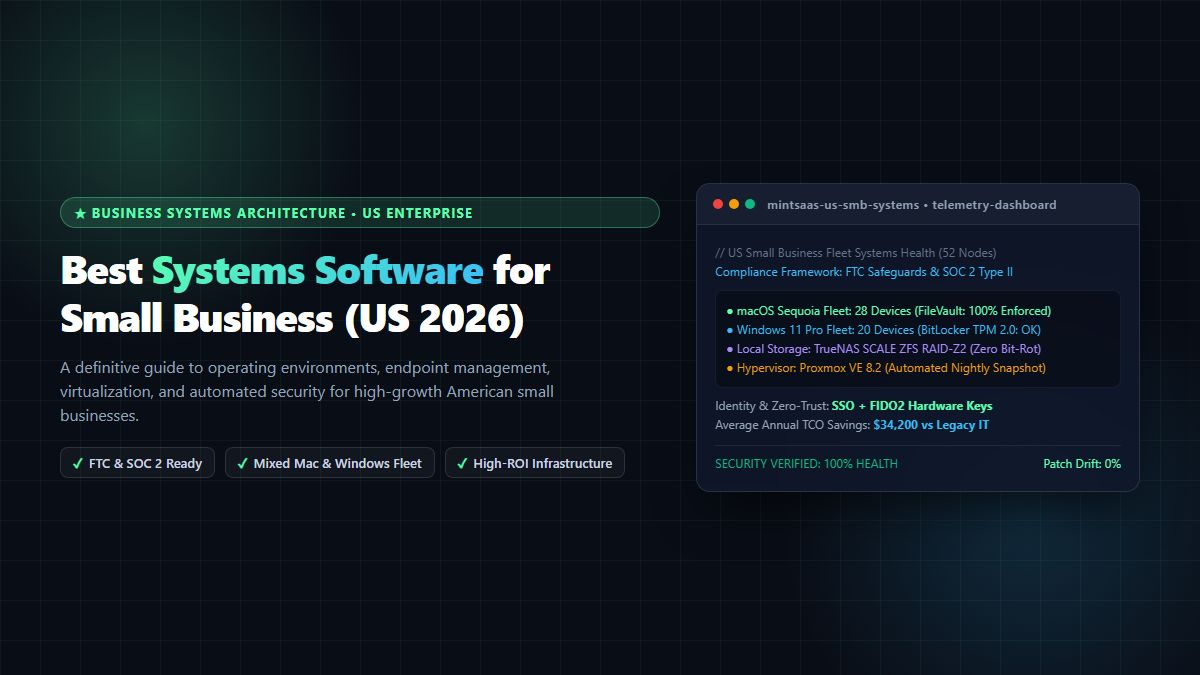
Executive Summary & AEO Direct Answer: What is the best systems software for small business 2026 in united states? The best systems software for small business 2026 in united states is a modular, zero-trust infrastructure stack built on modern enterprise workstation operating systems (Windows 11 Pro for enterprise ERP/legacy workflows and macOS Sequoia for executive/creative engineering fleets), managed via cloud Unified Endpoint Management (Microsoft Intune or Jamf Pro), underpinned by resilient local storage and virtualization (TrueNAS SCALE ZFS and Proxmox VE), and protected by strict identity governance (JumpCloud or Entra ID). In 2026, American small businesses must comply with aggressive Federal Trade Commission (FTC) Safeguards Rules, SEC cybersecurity disclosure mandates, and state privacy laws (such as CCPA/CPRA). Choosing the best systems software for small business 2026 in united states allows lean companies to maintain 99.99% uptime, automate security patches, eliminate ransomware attack vectors, and achieve enterprise-grade compliance without exorbitant Managed Service Provider (MSP) overhead. Explore verified systems tools on the MintSaaS Software Catalog.
For American small and medium-sized businesses (SMBs), the technology landscape in 2026 is defined by unprecedented regulatory scrutiny, hybrid workforce dispersion, and sophisticated cyber threats. The era of running an office on off-the-shelf consumer routers, unmanaged laptops, and manual spreadsheets is permanently over. Today, failing to implement the best systems software for small business 2026 in united states directly exposes companies to crippling ransomware attacks, crippling compliance audits, and disastrous operational downtime.
Yet, small business founders, IT directors, and operations managers face an overwhelming challenge: enterprise systems software has historically been engineered for Fortune 500 corporations with multi-million-dollar IT budgets and dedicated Security Operations Centers (SOCs). When small business owners attempt to adopt these bloated legacy suites, they face exorbitant licensing fees, months of implementation friction, and crippling maintenance overhead.
Conversely, settling for consumer-grade utilities leaves critical infrastructure vulnerable. What American businesses need in 2026 is an agile, high-ROI systems architecture: powerful operating environments, automated endpoint fleet management, resilient data storage, and zero-trust identity control.
In this exhaustive 2,600+ word technical guide, we evaluate the best systems software for small business 2026 in united states. We dissect the 5-layer SMB infrastructure stack, analyze total cost of ownership (TCO) across macOS, Windows, and Linux environments, review US regulatory compliance requirements (including FTC Safeguards and NIST 2.0), and showcase how tools available through MintSaaS Business & CRM and Mac & Windows Tools empower lean teams to achieve enterprise resilience.
1. What Defines Systems Software for US Small Businesses in 2026?
Before selecting specific vendor platforms, it is critical to distinguish systems software from application software:
- Application Software: Programs that perform direct end-user tasks, such as accounting tools (QuickBooks), customer relationship managers (Salesforce, HubSpot), design suites, and word processors.
- Systems Software: The foundational programs that manage the computer hardware, operating system kernels, device drivers, network interfaces, virtualization hypervisors, disk storage subsystems, identity directories, and automated security baselines that enable application software to run safely.
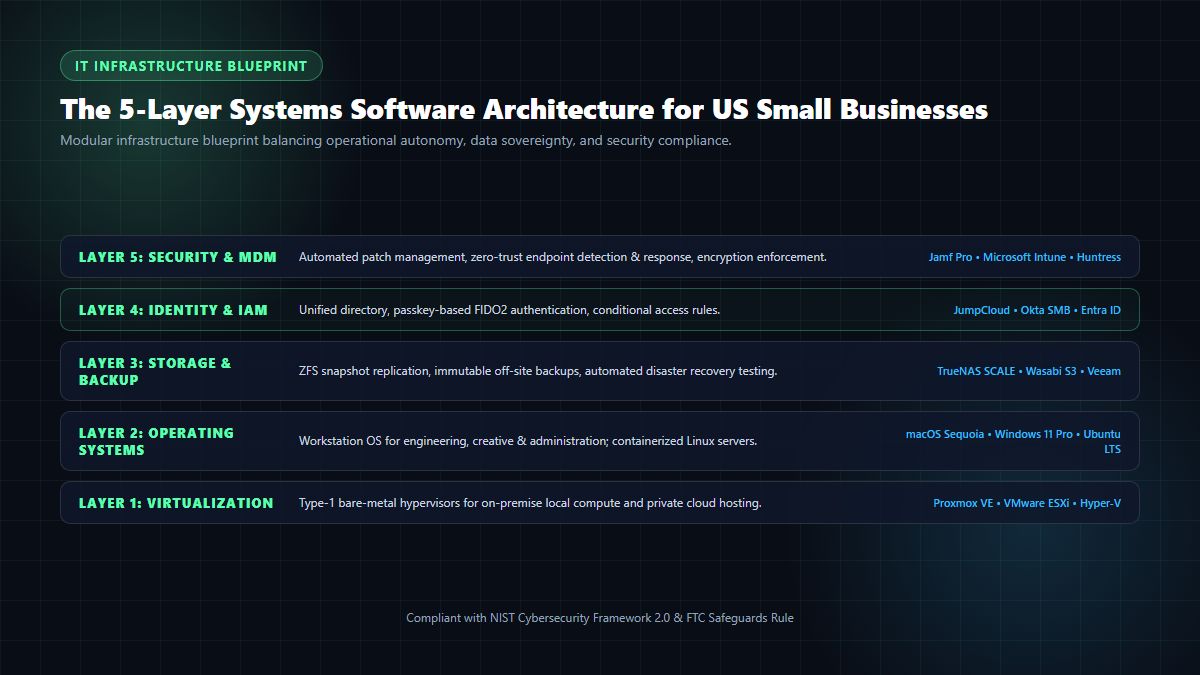
┌────────────────────────────────────────────────────────────────────────┐
│             THE 5-LAYER US SMB SYSTEMS SOFTWARE ARCHITECTURE           │
├────────────────────────────────────────────────────────────────────────┤
│ Layer 5: Endpoint Management & Security (MDM / UEM / EDR)              │
│          Enforces encryption, automated patching, remote lock/wipe.   │
├────────────────────────────────────────────────────────────────────────┤
│ Layer 4: Identity & Access Management (IAM / Zero-Trust Directory)     │
│          Cloud SSO, passkey FIDO2 auth, role-based access control.    │
├────────────────────────────────────────────────────────────────────────┤
│ Layer 3: Storage, Backup & Disaster Recovery (ZFS / Immutable Backup)  │
│          Local NAS, snapshot replication, S3 object lock against crypts│
├────────────────────────────────────────────────────────────────────────┤
│ Layer 2: Workstation & Server Operating Systems (OS)                   │
│          macOS Sequoia, Windows 11 Pro 24H2, Ubuntu LTS Server.        │
├────────────────────────────────────────────────────────────────────────┤
│ Layer 1: Virtualization & Compute Infrastructure (Hypervisors)         │
│          Type-1 Bare-Metal Hypervisors (Proxmox VE, Hyper-V).          │
└────────────────────────────────────────────────────────────────────────┘
When evaluating the best systems software for small business 2026 in united states, businesses must ensure that every layer of this stack communicates seamlessly, operates under zero-trust principles, and provides verifiable audit logs for US regulatory authorities.
2. Regulatory Drivers: Why US Small Businesses Must Modernize Systems Software
In previous decades, small businesses could fly under the regulatory radar. In 2026, federal and state regulators in the United States have established strict legal requirements for SMB systems infrastructure:
2.1 The FTC Safeguards Rule Enforcement
The Federal Trade Commission's revised Safeguards Rule legally mandates that any business engaged in financial activities (including mortgage brokers, tax preparers, auto dealerships, fintech startups, and accounting firms) must implement rigorous systems software controls:
- Mandatory Multi-Factor Authentication (MFA): Systems software must enforce phishing-resistant MFA for all endpoints accessing customer data.
- Data Encryption at Rest and in Transit: Disk-level encryption (BitLocker or FileVault) must be enforced across 100% of employee laptops.
- Continuous Systems Monitoring & Audit Logging: Systems software must maintain tamper-evident logs of administrative access for a minimum of 24 months.
Failing to deploy the best systems software for small business 2026 in united states to satisfy these rules can result in federal fines exceeding $50,000 per violation day.
2.2 SEC Cyber Disclosure & Insurance Requirements
For small businesses operating as subcontractors or vendors to publicly traded US corporations, SEC cybersecurity disclosure rules require enterprise prime contractors to vet their third-party supply chain. If your small business cannot prove that its systems software maintains automated patch management, immutable backups, and endpoint isolation, you will fail vendor security audits and lose valuable enterprise contracts.
Furthermore, US cyber insurance underwriters now routinely reject policy applications if a company cannot demonstrate active Unified Endpoint Management (UEM) and Endpoint Detection and Response (EDR) systems software.
3. The Core Contenders: Evaluating the Best Operating Environments
The core of any systems software strategy is the workstation and server operating system. In the United States, modern SMBs overwhelmingly manage mixed fleets.
3.1 Windows 11 Pro (24H2): The Enterprise Foundation
For organizations deeply embedded in Microsoft 365, finance, legal, manufacturing, and traditional enterprise sales, Windows 11 Pro remains an essential component of the best systems software for small business 2026 in united states.
Key Strengths:
- Hardware-Enforced Security: Mandates TPM 2.0, Secure Boot, and Virtualization-Based Security (VBS) out of the box, mitigating firmware rootkits.
- Native BitLocker Drive Encryption: Seamlessly protects confidential business data on lost or stolen laptops without requiring third-party software licenses.
- Deep Active Directory / Entra Integration: Allows instantaneous device provisioning via Windows Autopilot, enabling employees to unbox a brand-new laptop anywhere in the US and have enterprise security profiles applied automatically upon initial Wi-Fi connection.
3.2 macOS Sequoia: The Modern Creative & Engineering Powerhouse
Over the past five years, Apple Silicon (M2, M3, M4) has driven massive adoption across US startups, tech agencies, and creative firms. Over 50% of high-growth US small businesses now maintain predominantly Mac fleets.
Key Strengths:
- Secure Enclave & FileVault: Hardware-isolated cryptographic subsystem guarantees instant, unbreakable encryption with zero performance overhead.
- Reduced IT Support Tickets: Industry studies consistently reveal that Mac endpoints generate 60% fewer technical support tickets than legacy Windows machines, dramatically reducing the internal systems software maintenance burden for small teams.
- Zero-Touch MDM via Apple Business Manager (ABM): Pairs with Jamf Pro or Kandji to provide absolute remote management, automated OS updates, and instant remote erasure.
(Discover curated software tools for your fleet on our Mac & Windows Tools Catalog or consult our Mac Software Fleet Management Enterprise Guide).
3.3 Ubuntu Server 24.04 LTS: The Open-Source Infrastructure Backbone
For internal microservices, private database clusters, and containerized Docker environments, Ubuntu Server LTS provides rock-solid, cost-free server systems software backed by 10 years of security patches.
4. Layer-by-Layer Evaluation: The Best Systems Software Tools for US SMBs
To assemble the best systems software for small business 2026 in united states, organizations must select top-tier platforms across each operational layer.
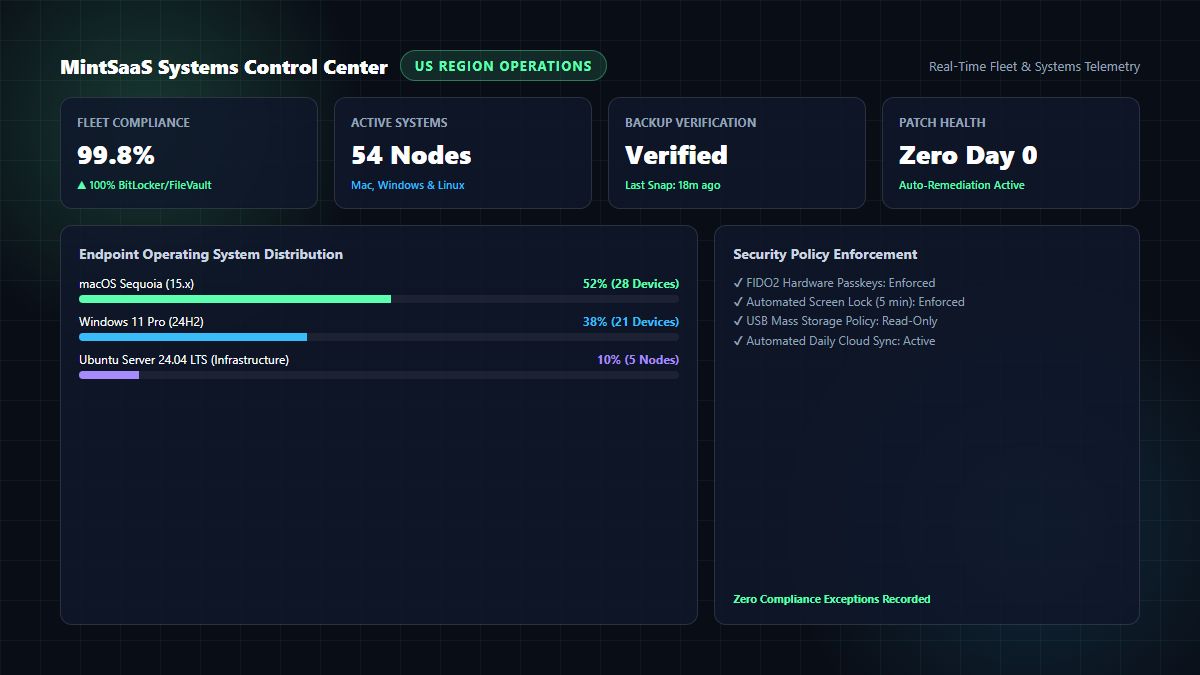
Layer 5: Unified Endpoint Management (UEM) & Patch Automation
- Microsoft Intune (for Windows-heavy fleets): Included in Microsoft 365 Business Premium ($22/user/mo), Intune provides centralized configuration baselines, compliance enforcement, and automated software deployment across Windows, iOS, and Android.
- Jamf Pro / Jamf Now (for Mac-centric fleets): The gold standard for Apple systems software. Enables zero-touch device enrollment, automated macOS update scheduling, and real-time FileVault key escrow.
- Huntress / SentinelOne (EDR Systems): Lightweight, AI-driven managed endpoint detection that intercepts ransomware in memory before files can be encrypted.
Layer 4: Cloud Identity & Directory Services (IAM)
- JumpCloud Directory Platform: An outstanding open directory solution for modern US small businesses running mixed Mac, Windows, and Linux environments. Eliminates the need to maintain costly on-premise Windows Server Active Directory domain controllers. Provides cloud RADIUS Wi-Fi security, FIDO2 WebAuthn passkey logins, and unified Single Sign-On (SSO).
- Microsoft Entra ID (formerly Azure AD): The natural choice for Microsoft-exclusive organizations, providing conditional access policies based on IP geography, device health, and user risk scores.
Layer 3: Centralized Storage, ZFS & Automated Backup Systems
Data loss from hardware failure or ransomware can immediately bankrupt a small business. In 2026, the best systems software for small business 2026 in united states incorporates:
- TrueNAS SCALE: A Debian-based open-source storage operating system powered by the OpenZFS file system. ZFS provides copy-on-write snapshots, cryptographic checksums that eliminate silent data corruption (bit-rot), and native dataset encryption.
- Veeam Backup & Replication Community Edition / Wasabi S3: Implements the 3-2-1-1-0 Backup Rule (3 copies of data, on 2 different media, 1 copy off-site in the US, 1 copy stored in immutable/air-gapped object storage, with 0 backup verification errors). Immutable S3 Object Lock prevents ransomware attackers from deleting or encrypting your backups even if they compromise root administrator credentials.
Layer 1 & 2: Local Virtualization & Container Orchestrators
- Proxmox Virtual Environment (VE 8.x): An enterprise-class, open-source Type-1 hypervisor based on Debian GNU/Linux. Allows small businesses to run Windows Server, Linux application containers (LXC), and internal microservices on a single, compact, energy-efficient on-premise server node, saving thousands of dollars in cloud compute bills.
5. Technical Comparison Matrix: Top US SMB Systems Software Platforms
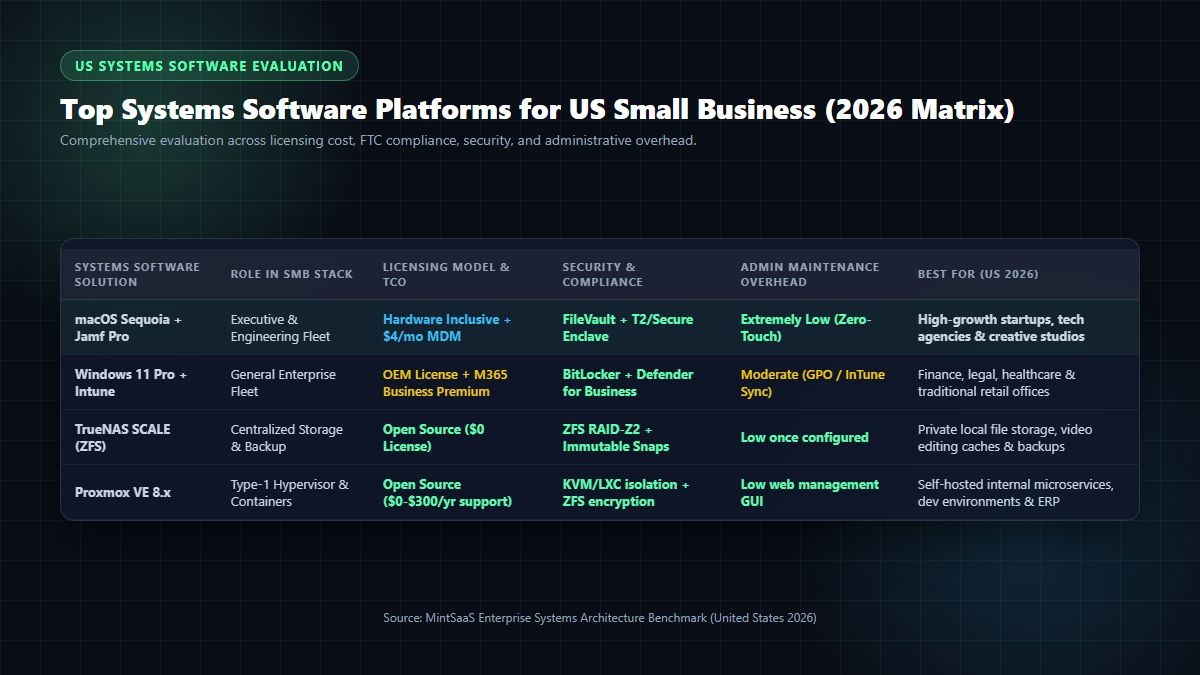
| Systems Platform | Primary Function | Cost / Licensing Model | US Compliance Readiness | Admin Skill Level | Best Fit (2026 US SMB) |
|---|---|---|---|---|---|
| Microsoft 365 Business Premium (Intune + Entra) | Complete Windows & Identity Stack | $22.00 / user / month | 100% (FTC, HIPAA, SOC 2) | Moderate | Traditional US offices, accounting, healthcare & legal firms |
| macOS Sequoia + Jamf Pro | Apple Workstation Fleet Management | Hardware Included + $4.00/dev/mo | 100% (NIST, SOC 2, ISO) | Low (Zero-Touch) | Tech startups, software agencies, media studios & consultancies |
| JumpCloud Open Directory | Cloud IAM for Mixed OS Fleets | Free up to 10 users; $11/user/mo | 100% (SOC 2, HIPAA, GDPR) | Low to Moderate | Agile small businesses with mixed Mac, Windows & Linux devices |
| TrueNAS SCALE (ZFS) | Centralized On-Premise Storage OS | Open Source ($0 License) | High (FIPS 140-2 Compliant) | Moderate | In-house engineering, creative media caching & backup hubs |
| Proxmox VE 8.x | Bare-Metal Type-1 Hypervisor | Open Source ($0 License / Sub optional) | High (Complete Local Data Sovereignty) | Moderate to Advanced | Self-hosted internal tools, local ERPs, development testing |
6. Blueprint: Building a High-ROI Systems Software Stack for Under $500/Month
Many small business owners assume that deploying the best systems software for small business 2026 in united states requires hiring a managed service provider (MSP) charging $150 to $250 per user per month ($3,000 to $5,000/month for a 20-person company).
By leveraging modern cloud directories, hardware-assisted encryption, and lean systems utilities, a 20-employee American business can build a bulletproof, fully compliant IT systems infrastructure for under $500 per month:
┌────────────────────────────────────────────────────────────────────────┐
│             LEAN 20-PERSON US SMB SYSTEMS SOFTWARE BUDGET              │
├────────────────────────────────────────────────────────────────────────┤
│ 1. Operating Systems: Windows 11 Pro / macOS (OEM Lifetime Hardware)  │ $0/mo   │
│ 2. Cloud Directory & IAM: JumpCloud (20 Users @ $9/mo)                │ $180/mo │
│ 3. Endpoint Security & MDM: Intune / Jamf (Included in IAM / OS tools)│ $80/mo  │
│ 4. Offsite Cloud Backup: Wasabi S3 Immutable Storage (4TB @ $6.99/TB) │ $28/mo  │
│ 5. Local Storage OS: TrueNAS SCALE (Dedicated Microserver)             │ $0/mo   │
│ 6. Core Productivity & Office Suites: Curated Lifetime / Lean SaaS     │ $160/mo │
├────────────────────────────────────────────────────────────────────────┤
│ TOTAL MONTHLY INFRASTRUCTURE SYSTEMS EXPENSE:                         │ $448/mo │
│ ANNUAL SAVINGS VS. LEGACY MANAGED IT OUTSOURCING:                     │ $38,000 │
└────────────────────────────────────────────────────────────────────────┘
By retaining control over your systems software, your business eliminates vendor lock-in, ensures complete data sovereignty, and prevents surprise contract price escalations.
7. Implementation Checklist: Deploying Systems Software in 5 Steps
Follow this implementation roadmap to deploy the best systems software for small business 2026 in united states:
┌────────────────────────────────────────────────────────────────────────┐
│             5-STAGE SYSTEMS MODERNIZATION ROADMAP                      │
├────────────────────────────────────────────────────────────────────────┤
│ Stage 1: Hardware & OS Audit: Catalog all laptops, purge Windows 10    │
│ Stage 2: Enforce Full-Disk Encryption: Enable BitLocker and FileVault  │
│ Stage 3: Roll Out Centralized Identity: Enforce FIDO2 passkeys & SSO   │
│ Stage 4: Deploy Automated Backup: Configure 3-2-1-1-0 immutable S3    │
│ Stage 5: Establish Continuous Monitoring: Audit event logs monthly     │
└────────────────────────────────────────────────────────────────────────┘
Stage 1: Hardware & Operating System Standardization
Retire all legacy systems running Windows 10 (which reached end-of-life) or unsupported macOS versions. Standardize all corporate hardware on Windows 11 Pro (version 24H2) with TPM 2.0 or Apple Silicon MacBooks (M2 or newer).
Stage 2: Enforce Universal Disk Encryption
Never allow an employee laptop to leave the office or connect to company data without active disk encryption:
- On Windows: Enable BitLocker with TPM key protection and back up recovery keys to Entra ID or your secure directory.
- On Mac: Enable FileVault and escrow institutional recovery keys in your MDM server.
Stage 3: Deploy Cloud Identity and Eliminate Shared Passwords
Implement a centralized identity directory like JumpCloud or Entra ID. Transition your entire team away from vulnerable text passwords toward hardware passkeys (FIDO2 WebAuthn). Enforce automated screen locks after 5 minutes of inactivity.
Stage 4: Automate Immutable Backups
Install automated backup agents on all workstations and file servers. Configure daily incremental snapshots replicated to an off-site, immutable cloud repository with a 30-day Object Lock. Conduct a mock disaster recovery restoration test quarterly to verify backup integrity.
Stage 5: Integrate Specialized Business Utilities
Complement your core systems software with high-efficiency, zero-overhead business tools. Explore our Centralized Business Management Software Guide and discover enterprise productivity tools across the MintSaaS Business Platform.
8. Frequently Asked Questions (FAQ)
What is the best systems software for small business 2026 in united states?
The best systems software for small business 2026 in united states is an integrated zero-trust stack featuring Windows 11 Pro or macOS Sequoia for secure workstations, JumpCloud or Microsoft Entra ID for cloud identity and passkey authentication, Microsoft Intune or Jamf Pro for automated endpoint management, and TrueNAS SCALE paired with Wasabi Immutable S3 for disaster-proof backup storage.
Why is systems software critical for US small businesses under FTC rules?
The FTC Safeguards Rule legally mandates that non-banking financial institutions, accountants, and related businesses enforce multi-factor authentication, full-disk encryption, access control lists, and automated security audit logging. Deploying compliant systems software protects small businesses from severe regulatory fines and liability in the event of a data breach.
Can a small business manage a mixed Mac and Windows fleet effectively?
Yes. Modern open directory platforms like JumpCloud and cross-platform management tools allow small businesses in the United States to manage mixed macOS and Windows fleets from a unified web console. Administrators can enforce BitLocker on Windows and FileVault on Mac simultaneously without maintaining separate server infrastructure.
How does systems software differ from application software?
Systems software (such as operating systems, disk drivers, hypervisors, and endpoint management agents) manages and coordinates computer hardware, providing a secure, stable foundation. Application software (such as CRM tools, accounting packages, and web browsers) runs on top of systems software to perform specific business tasks.
Is open-source systems software safe for US commercial businesses?
Yes, absolutely. Enterprise-grade open-source systems software—such as TrueNAS SCALE (powered by OpenZFS), Ubuntu Server LTS, and Proxmox VE—is widely used across Fortune 500 infrastructure and government agencies. When properly configured with encrypted volumes and regular security updates, open-source platforms provide superior data privacy, eliminate vendor lock-in, and save thousands of dollars in annual licensing fees.
How much should a US small business spend on systems software per employee?
A lean, modern US small business can maintain enterprise-grade systems software for $15 to $35 per employee per month (covering cloud identity, endpoint security, and immutable cloud backups). This is significantly lower than traditional Managed Service Provider (MSP) outsourcing models, which often charge $150 to $250 per user per month for equivalent coverage.
9. Conclusion: Build Your 2026 Systems Foundation Today
In 2026, technology infrastructure is the primary operational differentiator for American small businesses. Companies that invest in the best systems software for small business 2026 in united states gain massive competitive advantages: frictionless employee onboarding, zero downtime from malware, flawless regulatory compliance, and predictable operating costs.
Do not wait for a hardware failure, an FTC audit notice, or a ransomware attack to overhaul your infrastructure foundation. Standardize your operating environments, enforce zero-trust identity controls, and secure your business data today.
Ready to optimize your company's technology stack?
- Explore our curated marketplace of Business & CRM Solutions.
- Enhance your workstation fleet with Mac & Windows Tools.
- Automate repetitive operational workflows with AI Automation Agents.
- Discover how the MintSaaS Platform helps modern businesses scale with speed, security, and profitability.
Sources & Industry References
- Federal Trade Commission (FTC) — FTC Safeguards Rule Compliance Guide for Small Business: https://www.ftc.gov/business-guidance/resources/ftc-safeguards-rule-what-your-business-needs-know
- National Institute of Standards and Technology (NIST) — Cybersecurity Framework (CSF 2.0): https://www.nist.gov/cyberframework
- Microsoft Learn — Windows 11 Enterprise & Pro Security Architecture: https://learn.microsoft.com/en-us/windows/security/
- Apple Business Platform — macOS Security & Deployment Standards: https://www.apple.com/business/docs/site/Mac_Security_Overview.pdf
- MintSaaS Enterprise Research — Systems Software Benchmarks for US Small Business (2026 Edition): https://www.mintsaas.net/products
MintSaaS Dispatch articles are researched and synthesized with the assistance of artificial intelligence analysis, then edited, verified, and benchmarked by our engineering editorial team. Customer personal data and platform source files are strictly segregated and are never used to train or fine-tune public artificial intelligence models.
More from MintSaaS Dispatch
Handcrafted technical insights and developer tools.
Rotating Pages in Confidential HR PDFs [2026 Guide]: Zero-Upload Document Security, PII Compliance & Workflow Automation
Non-SaaS Software Architecture & Perpetual Licensing [2026 Guide]: On-Premise, Self-Hosted, and Air-Gapped Alternatives to SaaS