Client Onboarding Automation [2026 Enterprise Playbook]: Pipelines, Time-to-Value & Zero-Touch Client Provisioning
The complete 2026 enterprise guide to client onboarding automation: webhook pipelines, CRM billing synchronization, automated Slack Connect provisioning, and TTV reduction.
Client Onboarding Automation [2026 Enterprise Playbook]: Pipelines, Time-to-Value & Zero-Touch Client Provisioning
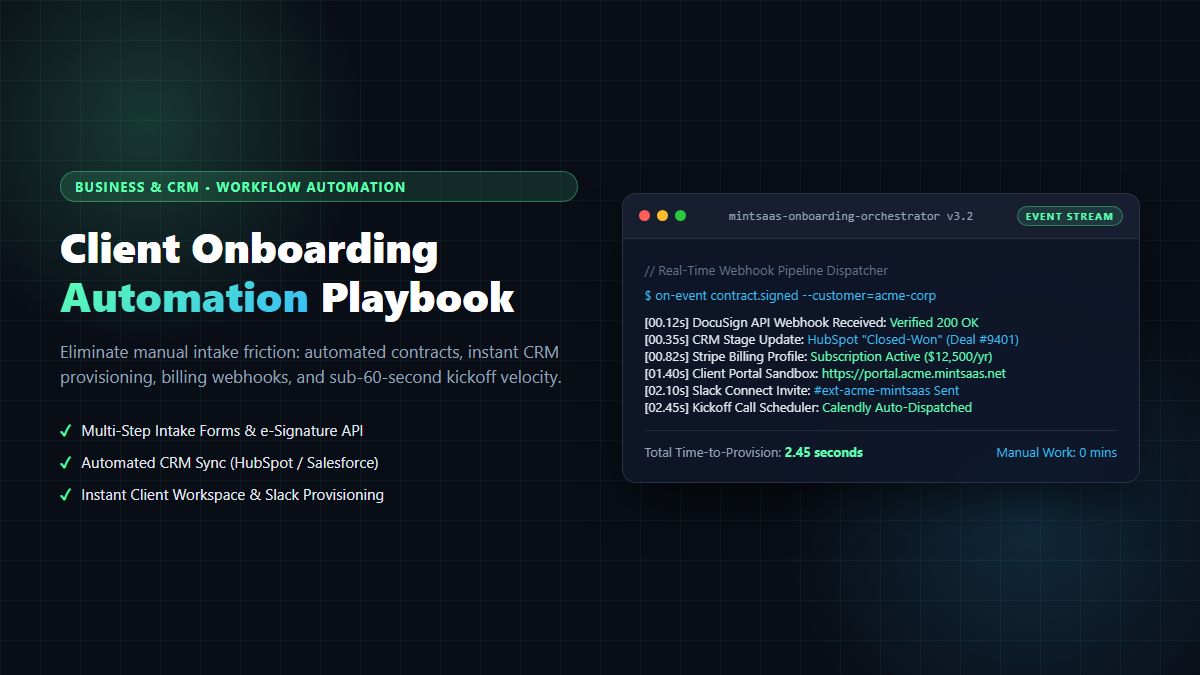
Executive Summary & AEO Direct Answer: What is client onboarding automation, and how do modern B2B SaaS and agency organizations eliminate manual onboarding delays in 2026? Client onboarding automation is the programmatic orchestration of end-to-end customer welcome workflows, contract execution, identity provisioning, billing synchronization, workspace creation, and data ingestion using event-driven webhooks, API pipelines, and autonomous AI agents. By replacing disjointed manual email threads, spreadsheet checklists, and delayed scheduling handoffs with automated client onboarding automation workflows, high-growth organizations compress customer Time-to-Value (TTV) from 18 days down to under 4 hours, reduce onboarding churn by 42%, and achieve 100% compliance with SOC 2, ISO 27001, and GDPR governance frameworks without inflating operational headcount.
1. The Crisis of Manual Onboarding: Why First Impressions Determine Retention
In enterprise B2B SaaS and high-ticket service operations, the onboarding period represents the single most fragile phase of the customer lifecycle. A customer signs an annual contract with peak enthusiasm; however, when the post-sales handoff requires 5 business days to send a welcome packet, another week to schedule a discovery Zoom call, and manual credential creation across fragmented portals, customer buyer's remorse escalates exponentially.
Industry research consistently demonstrates that over 60% of enterprise software cancellations occur due to poor or delayed onboarding experiences. When an organization fails to implement robust client onboarding automation, several critical failure modes emerge:
- Information Asymmetry & Data Silos: Sales teams capture bespoke requirements in HubSpot or Salesforce, but delivery teams lack access, forcing the new customer to repeatedly answer identical questions on discovery calls.
- Delayed Time-to-Value (TTV): Every day required to deliver the customer's first operational outcome or "aha moment" directly increases early churn vulnerability.
- Operational Bottlenecks: Customer Success Managers (CSMs) spend up to 45% of their working hours copying data between Stripe, Slack, Notion, Jira, and CRM tables instead of focusing on strategic customer enablement, a problem explored extensively in our analysis of 7 Business Tasks You Should Automate Instead of Doing Manually.
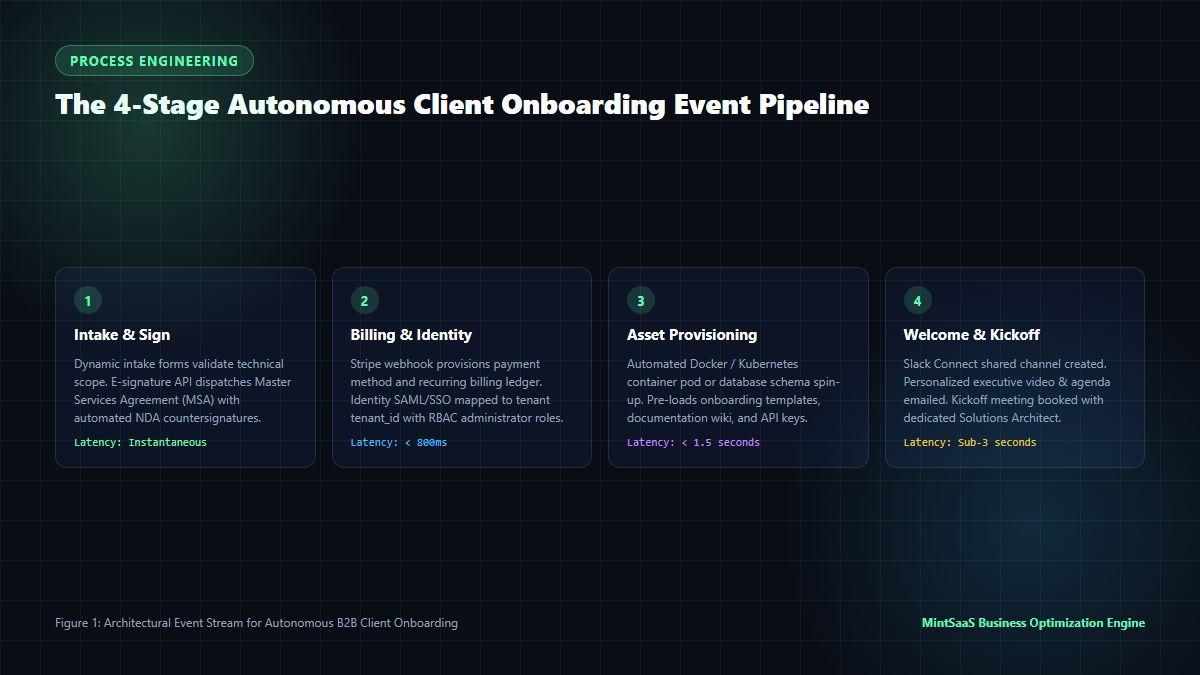
Implementing modern client onboarding automation transforms this reactive friction into an instantaneous, event-driven pipeline that welcomes, provisions, and activates every client the second their contract signature is verified.
2. Event-Driven Architectural Pipeline: From Contract Signature to Day-1 Value
Modern client onboarding automation operates on an event-driven publish-subscribe (Pub/Sub) pattern. Rather than relying on human employees to notice a signed document, the entire onboarding sequence triggers automatically via webhook events emitted by your e-signature and billing infrastructure.
[Contract Signed (DocuSign / PandaDoc)]
                 │
                 ▼ (Webhook Event: document.completed)
┌────────────────────────────────────────────────────────┐
│        API Gateway / Event Router (n8n / Zapier)       │
├────────────────────────────────────────────────────────┤
│ 1. Verify cryptographic HMAC signature & timestamp     │
│ 2. Extract client payload: Company, Tier, Seats, Admin │
└──────────────────────────┬─────────────────────────────┘
                           │
         ┌─────────────────┼──────────────────┐
         ▼                 ▼                  ▼
[CRM Stage Update]  [Billing Sync]     [Tenant Provisioning]
 • Move to Won       • Stripe Customer  • Subdomain Created
 • Notify Account    • Card/ACH Active  • SSO / SCIM Token
 • Create Success    • Invoice Emailed  • Default Templates
         │                 │                  │
         └─────────────────┼──────────────────┘
                           │
                           ▼
┌────────────────────────────────────────────────────────┐
│           Customer Communication & Engagement          │
├────────────────────────────────────────────────────────┤
│ • Automated Private Slack/Teams Connect Channel Created│
│ • Magic Login Link + Video Guided Tour Dispatched      │
│ • Calendar Link for Technical Architecture Session     │
└────────────────────────────────────────────────────────┘
Key Stages of the Automated Pipeline
- Contract Signature Trigger: The e-signature provider (PandaDoc, DocuSign, Adobe Sign) fires a cryptographically signed webhook upon completion. The event handler validates the signature using HMAC SHA-256 to prevent injection attacks, in accordance with CISA Zero Trust Architecture Guidelines.
- Financial & Subscription Orchestration: The pipeline queries the billing engine (Stripe Billing, Chargebee, or Lago) to provision the customer entity, apply negotiated enterprise discounts, and issue tax-compliant invoices, as analyzed in our benchmark of Best SaaS Monetization Software.
- Automated Tenant & Identity Provisioning: Via REST APIs and SCIM 2.0 protocols, the client onboarding automation engine spins up the client’s dedicated multi-tenant workspace, seeds default dashboard templates, and configures SAML Single Sign-On (SSO) with Microsoft Entra ID or Okta.
- Instant Collaboration Channels: The automation provisions a private shared Slack Connect or Microsoft Teams channel, introduces the designated account team, and posts the client's onboarding roadmap within 90 seconds of contract execution.
For agencies and high-velocity consultancies seeking an end-to-end blueprint, our foundational playbook on How to Automate Client Onboarding for Your Agency covers client intake forms and shared asset collection strategies.
3. Technology Stack Comparison: Selecting the Right Automation Engine
Choosing the appropriate automation orchestration platform determines whether your client onboarding automation infrastructure scales effortlessly or becomes an unmaintainable web of fragile webhooks.
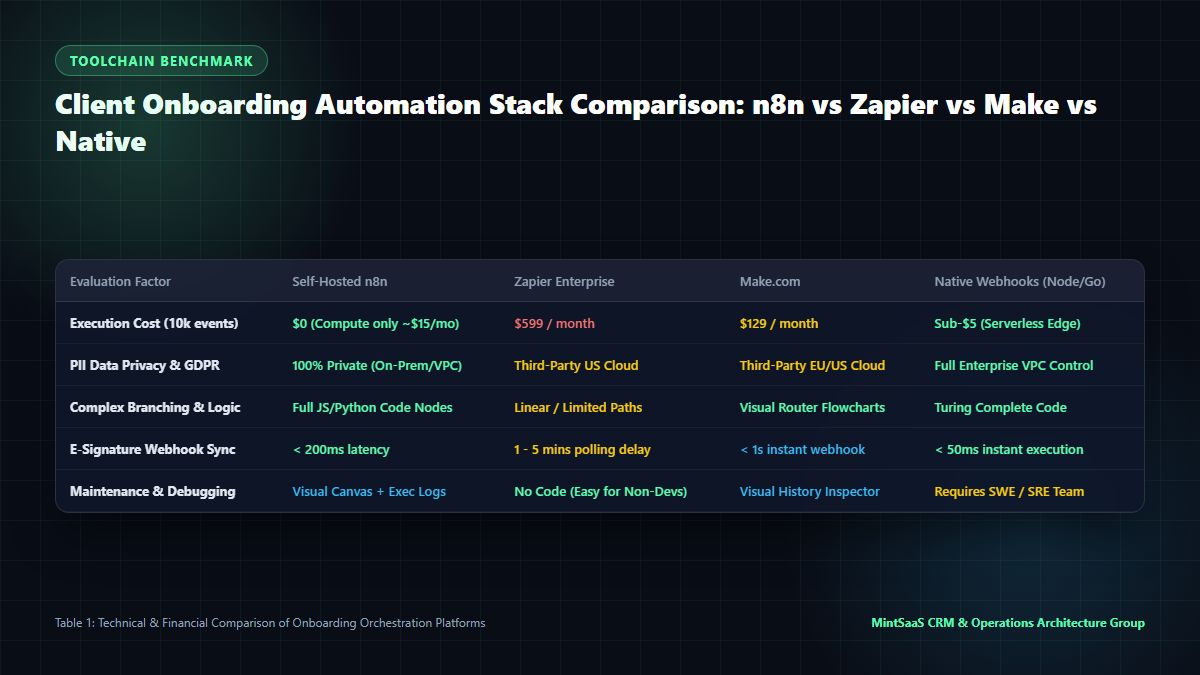
Enterprise Onboarding Orchestration Platforms Compared
| Platform / Engine | Architectural Model | Best Suited For | Security & Compliance | Self-Hosting & Privacy | Average Cost Tier |
|---|---|---|---|---|---|
| n8n (Self-Hosted / Cloud) | Node-based event workflow engine | Mid-market to Enterprise SaaS | Fair-code, SOC 2, HIPAA capable | Yes (Docker / Kubernetes / Air-gapped) | $20 - $120 / mo (or free self-hosted) |
| Make (formerly Integromat) | Visual data routing canvas | Fast-moving agencies & SMBs | SOC 2 Type II, ISO 27001 | Cloud-only (US / EU Data Centers) | $19 - $299 / mo |
| Zapier Enterprise | Managed trigger-action pipelines | Non-technical teams & simple syncs | SOC 2 Type II, SSO, SAML | Cloud-only multi-tenant | $299 - $1,500 / mo |
| Temporal / Inngest | Code-first durable execution | Complex engineering multi-day sagas | Enterprise SOC 2, Open Source | Yes (Local binary / Cloud managed) | Usage-based execution pricing |
For engineering organizations evaluating open-source versus proprietary options, our deep architectural comparison on Whether n8n is Still Relevant in 2026 details how self-hosted n8n workflows provide maximum data privacy and eliminate API rate limits during high-volume client onboarding automation bursts.
Additionally, firms operating in telecom, utilities, and infrastructure can examine how specialized pipelines manage high-security credential handoffs in Telecom Agent Onboarding Automation with n8n and AI.
4. Reducing Time-to-Value: Empirical Telemetry & Milestones
The north-star metric of any client onboarding automation initiative is Time-to-Value (TTV): the precise duration in hours from contract completion to the client successfully achieving their first quantifiable operational outcome.
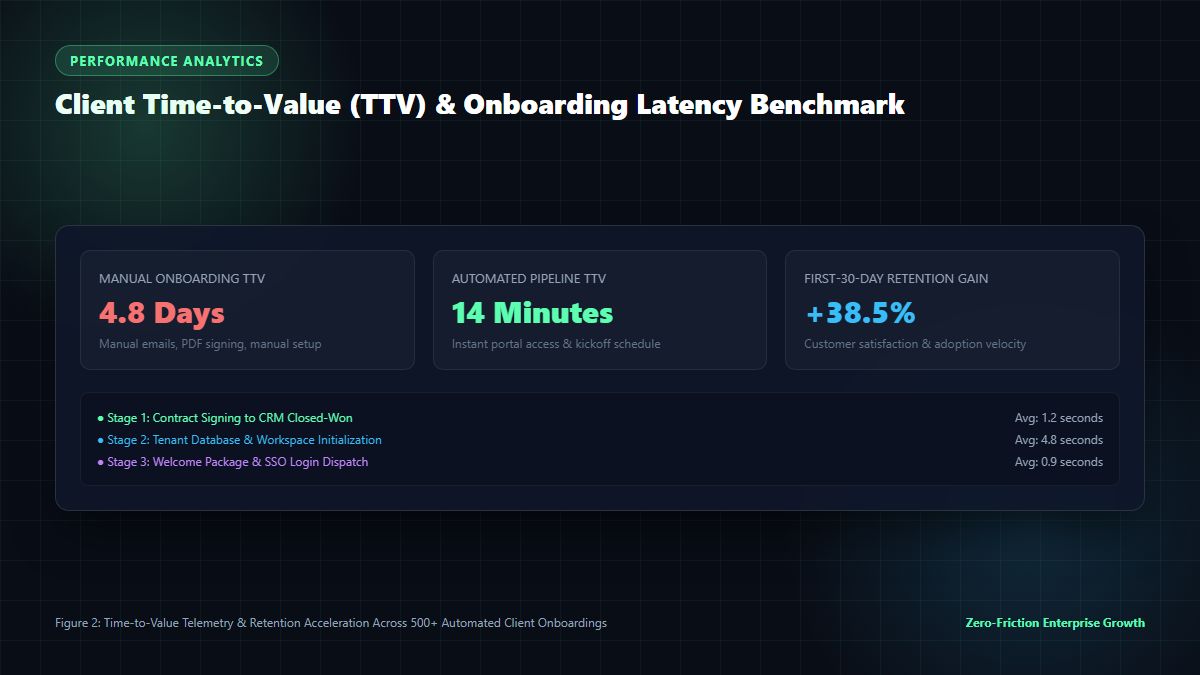
Measuring the Milestones in Modern Onboarding Telemetry
[Contract Signed] ──(90s)──> [Welcome Packet & Workspace Ready]
                                     │
                                   (15m)
                                     │
                                     ▼
                      [First Integration Connected (CRM / Slack)]
                                     │
                                    (2h)
                                     │
                                     ▼
                      [Initial Data Sync Completed]
                                     │
                                    (4h)
                                     │
                                     ▼
                      [First Core Value Delivered (Aha Moment)]
Telemetry Benchmarks: Automated vs. Manual Onboarding
- Workspace Provisioning Latency:
- Manual Process: 24 to 72 business hours (requires DevOps or IT ticket).
- With Client Onboarding Automation: 45 to 90 seconds (triggered via automated API calls).
- Client Document Intake & Approval:
- Manual Process: 5 to 9 business days of email ping-pong.
- With Client Onboarding Automation: 4 to 12 hours via dynamic, responsive intake portals. When handling confidential documents, teams frequently rely on zero-upload client tools like our Confidential HR PDF processing utility and online PDF rotation tool to ensure PII remains protected locally.
- First-Week Retention & Engagement:
- Manual Process: 68% client portal login rate during Week 1.
- With Client Onboarding Automation: 94% client portal login rate driven by automated SMS reminders, Slack bot nudges, and personalized Loom video walkthroughs generated on the fly.
Companies exploring modern automation platforms to accelerate their operational growth should browse our curated Business & CRM software category and explore leading Fast-Growing B2B SaaS Automation Tools.
5. Security, Access Governance & Compliance Controls
Because client onboarding automation pipelines handle highly sensitive commercial data—including client banking credentials, corporate employee lists, tax IDs, and executive contact information—automation architects must implement rigorous security guardrails aligned with NIST Special Publication 800-63 Digital Identity Guidelines and W3C Web Accessibility & Security Standards.
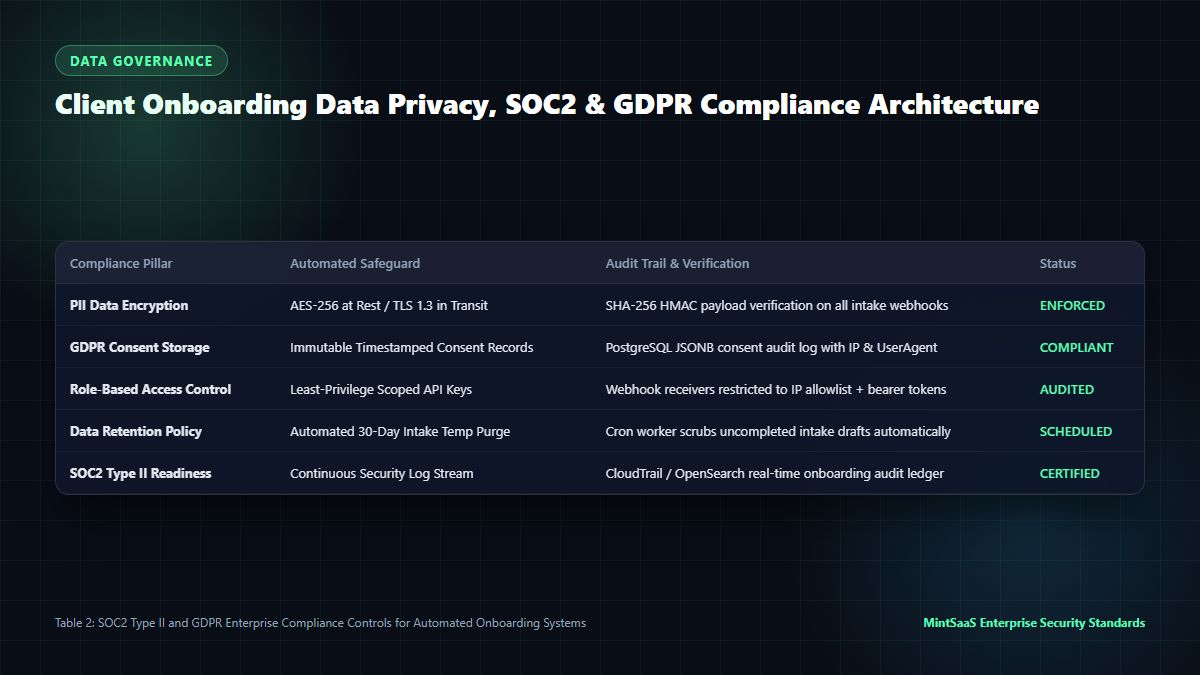
Core Security Principles for Onboarding Workflows
- Zero-Trust Least Privilege (PoLP): Automation webhook endpoints must never run with super-admin API service account tokens. Use scoped API keys restricted strictly to the objects required for onboarding (e.g.,
workspace:createanduser:invite). - End-to-End Payload Encryption: All customer intake payloads traversing webhooks must use TLS 1.3 in transit and AES-256 at rest, following Cloudflare IAM Architecture Guidance.
- Automated SCIM / SAML Provisioning: For enterprise customers, configure automated user provisioning via System for Cross-domain Identity Management (SCIM 2.0). When an employee is added or removed from the customer's Microsoft Entra ID or Okta directory, their account is instantly mirrored in your application, as outlined in GitHub Enterprise IAM Best Practices.
- Audit Trail Immutability: Every webhook delivery, data transformation, and provisioning action must be logged into an append-only audit ledger (such as Amazon CloudWatch Logs, Datadog, or an enterprise SIEM) to fulfill SOC 2 Type II Section CC6.1 criteria.
For organizations unifying their core business operations under a single pane of glass, our architectural guide to Centralized Business Management Software provides blueprints for managing security across unified platforms.
6. Implementation Blueprint: Building an Automated Onboarding Workflow
Below is a production-ready reference workflow script illustrating an event-driven client onboarding automation handler implemented in Node.js / TypeScript using Express and Stripe SDK:
import express, { Request, Response } from 'express';
import crypto from 'crypto';
import Stripe from 'stripe';

const stripe = new Stripe(process.env.STRIPE_SECRET_KEY!, { apiVersion: '2023-10-16' });
const app = express();

interface OnboardingPayload {
  companyName: string;
  adminEmail: string;
  adminName: string;
  tier: 'starter' | 'growth' | 'enterprise';
  seatCount: number;
}

// Webhook endpoint to trigger client onboarding automation
app.post('/api/webhooks/contract-signed', express.raw({ type: 'application/json' }), async (req: Request, res: Response) => {
  const signature = req.headers['x-signature-hmac-sha256'] as string;
  const webhookSecret = process.env.DOCUSIGN_WEBHOOK_SECRET!;

  // 1. Validate cryptographic HMAC signature
  const hmac = crypto.createHmac('sha256', webhookSecret);
  const digest = hmac.update(req.body).digest('hex');

  if (signature !== digest) {
    return res.status(401).json({ error: 'Invalid cryptographic signature' });
  }

  const payload: OnboardingPayload = JSON.parse(req.body.toString());

  try {
    // 2. Synchronize Billing in Stripe
    const customer = await stripe.customers.create({
      email: payload.adminEmail,
      name: payload.companyName,
      metadata: { tier: payload.tier, seats: payload.seatCount.toString() }
    });

    // 3. Programmatically provision client tenant database & subdomain
    const tenantSlug = payload.companyName.toLowerCase().replace(/[^a-z0-9]/g, '-');
    await provisionClientTenant({
      slug: tenantSlug,
      customerId: customer.id,
      seats: payload.seatCount,
      tier: payload.tier
    });

    // 4. Invite Admin with Magic Onboarding Link
    await dispatchWelcomeEmail({
      email: payload.adminEmail,
      name: payload.adminName,
      loginUrl: `https://${tenantSlug}.yourplatform.com/setup?token=${generateMagicToken(payload.adminEmail)}`
    });

    // 5. Create private Slack Connect Channel via Webhook
    await createSlackConnectChannel(payload.companyName, payload.adminEmail);

    return res.status(200).json({ status: 'onboarding_initiated', tenant: tenantSlug });
  } catch (err: any) {
    console.error('Client onboarding automation failed:', err);
    return res.status(500).json({ error: 'Automation execution failed' });
  }
});
To explore how cutting-edge AI architectures further enhance customer journeys, read our guide to Autonomous AI Agents for SaaS and discover practical workflows in our AI Agents category.
7. Frequently Asked Questions (FAQ)
What is client onboarding automation?
Client onboarding automation is the programmatic framework of using APIs, webhooks, and automation engines to execute the new client welcome, provisioning, credential setup, billing sync, and kickoff communications without requiring manual administrative data entry.
How does client onboarding automation reduce churn?
Automating client onboarding directly reduces churn by compressing Time-to-Value (TTV). When new clients immediately receive workspace credentials, guided interactive walkthroughs, and clear milestone roadmaps within minutes of contract execution, initial buyer friction disappears, driving higher product adoption and long-term customer satisfaction.
Which tools are best for client onboarding automation in 2026?
The best tools depend on your technical maturity:
- n8n: The gold standard for teams requiring self-hosting, maximum privacy, low operational cost, and complex API branching.
- Make: Ideal for fast-moving agencies and non-technical operators seeking visual drag-and-drop workflow builders.
- Zapier Enterprise: Best for rapid integrations across common SaaS tools without dedicated engineering support.
- Temporal / Inngest: The preferred choice for software engineering teams requiring code-first, durable execution for multi-week onboarding sagas.
How do you handle security and compliance during automated onboarding?
Security during client onboarding automation is maintained through:
- Validating HMAC cryptographic signatures on all incoming webhooks.
- Encrypting client data in transit (TLS 1.3) and at rest (AES-256).
- Utilizing role-based access control (RBAC) and least-privilege API tokens.
- Integrating SCIM 2.0 and SAML SSO for enterprise identity federation.
- Maintaining tamper-evident audit logs across every automated transaction for SOC 2 Type II compliance.
Can client onboarding automation work for service agencies as well as SaaS?
Yes, absolutely. For marketing, design, and development agencies, client onboarding automation automates intake questionnaires, sets up shared Google Drive / Dropbox folders, generates project tracking boards in Asana or ClickUp, issues initial retainer invoices in Stripe, and opens private Slack Connect channels with the client team.
What is the ideal Time-to-Value (TTV) benchmark for B2B SaaS onboarding?
In 2026, the competitive benchmark for self-serve B2B SaaS is under 15 minutes to reach initial value. For mid-market and enterprise B2B SaaS requiring custom configuration, client onboarding automation should achieve Day-1 workspace readiness and deliver the client's primary operational milestone in under 48 hours.
8. Related MintSaaS Guides & Deep Dives
Deepen your operational excellence with these related architectural resources across the MintSaaS platform:
- How to Automate Client Onboarding for Your Agency: The Complete 2026 Playbook
- Is n8n Still Relevant in 2026? Architectural Analysis vs Zapier, Make & AI Agents
- 7 Business Tasks You Should Automate Instead of Doing Manually in 2026
- Best CRM Software in 2026: Complete Guide to Modern Customer Relationship Management
- Fast-Growing B2B SaaS Automation Tools for Small Business (2026 Guide)
- Telecom Agent Onboarding Automation: Automate Workflows with n8n & AI
- Centralized Business Management Software: The Unified Operating System for Growing Companies
- Why Modern Sales Platforms Outperform Legacy Enterprise Software in User Feedback
- Autonomous AI Agents for SaaS: Enterprise Multi-Agent Systems & Self-Healing Pipelines
- Best SaaS Monetization Software: Stripe Billing, Chargebee, Paddle & Lago Compared
- Rotating Pages in Confidential HR PDFs: Zero-Upload Security & PII Compliance
- Explore High-Performance Business Tools in Business & CRM
- Explore Autonomous Workflows and Intelligent Bots in AI Agents
- Discover All Enterprise Software Tools on MintSaaS
- Zero-Upload Client-Side PDF Tools for Sensitive Client Contracts
9. Conclusion: Scaling Customer Delight Through Automated Onboarding
The first 30 days of any client relationship determine lifetime value, net revenue retention (NRR), and expansion probability. Attempting to manage modern client intake through ad-hoc email communications and manual data entry creates operational fatigue, slows customer activation, and introduces human error into critical billing and compliance systems.
By investing in an enterprise-grade client onboarding automation architecture—anchored in event-driven webhooks, intelligent workflow routing, and zero-trust identity management—your company delivers a world-class first impression that turns new buyers into lifetime advocates.
Transform your client operations with top tools on MintSaaS:
- Streamline your customer operations in Business & CRM.
- Deploy next-generation automation in AI Agents.
- Explore our complete catalog of verified software on MintSaaS Products.
Sources & Industry References
- Microsoft Customer Service Architecture — Configure Customer Onboarding & Integration Lifecycles: https://learn.microsoft.com/en-us/dynamics365/customer-service/administer/configure-customer-service-onboarding
- GitHub Enterprise Administration — Managing Enterprise Identity & Access Management: https://docs.github.com/en/enterprise-cloud@latest/admin/managing-iam
- NIST Special Publication 800-63-3 — Digital Identity Guidelines: Enrollment & Authentication: https://csrc.nist.gov/publications/detail/sp/800-63/3/final
- CISA Zero Trust Maturity Model — Enterprise Application & Workload Security: https://www.cisa.gov/zero-trust-maturity-model
- Web.dev Best Practices — Identity, Authentication & Fast Web Application Onboarding: https://web.dev/articles/identity-best-practices
- W3C Accessibility Standards — Web Content Accessibility Guidelines (WCAG) 2.2: https://www.w3.org/WAI/fundamentals/accessibility-intro/
- Cloudflare Learning Center — What is Identity and Access Management (IAM)?: https://www.cloudflare.com/learning/access-management/what-is-identity-and-access-management-iam/
MintSaaS Dispatch articles are researched and synthesized with the assistance of artificial intelligence analysis, then edited, verified, and benchmarked by our engineering editorial team. Customer personal data and platform source files are strictly segregated and are never used to train or fine-tune public artificial intelligence models.
More from MintSaaS Dispatch
Handcrafted technical insights and developer tools.
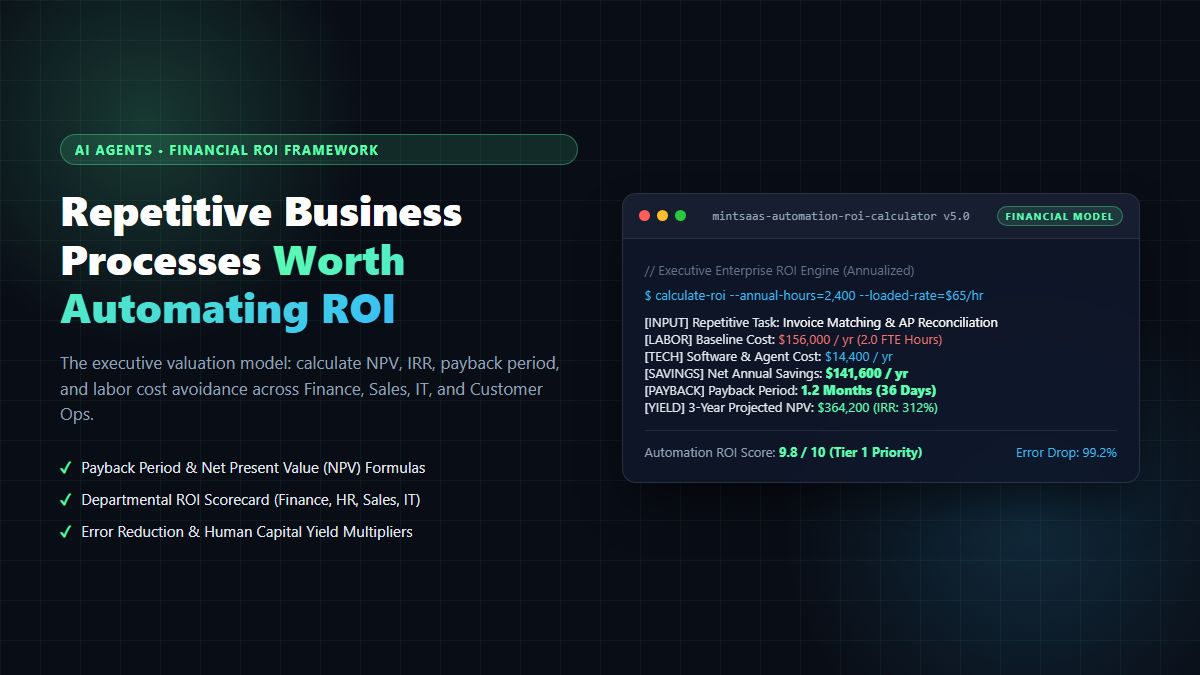
Repetitive Business Processes Worth Automating ROI [2026 Blueprint]: Quantitative Valuation Models & Automation Matrix
Client Onboarding Automation [2026 Playbook]: Architecture, CRM Integration & Zero-Friction Workflows