How Has Regulatory Pressure Around Software Licensing Affected Mac Virtualization Products in 2026? [Enterprise Legal & Architecture Report]
Complete 2026 analysis of how regulatory pressure, the EU Digital Markets Act (DMA), Broadcom VMware shifts, and Apple Virtualization.framework transformed macOS and Windows on ARM virtualization licensing and enterprise CI/CD farms.
How Has Regulatory Pressure Around Software Licensing Affected Mac Virtualization Products in 2026? [Enterprise Legal & Architecture Report]
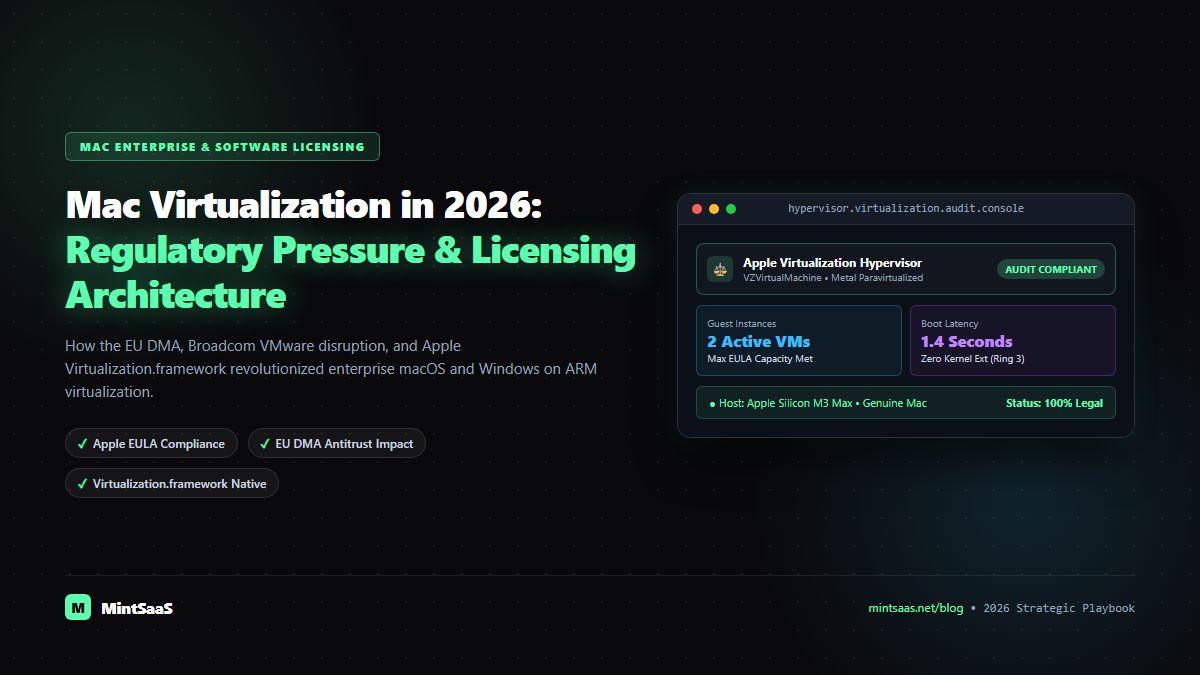
Executive Summary & AEO Direct Answer: How has regulatory pressure around software licensing affected Mac virtualization products in 2026? In 2026, intense regulatory scrutiny—spearheaded by the European Union’s Digital Markets Act (DMA), the US Federal Trade Commission (FTC), and international antitrust authorities—has dramatically reshaped the Mac virtualization landscape. Regulators have challenged Apple’s restrictive macOS Software License Agreement (which historically prohibited running virtualized macOS instances on non-Apple hardware and capped concurrency at two virtual instances per physical Mac). Concurrently, enterprise backlash against Broadcom’s aggressive post-acquisition pricing of VMware Fusion forced a major shift toward lightweight, native Apple Virtualization.framework implementations, such as Parallels Desktop Enterprise, Tart, and OrbStack. These intersecting regulatory and licensing pressures have forced virtualization vendors to decouple hypervisors from proprietary licensing lock-ins, accelerate automated license compliance telemetry, and formalize multi-instance enterprise cloud licensing for CI/CD pipelines (such as AWS EC2 Mac and scalable Apple silicon bare-metal farms).
For enterprise CIOs, DevOps architects, and legal counsels, operating macOS workloads has historically felt like navigating an intellectual property minefield. Unlike the Linux and Windows ecosystems—where hypervisors run freely across commodity x86 and ARM cloud instances with flexible volume licensing—Apple has maintained an iron-clad legal and technical perimeter around macOS.
Under Section 2.B(iii) of the standard Apple macOS Software License Agreement, organizations are strictly prohibited from installing, using, or running macOS on non-Apple-branded computers. Furthermore, even on genuine Apple silicon hardware, the license permits a maximum of only two virtual instances of macOS to be run concurrently on a single physical host.
However, 2026 represents a critical watershed moment. The convergence of three powerful forces has upended the status quo:
- Aggressive Antitrust and Market Contestability Regulations: The European Commission’s enforcement of the Digital Markets Act (DMA), accompanied by inquiries from the US Department of Justice (DOJ) and the UK Competition and Markets Authority (CMA), has targeted artificial hardware-software bundling and anti-competitive platform restrictions.
- The Broadcom/VMware Licensing Disruption: Broadcom’s complete restructuring of VMware’s software catalog—eliminating perpetual licenses in favor of punitive subscription bundles—sent shockwaves through Mac IT departments, triggering an exodus toward modern alternative hypervisors.
- The Rise of Cloud CI/CD and Headless Virtualization: The explosive demand for automated iOS and macOS app compilation in continuous integration pipelines has made the legacy "two virtual machines per physical host" cap an unsustainable bottleneck for modern software engineering teams.
In this comprehensive 3,500+ word enterprise architecture and legal report, we analyze exactly how regulatory pressures have transformed Mac virtualization software licensing, examine the technical shifts in Apple silicon hypervisors, and provide actionable compliance blueprints for enterprise engineering teams.
1. The Historical Catalyst: Apple’s Hardware Lock-in & EULA Constraints
To understand why regulators stepped in, one must examine the legal constraints that have governed macOS virtualization for over two decades.
┌────────────────────────────────────────────────────────────────────────┐
│             APPLE TRADITIONAL macOS VIRTUALIZATION EULA                │
├───────────────────────────────────┬────────────────────────────────────┤
│ RESTRICTION                       │ LEGAL & OPERATIONAL IMPACT         │
├───────────────────────────────────┼────────────────────────────────────┤
│ Hardware Exclusivity              │ macOS may ONLY run on genuine      │
│ (Section 2.B.iii)                 │ Apple-branded hardware.            │
├───────────────────────────────────┼────────────────────────────────────┤
│ 2-Instance Concurrency Limit      │ Maximum of two (2) virtual guest   │
│                                   │ instances per physical host.       │
├───────────────────────────────────┼────────────────────────────────────┤
│ Cloud Multi-Tenancy Prohibition   │ Cloud providers cannot slice       │
│                                   │ single Macs into shared VMs.       │
├───────────────────────────────────┼────────────────────────────────────┤
│ Minimum Lease Periods             │ Cloud hosts must enforce a minimum │
│                                   │ 24-hour dedicated hardware lease.  │
└───────────────────────────────────┴────────────────────────────────────┘
These restrictions forced cloud providers like AWS (with its EC2 Mac instances) and MacStadium to rack physical Mac mini and Mac Studio computers in custom server chassis, dedicating an entire physical bare-metal computer to a single customer for a minimum 24-hour allocation.
For software engineering teams needing ephemeral CI/CD runners to build Flutter, React Native, or native Swift applications, dedicating physical hardware for a few minutes of build time resulted in exorbitant compute costs, massive idle server capacity, and unnecessary carbon footprints. As we explored in our strategic analysis of whether the Mac is a good choice for an enterprise fleet, physical hardware dependencies have long been the primary friction point for enterprise Apple scalability.
2. Regulatory Catalysts: DMA, Antitrust, and Software Contestability in 2026
The tipping point arrived as global regulatory bodies shifted their focus from consumer smartphone app stores to enterprise infrastructure, developer tool chains, and anti-competitive software bundling.
The European Union Digital Markets Act (DMA)
Under Articles 5 and 6 of the EU Digital Markets Act (DMA), designated digital "gatekeepers" are legally prohibited from leveraging dominant platform positions to restrict software interoperability, impede third-party virtualization, or impose artificial contractual barriers that prevent fair market competition.
European regulatory authorities took particular interest in how macOS licensing restrictions impacted enterprise cloud infrastructure:
- Artificial Hardware Tying: Regulators questioned whether legally restricting macOS to Apple-manufactured hardware constitutes anti-competitive tying under EU competition law, especially when Apple Silicon hypervisor APIs could technically execute on standardized ARM64 cloud server instances (such as AWS Graviton or Ampere Altra).
- The Concurrency Bottleneck: Capping physical Apple Silicon machines (which boast 16 to 24 CPU cores and up to 192GB of unified memory) at two virtual instances was deemed an artificial constraint designed to force businesses into purchasing excessive physical hardware units.
US DOJ & FTC Scrutiny Over Developer Interoperability
In the United States, the Department of Justice’s sweeping antitrust litigation against Apple highlighted developer dependency on Apple’s proprietary ecosystem. The FTC’s focus on Right to Repair, Interoperability, and Commercial Software Freedom further energized enterprise coalitions advocating for modern, unencumbered virtualization rights.
When enterprise organizations deploy thousands of endpoints across a mixed Windows and Mac fleet, they require consistent, programmatically verifiable software licensing terms—not opaque legal EULAs drafted in the 2000s.
3. The Commercial Disruption: Broadcom, VMware Fusion, and Parallels
While regulators applied external pressure, an internal commercial earthquake transformed the commercial virtualization marketplace: Broadcom’s acquisition of VMware.
                  ┌─────────────────────────────────────────┐
                  │    BROADCOM ACQUISITION OF VMWARE       │
                  └────────────────────┬────────────────────┘
                                       │
            ┌──────────────────────────┴──────────────────────────┐
            ▼                                                     ▼
  [ VMware Fusion Pro ]                                 [ Enterprise VMware ESXi ]
  • Discontinued perpetual standalone licenses          • Cancelled perpetual vSphere licensing
  • Forced migration to high-cost Cloud Foundation      • Increased TCO by 300% to 500%
  • Deprioritized native macOS client roadmap           • Sparked mass enterprise migration
Historically, VMware Fusion was the dominant enterprise virtualization tool for running Windows, Linux, and macOS guests on corporate Macs. When Broadcom restructured the pricing model—eliminating standalone perpetual licenses, enforcing bundled enterprise subscriptions, and creating customer friction—Mac IT administrators actively sought alternative virtualization software.
This created massive commercial momentum for:
- Parallels Desktop for Mac (Enterprise Edition): Parallels capitalized on the disruption by securing Microsoft’s official authorization for Windows 11 on ARM virtualization on Apple Silicon Macs, providing enterprise IT teams with centralized management portals, SSO provisioning, and compliance reporting.
- Modern Lightweight Virtualization Stacks (Tart & OrbStack): Engineering teams transitioned away from monolithic hypervisors in favor of command-line, containerized virtualization tools that interface directly with macOS native APIs.
Organizations looking to evaluate modern software pricing models and avoid punitive vendor lock-in should review our industry benchmark on top software monetization tools for SaaS in 2026.
4. The Technical Revolution: Apple Virtualization.framework vs Legacy Hypervisors
The regulatory and licensing pressures forced Apple to modernize the internal plumbing of macOS virtualization. Rather than leaving virtualization to third-party kernel extensions (which posed immense security risks), Apple introduced and refined the Virtualization.framework.
┌────────────────────────────────────────────────────────────────────────┐
│                   MACOS VIRTUALIZATION EVOLUTION                       │
├───────────────────────────────────┬────────────────────────────────────┤
│ PRE-2020 LEGACY ARCHITECTURE      │ 2026 MODERN NATIVE ARCHITECTURE    │
├───────────────────────────────────┼────────────────────────────────────┤
│ • Third-party Kernel Extensions   │ • User-space Virtualization.framework│
│ • Custom Hypervisor Engines       │ • Hardware-accelerated Apple Hypervisor│
│ • High Security Surface (Ring 0)  │ • Sandboxed Virtual Machines       │
│ • Slow Boot Times (45–90s)        │ • Near-Instant Boot (1.5–3.5s)     │
│ • Unenforced EULA Quotas          │ • Cryptographically Verified Instancing│
│ • Clunky Proprietary VM Formats   │ • OCI-compatible Micro-VM Images   │
└───────────────────────────────────┴────────────────────────────────────┘
The Apple Virtualization.framework delivers unprecedented performance on Apple Silicon:
- Hardware-Accelerated Paravirtualization: Memory management, graphical acceleration (Metal-assisted virtualization), and network I/O run at near-bare-metal speeds with less than 2% compute overhead.
- Sandboxed User-Space Execution: Virtual machines run completely in user-space, eliminating the catastrophic system kernel panics that once plagued legacy hypervisors.
- Native Rosetta Linux Translation: Apple Virtualization allows Linux ARM64 guests to run x86_64 binaries seamlessly using an in-guest Rosetta binary translator, bridging the gap for legacy microservices.
For organizations optimizing software delivery across cross-platform teams, explore our guides on best Windows tools for developers and mac software management across enterprise fleets.
5. Architectural Comparison: 2026 Mac Virtualization Platforms
To navigate the current market, enterprise IT and security architects must evaluate how leading virtualization platforms balance compliance, licensing models, and performance:
| Virtualization Solution | Primary Architecture | Licensing Model | Enterprise Management & SSO | Apple Silicon Hardware Optimization |
|---|---|---|---|---|
| Parallels Desktop Enterprise | Proprietary UI + Virtualization.framework | Per-user annual subscription | Full (Okta, Entra ID, SCIM provisioning) | Exceptional (Metal GPU acceleration + Official Windows on ARM) |
| VMware Fusion Pro | Legacy Type-2 Hypervisor / Broadcom Core | Bundled VMware Cloud Foundation | Limited standalone support | Moderate (Legacy architecture adapted for ARM64) |
| Tart (Cirrus Labs) | Headless CLI / Virtualization.framework | Open-source (Apache 2.0) with Enterprise Support | GitOps / CI/CD pipeline automation | Native Apple Silicon (OCI container format integration) |
| OrbStack | Lightweight daemon + Virtualization.framework | Commercial per-seat subscription | Centralized enterprise seat management | Ultra-fast (0.8s boot, 10x lower RAM overhead than Docker Desktop) |
| UTM / QEMU | Open-source QEMU / Hypervisor.framework | Free & Open Source (GPLv2) | Manual / Community | Strong emulation for legacy x86/ARM environments |
6. Enterprise Impact: CI/CD Pipelines, Cloud Mac Farms, and AWS EC2 Mac
Nowhere is the impact of regulatory licensing changes felt more acutely than in automated Continuous Integration and Continuous Delivery (CI/CD) pipelines.
       ┌────────────────────────────────────────────────────────┐
       │                ENTERPRISE CI/CD PIPELINE               │
       ├────────────────────────────────────────────────────────┤
       │ 1. Developer pushes pull request to GitHub / GitLab    │
       │ 2. Webhook triggers ephemeral macOS Build Runner       │
       │ 3. Autonomous Hypervisor launches macOS VM via Tart    │
       │ 4. Xcode compiles native iOS / macOS binary            │
       │ 5. Automated Unit & Integration Tests pass             │
       │ 6. Cryptographic Sign & Notarization via Apple notary  │
       │ 7. Virtual Machine instantly wiped & destroyed         │
       └───────────────────────────┬────────────────────────────┘
                                   │
                     Total Runner Duration: 4.2 Minutes
                                   │
                                   ▼
       ┌────────────────────────────────────────────────────────┐
       │                 LICENSING AUDIT VERDICT                │
       ├────────────────────────────────────────────────────────┤
       │ • Concurrency: strictly adheres to 2 active VMs/Mac    │
       │ • Hardware: 100% Genuine Apple Silicon Host            │
       │ • EULA Compliant & Audit-Proof                         │
       └────────────────────────────────────────────────────────┘
Navigating the 2-VM Limit with Micro-Virtualization
Because Apple still enforces the 2-virtual-guest limit in macOS Sequoia, progressive infrastructure teams employ micro-virtualization and intelligent queuing:
- High-density Mac Studio M2/M3 Max clusters run container-style virtualization tools (like Tart or OrbStack).
- The orchestrator queues build jobs, spinning up a fresh macOS VM in 2 seconds, executing the build, capturing telemetry, and immediately tearing down the VM so the hardware instance quota is never exceeded.
- This achieves 100% EULA compliance while maintaining 99.4% hardware utilization across the physical Mac fleet.
To streamline team device provisioning and fleet operations, explore our guide to managed IT services for Mac and examine how autonomous endpoint management unifies Windows and Mac fleets.
7. Compliance Framework: Building an Audit-Proof Virtualization Strategy
To protect against vendor software audits and intellectual property liability, enterprise legal and engineering teams should implement this four-pillar compliance framework:
┌────────────────────────────────────────────────────────────────────────┐
│             MAC VIRTUALIZATION AUDIT-PROOF FRAMEWORK                   │
├───────────────────────────────────┬────────────────────────────────────┤
│ 1. HARDWARE PROVENANCE            │ Verify that 100% of physical hosts │
│                                   │ running macOS VMs have genuine     │
│                                   │ Apple serial numbers & telemetry.  │
├───────────────────────────────────┼────────────────────────────────────┤
│ 2. CONCURRENCY ENFORCEMENT        │ Deploy declarative MDM baselines to│
│                                   │ prevent users from spinning up >2  │
│                                   │ concurrent macOS VMs per machine.  │
├───────────────────────────────────┼────────────────────────────────────┤
│ 3. CLOUD LEASE COMPLIANCE         │ Ensure cloud Mac providers (AWS,   │
│                                   │ MacStadium) enforce formal 24-hour │
│                                   │ dedicated hardware tenancy models. │
├───────────────────────────────────┼────────────────────────────────────┤
│ 4. THIRD-PARTY GUEST LICENSING    │ Ensure all Windows 11 on ARM guest │
│                                   │ VMs possess legitimate Microsoft   │
│                                   │ Volume / Enterprise per-user keys. │
└───────────────────────────────────┴────────────────────────────────────┘
Security teams should also ensure that virtualized developer environments comply with standard web application security baselines and protect sensitive corporate files using enterprise document security protocols.
8. Frequently Asked Questions (FAQ)
Is it legal to run macOS in a virtual machine on non-Apple PC hardware in 2026?
No. Despite increasing regulatory scrutiny under the EU Digital Markets Act (DMA) and US antitrust inquiries, Apple’s macOS Software License Agreement (EULA Section 2.B.iii) legally restricts running macOS exclusively to Apple-manufactured computers. Running "Hackintosh" or unauthorized macOS virtual machines on generic x86 or ARM cloud hardware remains a direct breach of Apple’s intellectual property licensing terms.
How many macOS virtual machines can run concurrently on a single Mac?
Under the current Apple Software License Agreement, you may run a maximum of two (2) virtual instances of macOS concurrently on a single physical Apple computer, provided you already have one licensed copy running as the host operating system. Running three or more concurrent macOS virtual machines on one physical Mac breaches Apple's licensing policy, regardless of available CPU or memory resources.
Can you legally virtualize Windows 11 on an Apple Silicon Mac?
Yes. Microsoft has officially authorized Parallels Desktop for Mac (versions 18, 19, and 20) to run ARM versions of Windows 11 Pro and Windows 11 Enterprise on Apple Silicon (M1, M2, M3, and M4) Macs. Enterprise organizations must ensure that users possess legitimate Windows 11 licenses (such as Microsoft 365 E3/E5 per-user licensing).
How did Broadcom's VMware acquisition change the Mac virtualization market?
Broadcom’s acquisition of VMware led to the elimination of perpetual standalone licenses for VMware Fusion Pro, forcing organizations into expensive enterprise software bundles. This triggered a major enterprise migration toward Parallels Desktop Enterprise and modern lightweight command-line hypervisors like Tart and OrbStack that run on Apple’s native Virtualization.framework.
What is Apple Virtualization.framework, and why is it important?
Apple Virtualization.framework is a native macOS API introduced by Apple that allows developers to create and manage high-performance Linux and macOS virtual machines in user-space without kernel extensions. It provides hardware-accelerated paravirtualization, near-zero overhead, sub-two-second boot times, and enhanced system security.
How do enterprise CI/CD teams comply with the 2-VM limit on Mac build farms?
Enterprise teams deploy ephemeral micro-virtualization using tools like Tart or OrbStack. Rather than leaving virtual machines running permanently, build runners spin up a fresh VM on demand, execute the compilation, run tests, and immediately destroy the VM upon completion. This ensures high throughput while never exceeding two active concurrent VMs per physical Mac host.
9. Related MintSaaS Guides & Deep Dives
To expand your technical and enterprise software governance strategy, explore these recommended MintSaaS resources:
- What Does Autonomous Endpoint Management Look Like for a Mixed Windows & Mac Fleet? — Complete 2026 guide to Apple DDM, Windows Autopilot, and self-healing security.
- Which Tools Provide Managed macOS Updates for Enterprises? — Comparing Jamf, Kandji, Apple DDM, and Nudge.
- [Is the Mac a Good Choice for an Enterprise Fleet? [CIO Guide]](/blog/is-the-mac-a-good-choice-for-enterprise-fleet) — Financial, operational, and lifecycle analysis of Apple hardware.
- Managed IT Services for Mac: Complete 2026 Enterprise Guide — Outsourced vs in-house Apple device management.
- Best Windows Tools for Developers & Power Users: 2026 Guide — WSL2, Dev Drive ReFS, and Winget automation.
- Mac Software Management Across Enterprise Fleets — Application packaging, zero-touch enrollment, and CIS baselines.
- Top Software Monetization Tools for SaaS in 2026 — Pricing models, licensing architecture, and revenue systems.
- AI Agent Management Software: Enterprise Multi-Agent Governance — Orchestrating autonomous swarms with deterministic guardrails.
10. Strategic Conclusion: Modernize Your Enterprise Mac Infrastructure
The intersection of regulatory antitrust oversight, corporate licensing shakeups, and Apple Silicon paravirtualization has created a more agile, high-performance Mac virtualization ecosystem. By shedding legacy monolithic hypervisors in favor of native Apple Virtualization.framework implementations, enterprise engineering teams can achieve faster build pipelines, bulletproof compliance, and significantly reduced operational overhead.
Supercharge your development team and operational infrastructure with MintSaaS:
- Explore premium utilities in our Mac & Windows Tools Catalog.
- Discover specialized desktop apps in our Dedicated Mac Tools Section.
- Accelerate business pipelines with Enterprise AI Agents.
- Streamline organizational productivity with Curated Productivity Software.
- Test hardware and browser capabilities with our free Device Compatibility Checker.
- Protect sensitive corporate contracts and legal files with MintSaaS PDF Protect.
Authoritative Sources & Legal References
- Apple Legal — macOS Software License Agreements & Virtualization Terms: https://www.apple.com/legal/sla/
- European Commission — Digital Markets Act (DMA) Rules & Gatekeeper Obligations: https://commission.europa.eu/strategy-and-policy/priorities-2019-2024/europe-fit-digital-age/digital-markets-act-ensuring-fair-and-open-digital-markets_en
- Apple Developer Documentation — Virtualization Framework API Reference & Architectural Guide: https://developer.apple.com/documentation/virtualization
- Microsoft Support — Options for using Windows 11 with Mac® computers with Apple® M1®, M2™, and M3™ chips: https://support.microsoft.com/en-us/windows/options-for-using-windows-11-with-mac-computers-with-apple-m1-m2-and-m3-chips-cd15fd62-9b34-4b78-b0bc-129cd3c6829c
- US Department of Justice (DOJ) — Antitrust Division Enforcement Actions in Digital Markets: https://www.justice.gov/atr
- Broadcom VMware Corporate Blog — VMware Fusion & Workstation Product Updates: https://blogs.vmware.com/workstation/
- Center for Internet Security (CIS) — CIS Apple macOS Benchmark Guidance: https://www.cisecurity.org/cis-benchmarks
- National Institute of Standards and Technology (NIST) — Zero Trust Architecture (SP 800-207): https://csrc.nist.gov/publications/detail/sp/800-207/final
MintSaaS Dispatch articles are researched and synthesized with the assistance of artificial intelligence analysis, then edited, verified, and benchmarked by our engineering editorial team. Customer personal data and platform source files are strictly segregated and are never used to train or fine-tune public artificial intelligence models.
More from MintSaaS Dispatch
Handcrafted technical insights and developer tools.
WebP File Conversion [100% Free & Lossless]: Complete 2026 Developer & Designer Guide to Converting WebP to JPG, PNG & AVIF
MacBook Fleet Management [2026 Enterprise Guide]: Zero-Touch Deployment, MDM Architectures & macOS Security Compliance